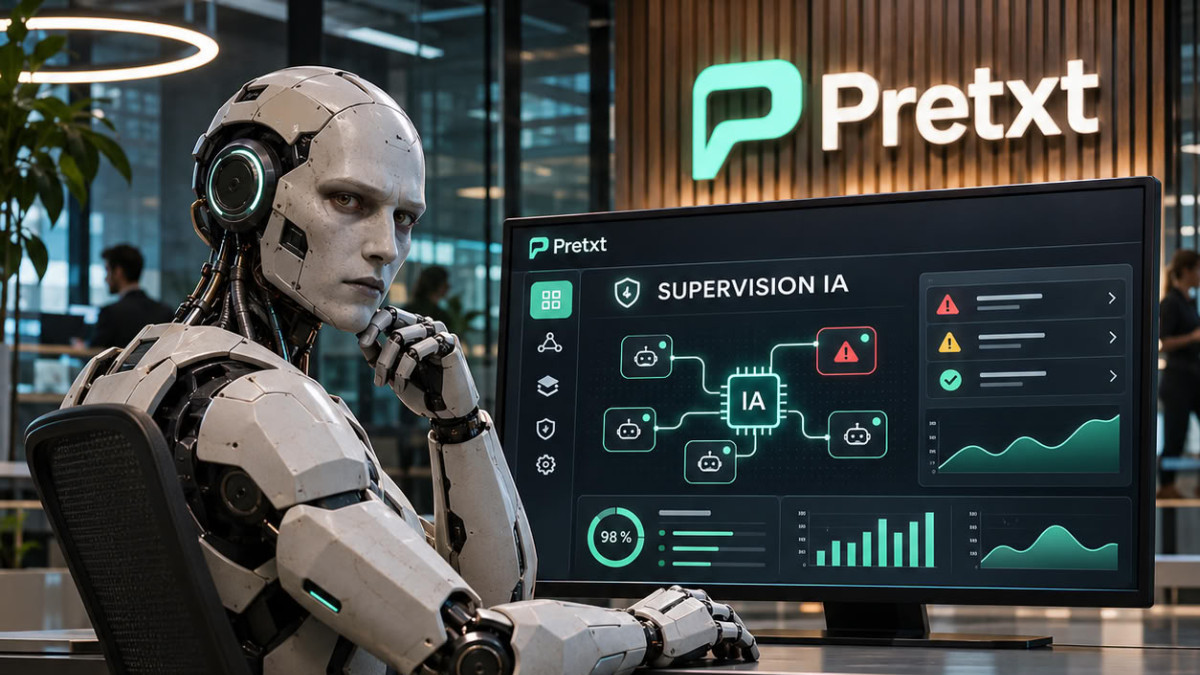

Pretxt, which has offices in Aspen, CO and Dublin, Ireland, is emerging from stealth with a $5 million seed funding round from Deciens Capital, Howdy Partners and Service Provider Capital. The young company fits into an emerging category: technologies designed to prevent AI agents from breaking out of their guardrails and causing unintended harm.
According to the source, AI is closer to a person than to a traditional computer program. It receives instructions, interprets them, can misinterpret them and respond, sometimes ambiguously. It is the combination of this misinterpretation and a wide latitude of action that can lead AI agents, meaning systems capable of acting autonomously, to deviate and cause damage.
Since language is inherently ambiguous, it is impossible to completely rule out these errors. Limiting the agents’ room for maneuver therefore remains the only direct solution, but too strict a restriction could significantly reduce the economic appeal of these tools. Without a new form of supervision, it would thus be difficult, still according to the source, to have useful agents without also having potentially dangerous ones. This need is giving rise to cybersecurity products that attempt to detect, at runtime, a potentially harmful action and control it before it produces its effects.
Pretxt is presenting precisely this type of product, called AI Supervision, which it describes as “an execution technology designed to supervise AI agents while they work, steering them back on course before mistakes become business consequences.”
Correct rather than block
Rather than reducing an agent’s capabilities, explains Aaron Costello, co-founder and CTO of Pretxt, the approach is to grant it the same level of access as an authorized employee, while continuously monitoring how it interacts with systems and people. The goal is to verify that these exchanges comply with company standards and remain aligned with what it expects from its employees.
When an agent oversteps its authority or deviates from its mission, Pretxt does not shut it down. The product “guides” it in the right direction, a comparison Costello illustrates as follows: an experienced supervisor, sitting permanently next to an intern, intervenes only when necessary, telling them to proceed differently.
This correction is context-dependent. New clients connect their agent to the platform, which allows reading its instructions and understanding its purpose. Pretxt then observes its operation, identifies the tools it has access to, for example to send an email, post on LinkedIn or update a database. The client finally specifies the rules to follow: what the agent must never do, the tasks reserved for it, or the data it must not consult. “It can be anything,” adds Costello. This information is integrated into Pretxt’s AI, which uses it as a framework for acceptable behavior.
An example in healthcare
Costello gives the example of a customer service agent used by a medical practice to help patients schedule appointments. The practice could have told Pretxt that this agent must never give medical advice. “We connect every time the agent interacts with the user,” he explains. A dedicated Pretxt agent then analyzes the exchange in real time to check if it contains medical advice.
If it does, the advice is prevented, but the agent is not stopped, because patients would then no longer be able to schedule appointments. Pretxt uses the same “guidance” method. According to Costello, the platform then tells the agent, invisibly: “You attempted to give medical advice. Continue helping the user with their appointment request, but do not attempt to give medical advice again.”
This, according to the source, is the purpose of the AI Supervision application: not to stop failing AI agents, but to keep them safe and prevent them from straying from the constraints set for them.
