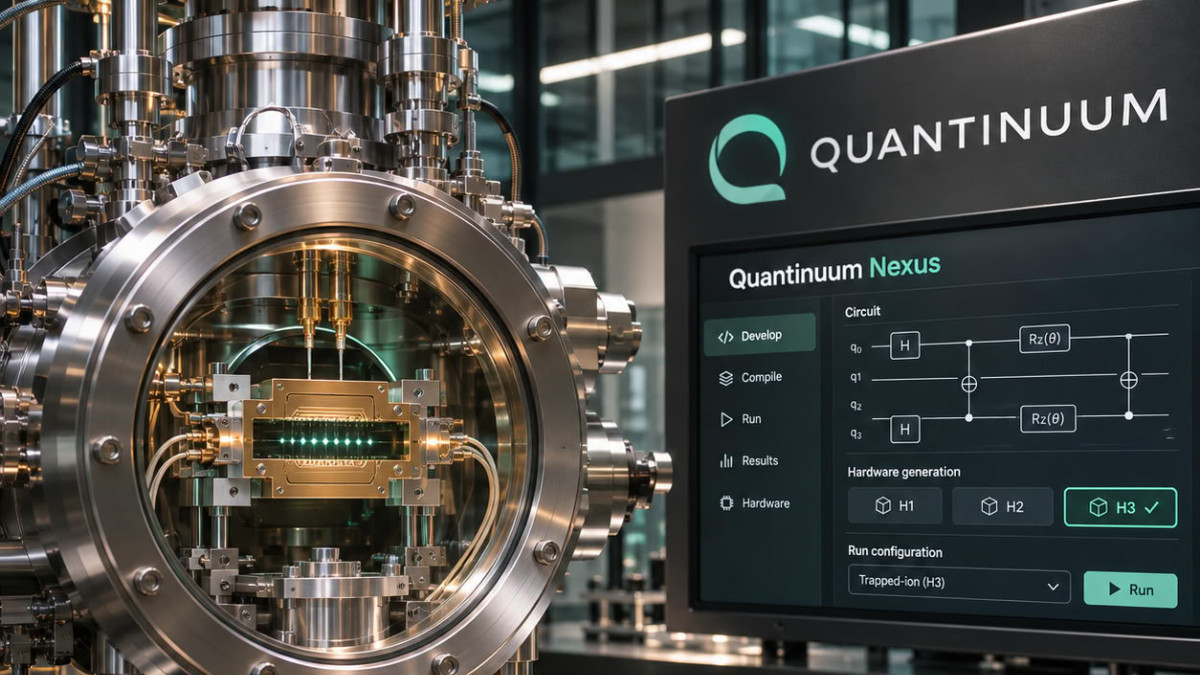

As companies seek to leverage quantum computing, publisher Quantinuum is aligning its software development with that of its machines. It has unveiled a new roadmap for its Nexus platform, which is set to accompany its next generations of systems up to Apollo, its first fault-tolerant system, scheduled for 2029.
The sector is evolving rapidly. According to analysts at consultancy McKinsey & Co, more than 300 organizations worldwide are working with quantum computing providers, and even more are experimenting with the technology. In a report published last month, they write that ‘many leaders now admit that quantum technology is arriving faster than they initially thought.’ They also note that ‘many companies in the sector are reaching their milestones faster than expected.’
Many of these providers aim to offer so-called ‘full-stack’ offerings, covering the entire chain from qubits (quantum bits) and the surrounding hardware to software, developer tools, hybrid quantum-classical environments, integrations with AI, and programming interfaces. This trend notably motivated Intel’s offer to acquire quantum software publisher Classiq for $2.3 billion. According to Pushkar Ranade, Intel’s CTO, the company spent a decade developing its quantum chips and development kit, managing its quantum business somewhat like a scientific project. With Classiq, he said, the group is ‘moving our quantum computing business from a pure R&D activity to a true commercial business.’
A roadmap staged across multiple generations
Quantinuum, born in 2021 from the merger of Honeywell’s quantum division and software publisher Cambridge Quantum Computing, is among the players building this type of offering. Josh Savory, the company’s Senior Director of Offering Management, believes the growing interest in software ‘shows that the field is focusing more on what it takes to make quantum computing useful.’ According to him, ‘qubit count matters, but customers primarily need accurate answers, at the pace required by their applications.’ The company simultaneously designs hardware, error correction, and compilers with its developer tools, which, according to Josh Savory, allows them to benefit as quickly as possible from hardware advances.
The third-generation Helios system, based on trapped ions, has 98 qubits. In October, it achieved an accuracy of 99.9995%, or five errors per million operations, a level that the company’s executives deem compatible with the target set for Apollo. Nexus already integrates customizable error suppression, ready-to-use primitives, logical qubits based on proprietary codes, and the InQuanto quantum chemistry platform. Other evolutions are planned for next year with the Sol system, and two years later with Apollo.
Open tools and a broadened ecosystem
Josh Savory cites Guppy FT, a fault-tolerant programming framework that extends the Guppy language, as an example of this articulation between software and architecture. Guppy FT and Guppy Algorithms, an open-source library of reusable algorithmic building blocks, were released in September. Nexus also supports tools already used by developers, including Nvidia’s CUDA-Q and Q#, an open-source language created by Microsoft.
According to Josh Savory, 215 companies are developing on Nexus, and the number of job submissions multiplied by 10 in the 12 months up to August, compared to the previous 12 months. In Japan, Quantinuum also upgraded the Reimei quantum computer, hosted at the RIKEN institute, by moving it from a 20-qubit H1 system to a 56-qubit H2 system. A separate announcement indicates that Quantinuum, RIKEN, and the SoftBank Group are exploring the direct connection of quantum systems to AI data centers in Japan.
Financially, Quantinuum reported revenue of $9.1 million in the third quarter, up 233% from $2.7 million. The company raised its annual revenue target from $31 million to $34 million. For Josh Savory, the essential distinction ‘is between developing error-corrected, supported applications today, and delivering universal fault tolerance at scale.’ He adds: ‘We are enabling the former while working on the latter.’
