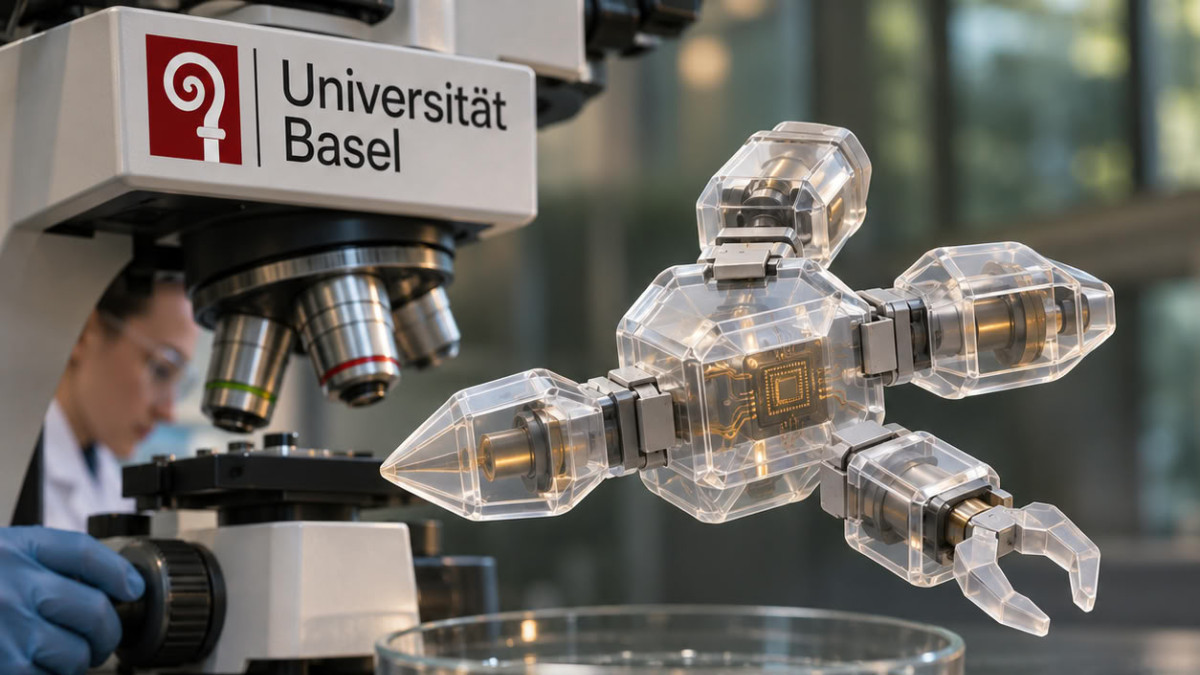

Researchers from the University of Basel, led by Prof. Dr. Cornelia Palivan, present a modular nanorobot whose structure can be adapted for different applications, from medicine to industry and environmental technologies. The work is described in the journal Advanced Functional Materials, where the team describes a system with greater functional flexibility than many existing devices.
Robotics at the nanoscale, which manipulates microscopic objects, has become a rapidly growing field of research. It is notably considered for delivering active substances to precise areas of the body. Unlike larger robots, these nanorobots are not made of electronics, computer chips, and software, but of biomolecules and nanoparticles.
“Previous nanorobots are often designed for a single specific task,” explains Cornelia Palivan. “Our modular system, on the other hand, can be adapted for different applications.” According to the researchers, the technology could therefore serve in medicine as well as in industry or environmental technologies.
A propulsion module and a capsule
The nanorobot resembles a lunar rocket composed of several modules. A magnetic propulsion module moves it, while a second module acts as a payload capsule, designed to safely transport therapeutic agents or enzymes—proteins that accelerate chemical reactions—to their site of action.
In previous work, Cornelia Palivan’s team had developed polymer vesicles at the nanoscale, which protect the enzymes they contain. Molecules can enter these vesicles through pores, be transformed by the enzymes, and then the products are released into the surrounding environment. The nanorobot’s capsule contains four of these enzyme-loaded vesicles. Depending on the design, the vesicles can also be opened selectively, for example to release bioactive compounds.
A DNA-based attachment and cell tests
The two modules are connected by a kind of “Velcro fastener” made of DNA. Complementary DNA strands, present on each module, ensure that the propulsion module and the capsule assemble in a programmable manner and remain firmly coupled.
To be able to attach to specific cells or materials, the capsule is also equipped with biomolecules that facilitate docking. In the laboratory, the team tested this mechanism on HeLa cells, a line of human cancer cells. The nanorobots, loaded with fluorescent molecules, accumulated on the surface of the cells, as observed under a microscope.
Equipped with the necessary enzymes, the nanorobots also enabled the production of an anticancer drug, which reduced the viability of HeLa cells to 16% in 72 hours. “The drug can have a concentrated local effect if we use our nanorobot to target it specifically on cancer cells,” explains Dr Voichita Mihali, first author of the study.
For uses outside the medical field, such as catalysis, the researchers highlight another advantage. Since the propulsion module is magnetic, the nanorobots can be recovered and reused once their task is completed. The team also succeeded in separating the two modules, reloading the capsules, and then reassembling them with the propulsion modules.
While use in humans remains a long-term goal, the system can, according to the authors, be adapted to other fields by simply modifying the payload capsule. The work was carried out as part of the National Center of Competence in Research Molecular Systems Engineering and the Swiss Nanoscience Institute, in collaboration with researchers from the University of Heidelberg.
