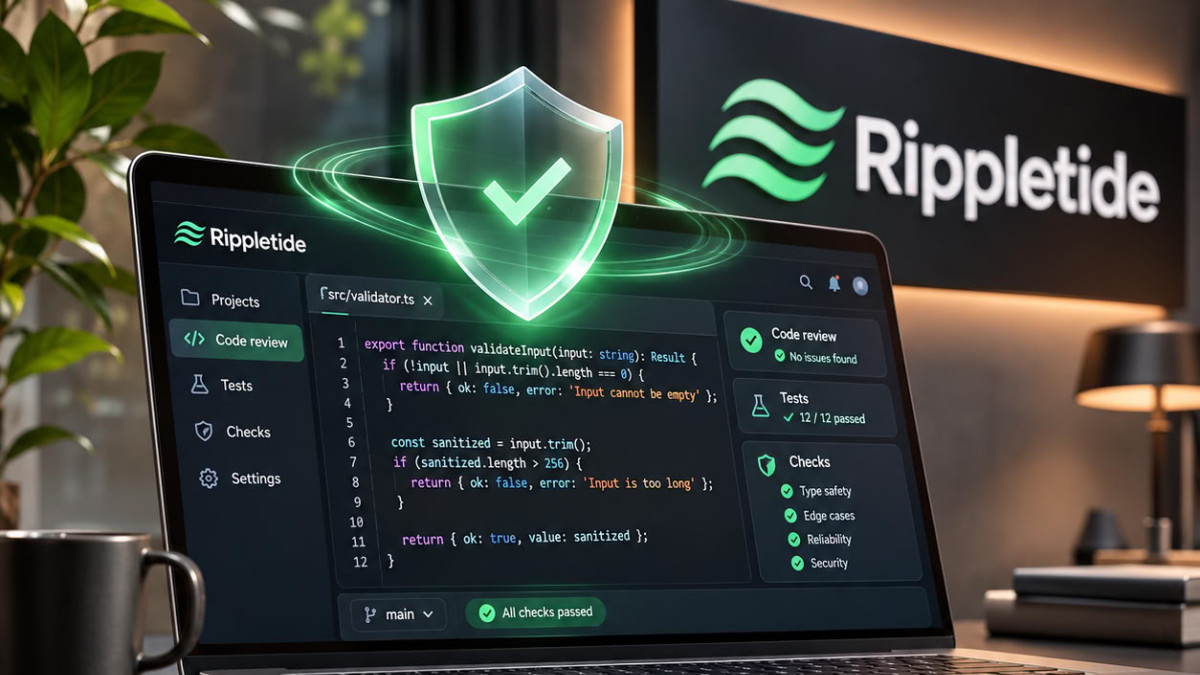

The French startup Rippletide, based in Paris, offers a tool that intercepts every action of Codex, OpenAI’s coding agent, and blocks those that violate predefined development rules. Initially launched for Claude Code, Anthropic’s coding agent, it now relies on Codex. According to the company, this integration makes code production more reliable and helps avoid technical debt in the long term.
Errors That Accumulate at Each Step
Coding agents are not inherently reliable. Large language models (LLMs), systems trained on vast volumes of text, can hallucinate, meaning they produce false information. For Rippletide, the only way to block these is to apply external safeguards to the model.
“If you take an LLM, there’s a 3 to 4% chance at all times that it won’t follow the instructions it was given. If at each step there’s a 3 to 4% chance, it compounds, and exponentially it explodes, ” Yann Bilien, co-founder of Rippletide, explains to The AI / news. Coding agents are particularly exposed to this, as they chain dozens of tool calls, commands, and file modifications. An agent can thus go off in the wrong direction and stay there for a long time without anyone noticing.
The problem intensifies at the scale of a large company. “If I put my coding agents in the hands of 5,000 or 10,000 engineers, the quality of my code will suffer, it will go in all directions, ” states the co-founder. He adds: “After three or four Claude Code tabs, the bottleneck is the developer’s attention.”
Installation in a Few Commands
The tool analyzes the codebase, Markdown files, comments, and requests that the developer repeats from one session to another, then proposes to turn these habits into explicit rules. These rules are stored in a neuro-symbolic graph, a system that combines a symbolic part, made of logical rules, and a neural part, namely an LLM. Rippletide then plugs into Codex’s hooks, trigger points activated at certain stages of its operation. “Every time the agent wants to call a tool, write a command, modify a file, it will be intercepted by Rippletide. We say whether it’s allowed to do it or not, and we say why, ” details Yann Bilien.
According to the startup, the gains are clear. “We reduce token consumption by two to three times, ” claims Yann Bilien, tokens being the text units processed by the model. This figure was measured on Claude Code, not on Codex. Rippletide also allows real-time tracking of the agent’s actions, a useful feature since coding agents do not natively offer any centralized, viewable history.
The tool is available on macOS, Windows, and Linux. Installation is done via the command ‘npm install -g rippletide-package’, followed by ‘rippletide login’, which opens a browser to connect to the Rippletide site. Connection to Codex is then done with several commands, including ‘rippletide codex setup’. This command creates four hooks: SessionStart, at the opening of each session; PreToolUse, which checks each tool call before execution; PostToolUse, which records the actual result of the action; and Stop, which controls the agent’s final response. For Claude Code, the dedicated version, which has not been updated since April, did not work during tests conducted by The AI / news. The tool is therefore, for now, reserved for Codex.
Rules to Define and a Cloud Requirement
By default, Rippletide applies no rules; they must be provided either manually in the interface or by asking Codex. A company’s coding conventions, naming rules, and architecture choices can thus be added. The Rippletide Codex plugin is still in beta and remains free for the time being.
However, the control comes with a trade-off. Decisions are not made locally but from Rippletide’s cloud, which receives the project’s instructions, details of commands and code modifications, the result of each action, and the agent’s final response. The startup offers data hosting in the European Union, without specifying if this applies by default.
