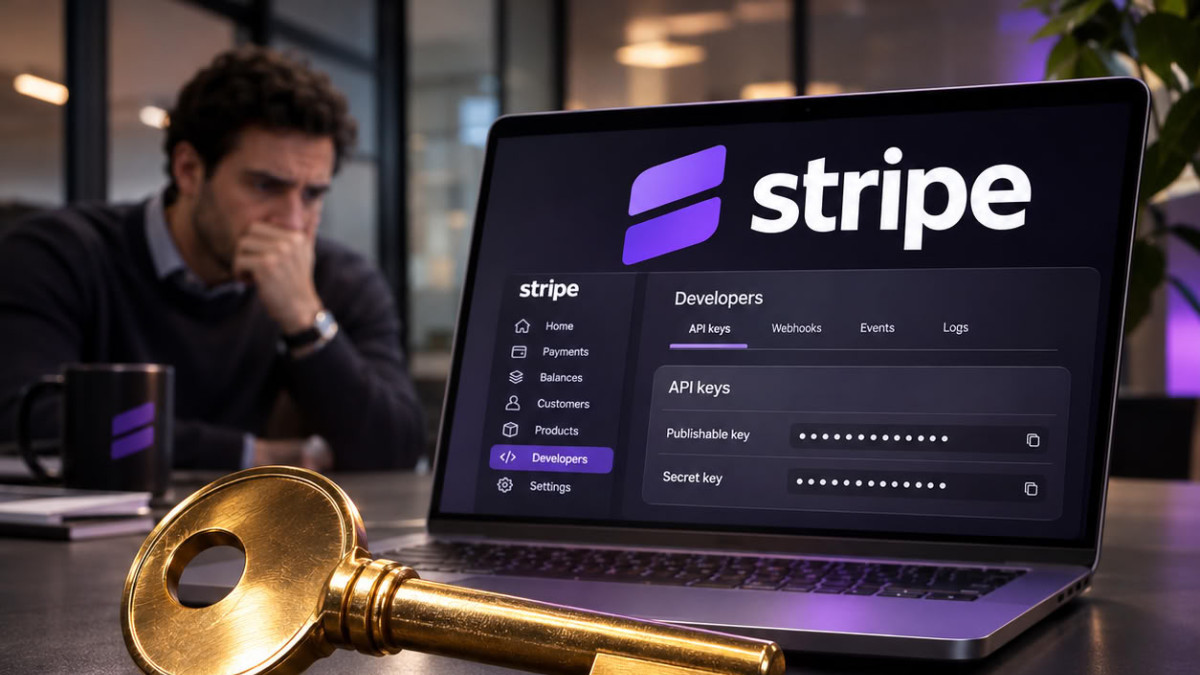

Stripe, the online payments specialist, is changing access to its secret production API keys. Starting November 20, 2026, the values of old keys will no longer be displayed in the dashboard, a decision made in a context marked by data leaks concerning the company spotted by ZATAZ. Existing keys will continue to function without requiring changes to integrations.
Stripe is gradually closing access to its API secrets
An API key may seem innocuous. In the wrong hands, however, it can become a true digital master key. In the online payments ecosystem, these credentials allow applications, servers, and third-party services to communicate with a financial provider’s infrastructure.
Until now, some legacy keys retained a particularity: their secret value could be viewed in the Dashboard, even after creation. This possibility will disappear. For new secret keys, Stripe will only display the value once, and the administrator must immediately store it in a secure environment.
The distinction is essential. A secret API key is used to authenticate computer requests and can, depending on the associated permissions, allow sensitive operations to be performed. Its disclosure can expose an organization to data manipulation, unauthorized access, or abuse of financial features.
The measure does not constitute a general revocation. Already deployed keys will remain operational, and the servers, applications, and extensions that use them will be able to continue communicating with the platform. Keys used in test mode are not affected.
An evolution that requires better access management
The change does not necessarily require immediate technical intervention, but it mandates a review of secret storage practices. Stripe invites its customers to verify, before November 20, that all production keys necessary for their services are stored in a secure device, such as a secrets vault or a password manager suited for professional use.
Administrators who need to retrieve an old value have a few days to do so. The company also recommends documenting each key from its admin interface, indicating its use and the location of its backup, without exposing the secret itself.
The announcement above all reminds us that masking a key does not mean disabling it. An already disclosed identifier remains potentially exploitable as long as it is valid, and its disappearance from the dashboard does not neutralize a copy previously retrieved by a third party. In case of suspected compromise, key rotation remains an essential measure. The ZATAZ Monitoring and Investigation Service indicates it very often spots API keys on the dark web and other black markets.
Stripe specifies that if a key is lost after November 20, it can be renewed from the Dashboard. The new value will be displayed only once, and the old key can remain active for a maximum period of seven days to allow for migration of integrations. However, when a key is considered compromised, keeping it valid can prolong the organization’s exposure.
For IT security managers, this evolution offers an opportunity to take inventory of keys in use, check their permissions, and identify those that have become unnecessary. It also recalls the principle of least privilege, according to which each application should only have the permissions necessary for its operation. Managers can consult the Stripe documentation on best practices for key management. The company’s message is twofold: existing integrations will not be disrupted by this change, but the responsibility for storing secrets appropriately will increasingly fall to the user organizations.
