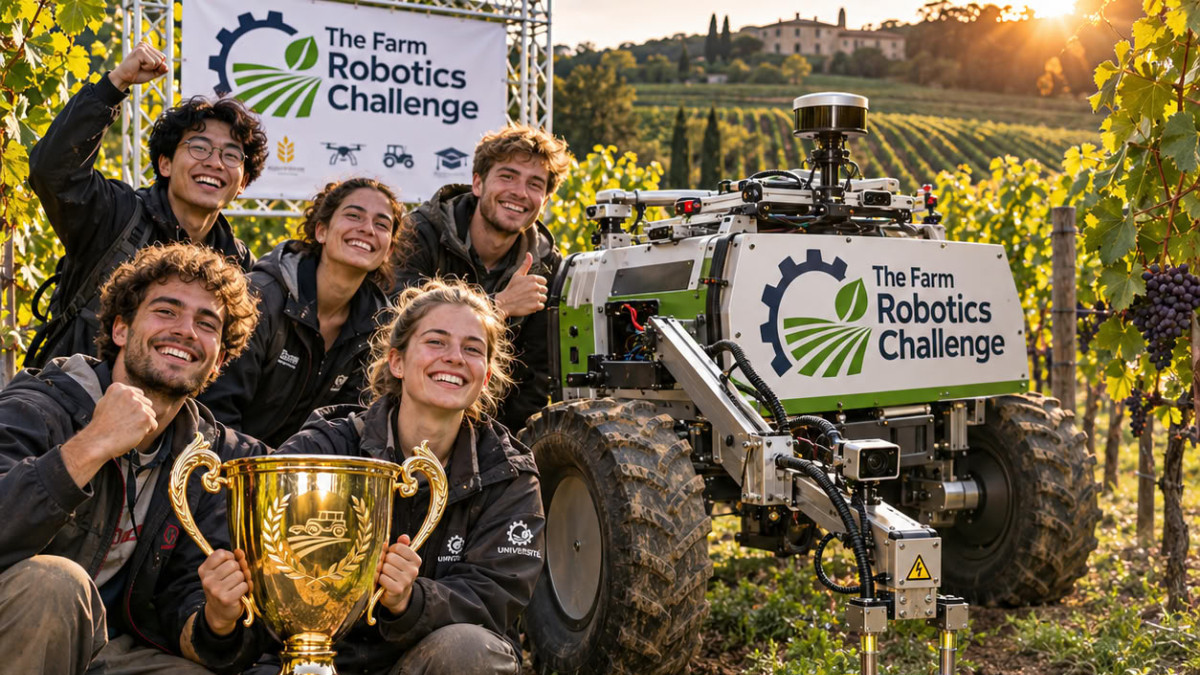

A team of undergraduate students from Cornell University has won the grand prize of The Farm Robotics Challenge with an autonomous robot that eliminates weeds using an electric discharge. Out of 96 teams in total, it beat 95 competitors, with the competition held on May 21. The project is now set to give rise to a start-up.
The robot can move autonomously through a vineyard or orchard, without a human operator. It electrocutes unwanted weeds with a low amount of electricity, which, according to the team, saves labor and energy, limits crop loss, and eliminates the need for herbicides, that is, chemical weedkillers.
The project is led by Andrew James, a student of agricultural science at Cornell’s College of Agriculture and Life Sciences (CALS). The team, composed of agriculture specialists and engineers, first studied existing electric weeding technologies before developing its own low-power system. It then built a functional prototype in four months of intensive work. Natalia Kurz, a biological engineering student at the same college, recalls many sleepless nights: “There were fears for us, like: is all this going to be for nothing?”
The grand prize, worth $50,000, will now fund the creation of the company Rootline Robotics, which will continue the robot’s development. Reservoir, an agricultural technology company that sponsored the competition, will host the startup in its incubator in Sonoma, California. James explains his long-standing desire: “I’ve always wanted to create a startup in the agricultural robotics sector. After winning this competition and seeing the support of so many industry players in this truly stimulating collaboration, it makes sense to continue.”
A long-standing problem for growers
Weeds are a major challenge in orchards and vineyards, as they take water and nutrients from the trees, especially in spring. Steve Selin, owner of South Hill Cider in Ithaca, describes very strong pressure: “Weeds grow right up to the base of the trees, because we can’t afford to cut or mulch as much as we’d like. If the trees are really stressed, they’ll just drop their fruit.”
To combat these plants, organic growers typically resort to string trimming, mowing, and mulching, methods that are very labor-intensive. Existing electric weeders require an operator, consume a lot of energy, and cost on average $150,000, an amount out of reach for most growers, according to James. Selin, who advised the students during the robot’s development, says he is eager to test this new technology.
An inherently interdisciplinary field
“Robotics brings together many systems into one,” explains Natalia Kurz. “It is interdisciplinary by definition.” Before commercializing the robot, the Rootline team must still improve its technology and validate it with farmers, while Kurz and Michael Neiss finish their studies. The latter believes the way the team came together was almost fateful: “When several different minds are gathered in the same room, you can find the most feasible and effective solutions.”
