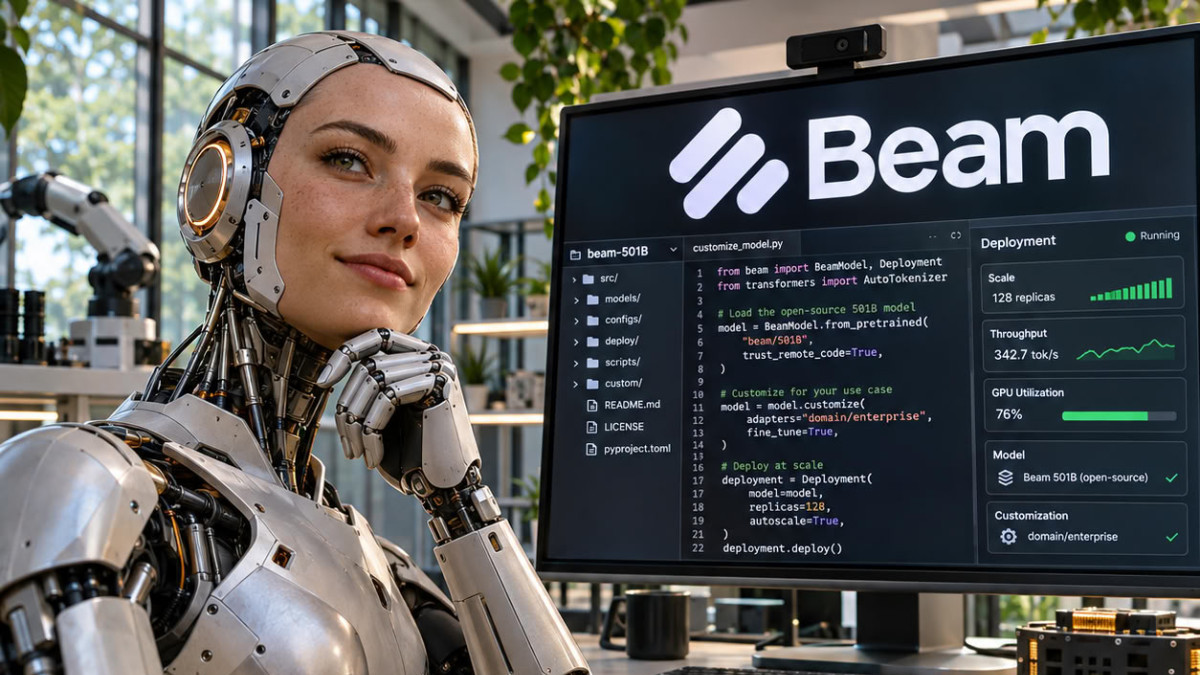

The American lab Reflection releases Beam, its first model, under an open license. This Mixture of Experts (MoE) language model, an architecture where only a portion of the network processes each token, i.e., each text fragment, has 501 billion parameters, with 23 billion activated per token. It accepts text input, has a 1M token context window, and is distributed under the Apache 2.0 license on Hugging Face.
- Reflection releases Beam, a 501-billion-parameter Mixture of Experts model, under the Apache 2.0 license.
- Beam targets code and agentic uses, and teams can run it on their own infrastructure.
- Only 23 billion parameters are active per token, but all 501 billion stay in memory.
- Beam offers a 1M-token context window and supports fine-tuning with LoRA adapters.
Beam is oriented towards code and agentic uses, meaning systems capable of chaining actions with tools. It targets teams who want to run a model of this size on their own hardware, on their infrastructure, or in the cloud, and adapt it to their needs. It comes with an open source harness written in Rust, a software environment that drives the model.
A Mixture of Experts architecture
Beam comprises 52 layers, with 256 experts per MoE layer, of which 8 are used per token. The 256 experts remain in memory: deployment therefore requires the memory of a 501 billion parameter model, but computation runs at the speed of a 23 billion parameter model. The BF16 checkpoint weighs about 1 TB in safetensors format, while the NVFP4 version, which stores most parameters in 4 bits, goes down to about 280 GB. According to the documentation, Blackwell chips natively execute this format, whereas older GPUs like the H200 cannot. The FP8 checkpoints are suited for Hopper and Ampere generations.
The model offers five reasoning levels: “low”, “medium” (default), “high”, “xhigh” and “max”. Reflection reports, based on its own results, a score of 81.6% on the SWE Bench Verified benchmark in BF16, versus 80.2% in FP8 and 80.7% in NVFP4. The score of 97.7% achieved on AIME 2026 is also among the figures provided by the publisher. Hugging Face also conducted five qualitative tests on specific tasks, which it presents as “vibe” evaluations and not as benchmarks.
Deployment and customization
Beam is supported at launch by the transformers, SGLang and vLLM libraries. Hugging Face also provides recipes for supervised fine-tuning (SFT, which involves training a model on annotated examples) and reinforcement learning (RL). In one example, fine-tuning with LoRA adapters, which modifies only a small part of the weights, yielded a response in the requested language on 16 out of 16 prompts, compared to 3 out of 16 for the base model. This test measures language compliance, not reasoning correctness. Beam is also accessible via Inference Providers, with providers Baseten, Fireworks and Together.
Reflection also announces $10,000 in Hub credits, distributed to the best projects built with Beam. Participants must publish a demo, a quantized model, a synthetic dataset, a reinforcement learning environment, or a benchmark, then share the link in the discussions tab of the model’s page.
