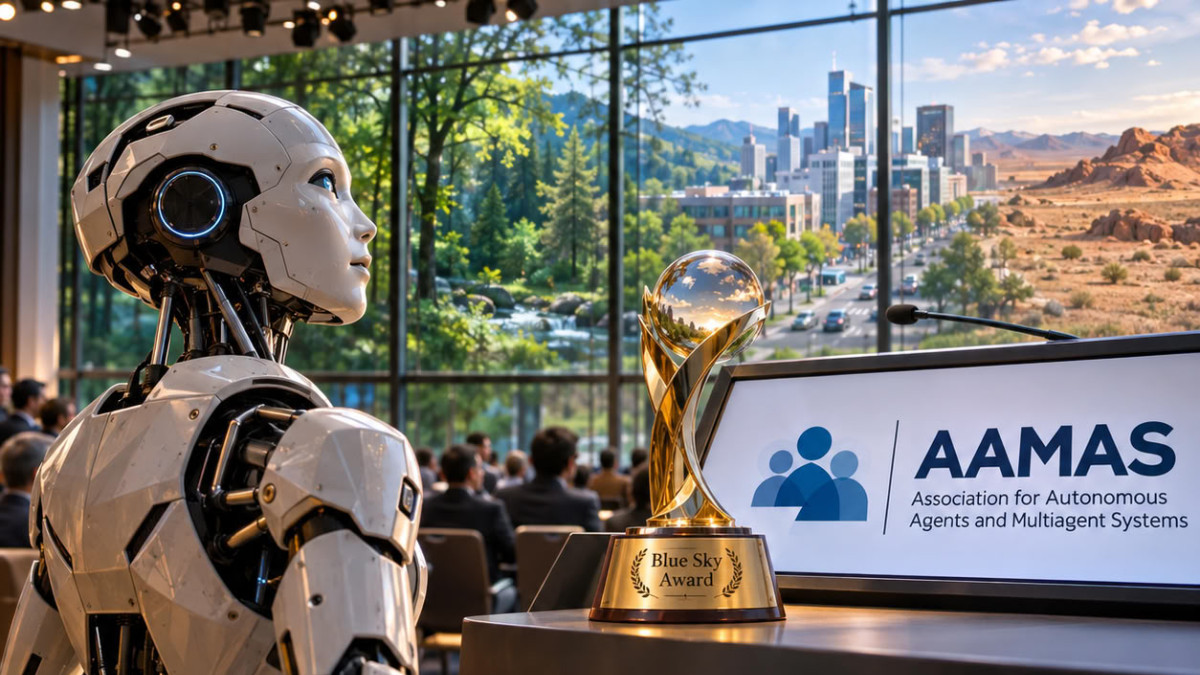

Florent Delgrange, a postdoctoral researcher at the Artificial Intelligence Lab of the Vrije Universiteit Brussel (VUB), received the Best Blue Sky Paper Award at the AAMAS 2026 conference for his work titled ‘Foundation World Models for Agents that Learn, Verify, and Adapt Reliably Beyond Static Environments’. In an interview, he presents the research program he proposes: enabling an autonomous agent to learn continuously, in a changing world, without losing the guarantees that make its behavior trustworthy.
- Florent Delgrange proposes combining reinforcement learning and reactive synthesis in one continuous loop.
- A verifier checks a learned world model so the agent’s behavior stays reliable.
- The model must be calibrated, compositional, and semantically queryable.
- Scaling to multi-agent systems remains the main obstacle, since local guarantees do not automatically yield global ones.
His paper starts from a simple observation. Reinforcement learning, which involves learning by trial and error, can be applied to environments for which one could never write all the rules. But the agent generally seeks to maximize a reward, and a poorly defined reward can be exploited. A high reward alone, therefore, does not prove that a safety or coordination requirement is met. Conversely, reactive synthesis, a method from formal methods, starts from a model of the environment and a logical description of the expected behavior to construct a policy that is correct by design. However, it assumes an explicit and fixed model, which is precisely what an agent evolving in an open and changing world lacks.
The proposal is to unite these two approaches in a single loop. A world model, i.e., an internal representation of the environment, would be learned from experience, but structured so that it can be analyzed by a verifier, a program tasked with checking the validity of behaviors. As the agent learns, it would update its model, measure the reliability of its abstraction, and verify that its policy still respects its specifications. The verifier could reject a dangerous update, request data on an uncertain area, or trigger a revision of the model.
A different vision from current models
For Florent Delgrange, the term ‘foundation’ refers first to reusability, not size. He does not envision a larger video predictor trained on more trajectories, but a persistent and structured model that an agent can carry from one task to another and from one population of agents to another. He compares it to a map that would show not only roads, but also explored areas, the conclusions that depend on these areas, and the moments when a change makes an old route unreliable.
He defines three expected properties. The model should first be calibrated: each learned abstraction would be accompanied by a measure of its error or coverage. It should then be compositional, with local dynamics and already verified certificates being reusable to assemble a new task. Finally, it should be semantically queryable: a formal requirement or a high-level instruction would help the agent derive a suitable reward or policy, with little additional experience.
He also points out that current models are primarily designed for a given task, environment, or training distribution, with the main objective being prediction accuracy. However, in his view, average accuracy does not equate to an ability to guarantee behavior. In the example of a warehouse, a model can predict almost all transitions correctly while missing a rare and dangerous interaction with a forklift, yet that single transition determines the validity of a collision avoidance guarantee. In this scheme, language models would play a complementary role: they would propose specifications or structured updates, which the world model would ground in experience and the verifier would check.
Multi-agent systems
In multi-agent systems, each learning agent is part of the environment of the others, making the problem more difficult. Florent Delgrange takes the example of a fleet of warehouse robots, which must avoid collisions, deliver their packages, and respect shared capacity constraints. If a robot changes its route, the system could identify the affected assumptions and guarantees, collect new data if necessary, and revise only the relevant components.
The main obstacle remains scaling. The joint state space grows very quickly with the number of agents, and local guarantees do not automatically combine into a global guarantee. The researcher believes it is necessary to develop methods to expose dependencies, preserve the validity of guarantees during their composition, and verify fast enough to influence learning in real time.
