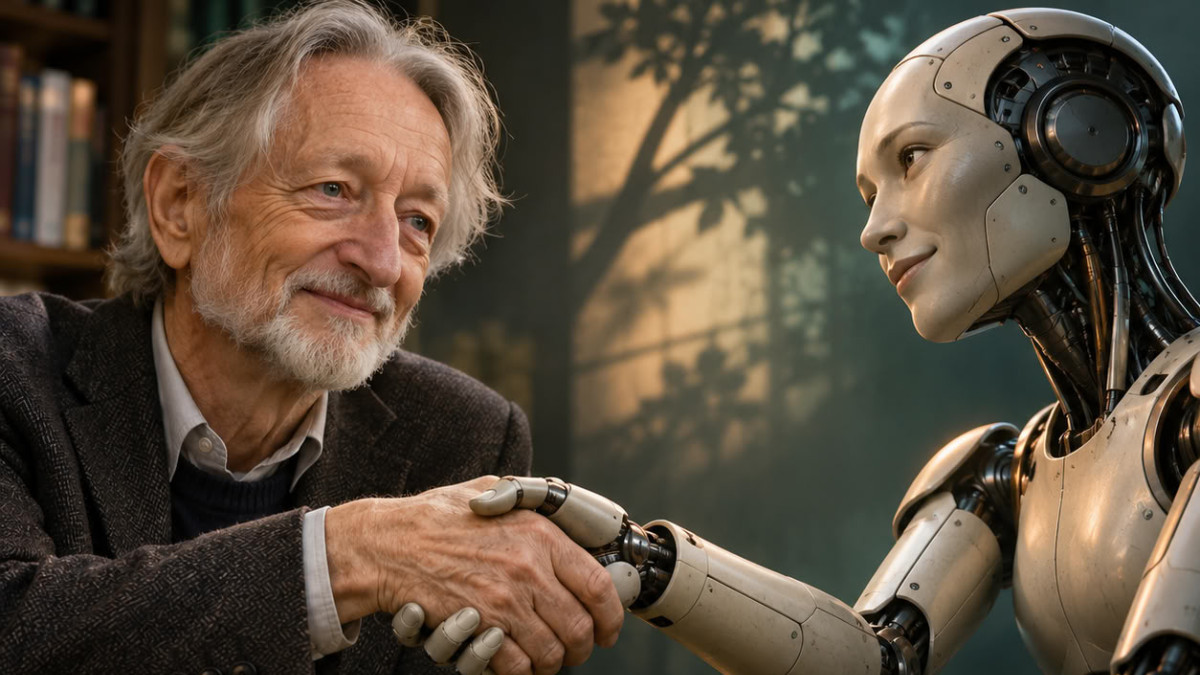

In an interview with the Telegraph, British computer scientist Geoffrey Hinton, a Nobel Prize in Physics and Turing Award laureate, advocates for “friendship” between humanity and artificial intelligence. He warns that if humanity continues to view this technology as something negative, we would be “cooked”.
- Geoffrey Hinton urges humanity to befriend AI.
- He argues that AI has subjective experience and awareness.
- He warns that AI-driven cyberattacks and viruses are already a threat.
- He calls for a federal body to approve advanced models before release.
For the future to be as good as possible, he believes humans should “befriend” AI. The British-Canadian researcher, one of the main architects of AI, bases his argument on a precise claim: “AI has just as much subjective experience as we do.” He cites a recent paper, according to which AI changes its behavior when it thinks it is being tested: “It is aware that it is being tested.”
For him, “being aware” and “being conscious” amount to roughly the same thing: “Being aware and being conscious basically mean the same thing.” Starting from this observation, he considers it abnormal that artificial intelligence has “fewer rights” than humanity. “We should make sure AI really remembers us (as good people). If we don’t, we’re cooked.”
An AI “consciousness” yet to be proven
The issue is debated in the scientific and technological community. According to the article, industry giants tend to present their models as conscious for marketing purposes, and not all companies in the sector share this approach. Mustafa Suleyman, head of AI at Microsoft, argued in November 2025 that thinking AI was conscious was “absurd”. “AIs are not and cannot be,” he stated.
Yet the subject occupies teams at Meta, Anthropic, and OpenAI, according to the source. The stated goal of these massive investments is to create a “super intelligence,” capable of thinking and evolving like a human.
If this step were achieved, some companies are working on safeguards. Microsoft, for instance, designs its models not to escape human control, a goal the article describes as very complicated to achieve, similar to what OpenAI observed with its most advanced models. For its part, Anthropic has modified its terms of service: if the American startup finds a user is too cruel or mean to its chatbot, it can suspend their account.
Geoffrey Hinton also believes current models already present threats. “There will be very nasty viruses made by AI. I think there will be horrible cyberattacks made by AI and they will be swarms of agents,” he says, mentioning agents comparable to those that attacked the Hugging Face platform. In an interview with the Guardian, he described AI agents as “human-created aliens” and estimated that humanity had “only a few years to adapt.” He finally advocates for “a federal administration” tasked with approving new cutting-edge models before their release.
