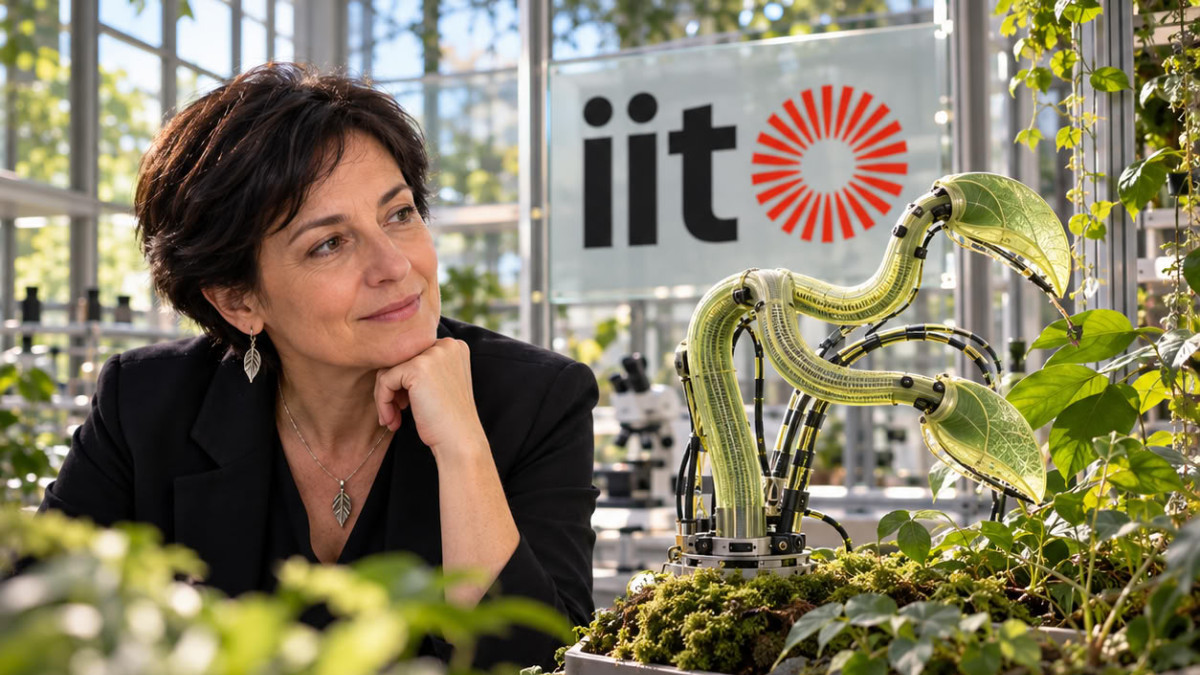

Barbara Mazzolai, a roboticist at the Italian Institute of Technology (IIT) in Genoa, has drawn inspiration from nature since the beginning of her career. She now advocates for a new approach, sustainability robotics, presented in a manifesto published in July in Nature Machine Intelligence.
Robots inspired by living organisms
A biologist by training, Barbara Mazzolai changed paths thanks to an unexpected opportunity, becoming one of the pioneers of bio-inspired robotics, which leverages solutions developed by living organisms. She has designed robots inspired by octopuses, plant roots, and even seeds. ‘I have always been fascinated by living organisms, by the extraordinary variety of nature’s solutions, selected by the evolutionary process,’ she says.
After a master’s degree in biology at the University of Pisa, she began working in 1999 as a research assistant for Paolo Dario, a recognized roboticist in this field. She started by developing sensors, then robots designed to monitor air, water, and soil. In 2004, she was promoted to assistant professor and participated in the design of a soft robot inspired by the octopus. ‘We proposed it as a paradigm to launch this idea of soft robotics: to demonstrate that can be soft while exerting significant force on the environment, as the animal does,’ she states.
In 2009, she became a team leader at the IIT’s Center for Micro-BioRobotics, before taking over its direction two years later, after completing her PhD in microsystems engineering at the University of Rome Tor Vergata.
The root model
Plants then took on a major role in her work. Mazzolai was drawn to the ability of roots to efficiently explore the subsoil, a capability she imagines transposing to machines used for environmental modeling and precision agriculture. According to her, roots only progress through their very fine tip, while their thicker base remains immobile, which drastically reduces the energy needed to traverse the earth, compared to a conventional drill that pushes the entire structure from the surface.
To reproduce this principle, her team developed a miniaturized 3D printer placed at the tip of the robot. It injects a thermoplastic filament through a heated nozzle and builds a snake-like body behind it. The tip also carries sensors to avoid obstacles and detect nutrients or water nearby. The researcher emphasizes that plants remain in motion throughout their lives: ‘They truly grow all their life. They adapt their morphology, their behavior to the external environment; they repair, they perceive, they communicate.’
More sustainable robotics
According to Barbara Mazzolai, many modern technologies, including plastics and car batteries, were designed with little thought to their end-of-life environmental effects. She wants to prevent robotics from following the same path. Sustainability robotics rests on three pillars: limiting the environmental impact of robots, making them accessible to people of all countries and socioeconomic conditions, and ensuring they are ‘symbiotic,’ meaning beneficial for both humans and nature.
Concretely, she proposes integrating the notion of life cycle into robot design, so that at the end of their use, these machines can be reused, recycled, or biodegraded. She says she is convinced that the means exist to achieve this and that this vision will inspire future roboticists. ‘There are young people who really want to work in this field because it’s the future, their future,’ she concludes. Faced with the threat of environmental degradation, ‘they want to develop something that can help.’