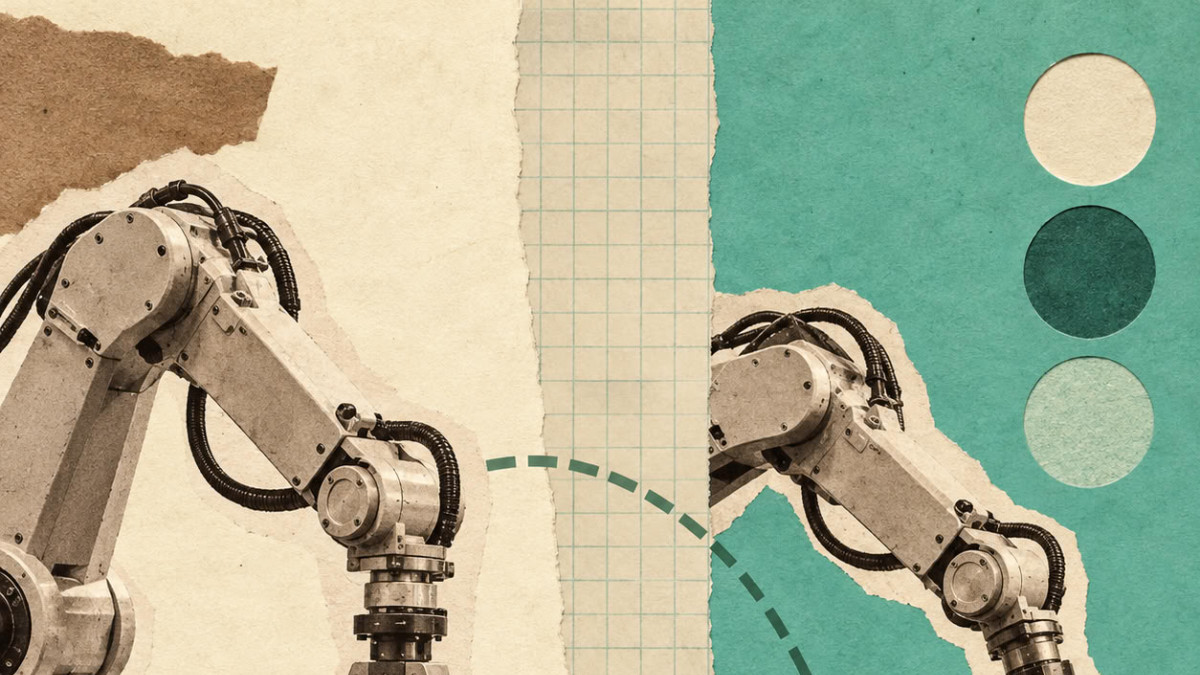

Google Cloud is opening Gemini Robotics ER 2 to its clients, a model tasked with planning robot duties, in public preview since October 27, 2026. The model does not command motors itself: it relies on other tools to act.
At the Singaporean institute A*STAR IMRE, which designs new materials, the lab houses an old microwave reactor with no API, only a touchscreen. Its executive director, Professor Loh Xian Jun, wants robots guided by ER 2 to be able to “read the touchscreen of an old microwave reactor lacking an API, balance and load a centrifuge, or safely move samples in a very busy lab.” He states this in the Google Cloud blog post, before adding: “This is the next level we aspire to reach.”
One model plans, another executes
Google DeepMind introduced ER 2 on July 30, 2026, available to developers via the Gemini API and Google AI Studio. Since October 27, Google Cloud enterprise customers can call it in Model Garden under the identifier gemini-robotics-er-2-preview, test it in Agent Studio, and deploy it using the platform’s security controls. According to the Gemini API documentation, its predecessor, ER 1.6, was discontinued as of August 31, 2026.
Google describes it as “a high-level brain for robots,” which “then hands off motor execution to any lower-level vision-language-action (VLA) model.” A VLA is a model that connects images, language, and actions. ER 2 receives video, audio, or text, breaks down the task, calls the tools declared by the developer, then reviews the video to verify a step succeeded and restart it if needed. Built on Gemini 3.5 Flash according to its spec sheet, it only outputs text. The model that commands the motors, Gemini Robotics 2, is reserved for partners in early access, per the DeepMind blog post from July 30.
Figures announced by Google, safety entrusted to the operator
Google claims 91.3% accuracy for pinpointing, in a video, the frame where a critical event occurs, with an average offset of 0.96 seconds. According to the company, the model runs at “4x the execution speed” of “many categories of larger models,” without naming those models. For task progress classification, the July blog post announces 57.4% correct responses. Google does not publish the test protocol or competitors’ scores.
The robotics documentation for the Gemini API specifies that “you are responsible for maintaining a safe environment around the robot.” The spec sheet excludes safety-critical applications, such as healthcare or transportation. In the DeepMind safety report, dated July 29, 2026, the best tested models detect, in an image, a boundary crossing within one meter of a person with an accuracy of approximately 79% to 93%. In an agentic version, models that reduce the rate of missed stops when a person is nearby to around 10% to 15% stop the robot without reason in 15% to 25% of cases. None come close to zero on both counts. The report judges it “currently preferable” to use these models with “low-level deterministic safety safeguards.”
A usage in operation and a promotional price
In these announcements, the only robotic usage described as operational comes from Boston Dynamics. On April 8, 2026, its visual inspection module for Spot, AIVI-Learning, switched to Gemini Robotics ER 1.6 for enrolled customers, for reading gauges, liquid indicator levels, conveyor damage, or pallet counting. Data sharing with Boston Dynamics is mandatory. Marco da Silva, who leads the Spot business, believes ER 2 brings “even more value” to these customers: “Video changes what an inspection can be.” No timeline for switching to ER 2 is published.
The Google Cloud pricing grid shows a promotional price for ER 2 of $1 per million input tokens, and $5 per million output tokens, until December 31, 2026. Google rebates 50% of net spend in credits, without specifying when these credits are issued or how long they remain valid. Starting January 1, 2027, the grid shows $2 for input and $10 for output.