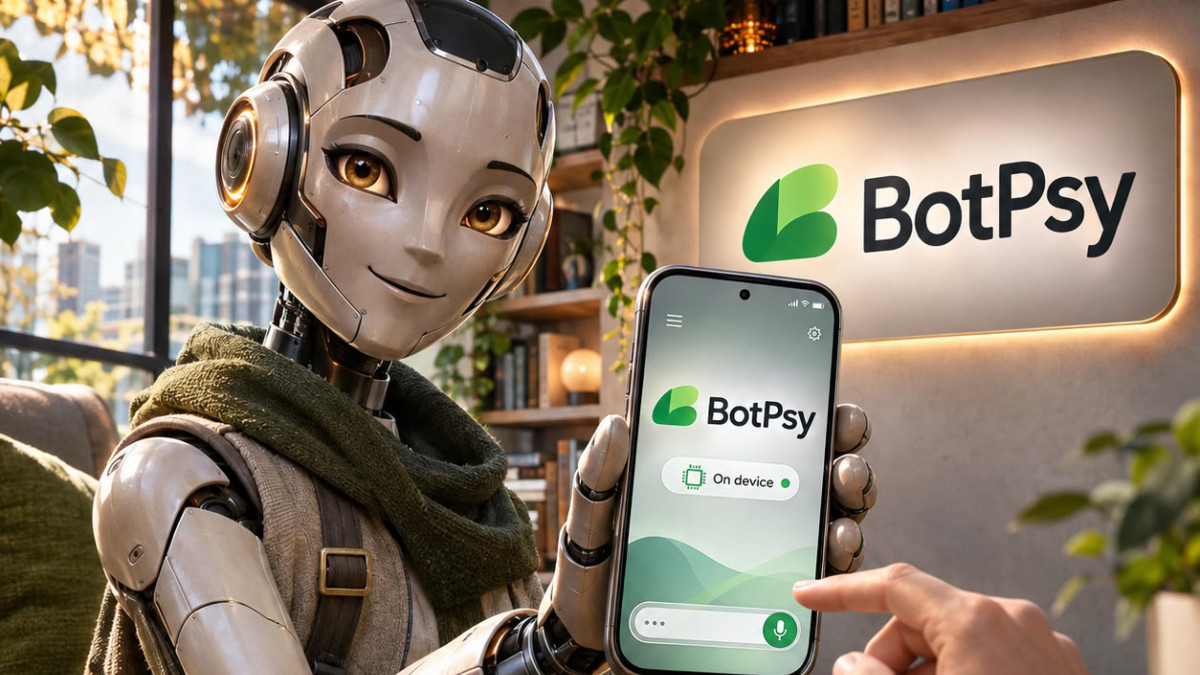

Tether AI Research introduces BotPsy, a 0.8B parameter model designed for function calling and agentic workflows, meaning a model’s ability to use tools to accomplish a task. Built from Qwen3.5-0.8B, it is intended to run directly on the user’s device.
According to the company, large cloud-hosted models incur high operating costs, which can vary unpredictably. Relying on these third-party models also exposes users to risks, as their providers can modify, restrict, or withdraw access at any time. Tether AI Research believes that not all tasks require peak intelligence, and that small, specialized agents can be just as effective for specific tasks at a significantly lower cost.
BotPsy is presented as a ‘personal assistant’ capable of performing simple tasks using tools, in areas such as web search, travel, commerce and finance, device and vehicle management, files, calendar, or email. Due to its size, it is best suited for low to medium difficulty tasks.
Reported Results Superior to Its Category
According to results published by the company, BotPsy achieves scores approximately twice as high as its base model on several tests. On BFCL v4, it improves from 23.4 to 44.0, on ACEBench from 30.1 to 58.7, and on τ-bench from 23.2 to 51.5. It outperforms Qwen3.5-2B-Think, a model 2.5 times larger, on five of the six agent benchmarks tested. Only Claw-Eval escapes it, with 48.9 against 46.5.
Tether AI Research also highlights safety. In automated tests covering six risk categories, BotPsy produces dangerous responses in 21% of cases, compared to 36% for its base model. This is the lowest rate among tested models of 1.2B parameters or less, where LFM2.5-1.2B-Think reaches 35% and MiniCPM5-1B-Think 47%. Regarding reasoning, the company indicates that BotPsy uses approximately three times fewer tokens, the units of text processed by the model, than its base model to correctly answer the GPQA Diamond benchmark, with 3,690 tokens versus 11,563.
A Four-Step Training Method
BotPsy is trained in four successive steps, starting with supervised learning on tool-use conversations, then multi-teacher distillation, before two rounds of reinforcement learning. The distillation here involves having the student model generate responses while receiving, token by token, feedback from three Qwen3.5-4B teacher models, each specialized in a domain. The reinforcement steps rely on rewards calculated by rules and verifiers, not on human judgments.
Limitations and Release
Tether AI Research specifies that BotPsy remains a small model that makes mistakes and is not intended for high-stakes automated decisions, nor for applications involving money, personal information, or health. The model was primarily trained and tested in English. Its performance drops in Hindi, with a score of 24.5 on Multi-IF, and in Russian, with 57.6. BotPsy is to be released with open weights under an Apache 2.0 license, for research and educational use, in three precisions: bf16, Q8, and Q4.
