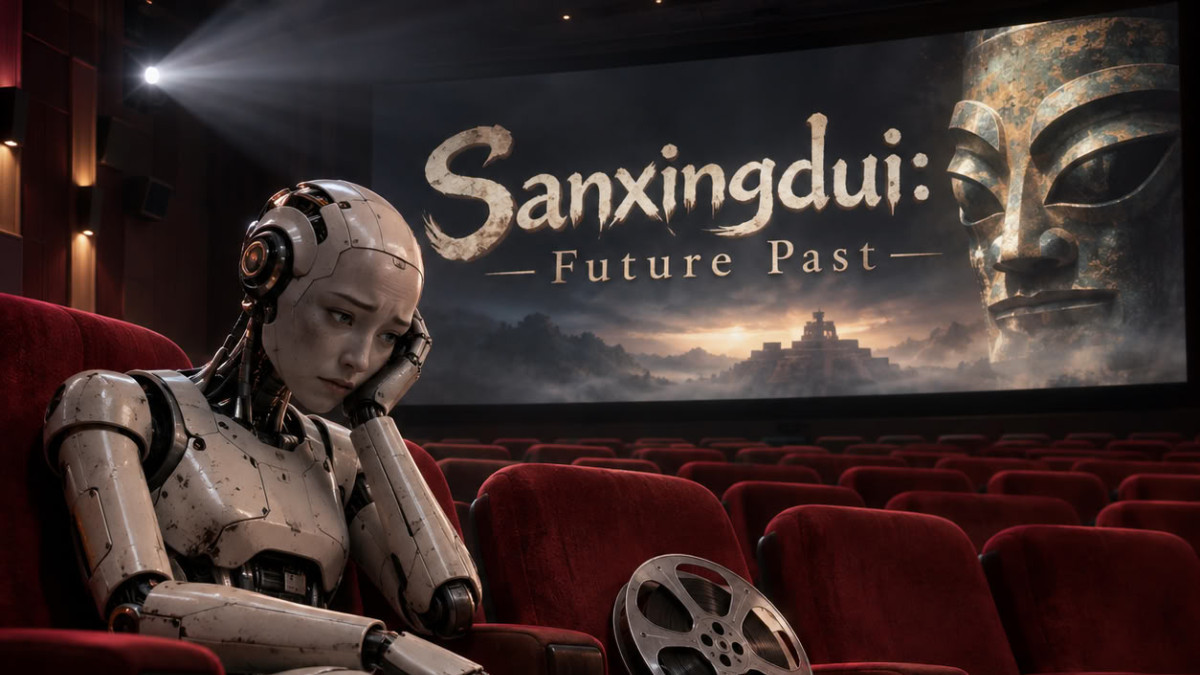

The first Chinese feature film entirely designed by artificial intelligence is struggling to win over audiences. Three weeks after its theatrical release, Sanxingdui: Future Past has earned only $270,000 in revenue, a result that contrasts with the boom of AI-generated content on Chinese smartphones.
According to data from Beacon Pro, a Chinese box office tracking organization, the film has grossed 1.8 million yuan, or about 246,000 euros (approximately $270,000), as reported by the South China Morning Post. An amount far from the tens of millions of yuan announced as the production budget.
A script and visuals deemed insufficient
With a runtime of 100 minutes, this science fiction film imagines a future where uncontrolled algorithms and artificial intelligence plunge humanity into catastrophe. To avoid its disappearance, survivors must decipher a message hidden in bronze objects from the ancient Shu kingdom.
The script clearly wasn’t enough to convince viewers. On social media, criticism has multiplied: several internet users complained about stiff facial expressions, visual inconsistencies from one scene to another, and the plot, deemed disjointed. One user summed up the feeling: ‘So obviously AI-generated.’
For its part, the People’s Daily, the official newspaper of the Chinese Communist Party, believes the film’s reception reveals the broader limits of AI-driven creation. According to the newspaper, the producers first generated a large quantity of images before trying to build a story around these sequences, a method that would have contributed to producing a disjointed narrative. ‘When technological wonders become commonplace, the real limit of AI-made films will lie in the aspects that AI cannot handle: scripts, acting, emotions, and judgment,’ the paper argues, while specifying that this failure would not mean the end of AI-made cinema.
An audience turning away from artificial content
The failure is all the more striking as China has become one of the main testing grounds for AI-generated entertainment. Micro-dramas, very short episodic series designed to be watched on smartphones, are experiencing spectacular growth there. According to official data, 430,000 micro-dramas were launched between January and August 2026, of which more than 90% contained AI-generated content.
For Michael Berry, a professor specializing in contemporary Chinese culture at the University of California, Los Angeles (UCLA), the omnipresence of this content could precisely explain the film’s rejection. ‘The public may equate AI-generated videos with vertical short films and disposable, cheap entertainment they consume on their phones while queuing, sitting in the back of a taxi, or going to the toilet,’ he analyzes. When paying for a cinema ticket, the viewer expects, according to him, ‘something different, something real.’
Another Chinese film seems to prove him right. Niu Lai, a low-budget animated film made by a mother-son duo over five years, has grossed over 51 million yuan (nearly 7 million euros) in its first three weeks in theaters. Betting on a handcrafted aesthetic and dialogue with deadpan humor, it has found its audience despite much more modest means.
For Michael Berry, the public might even start to tire of artificially generated content. ‘We are seeing a growing disinterest in AI-dominated content, in favor of art, stories, and visuals imbued with humanity,’ he believes.
