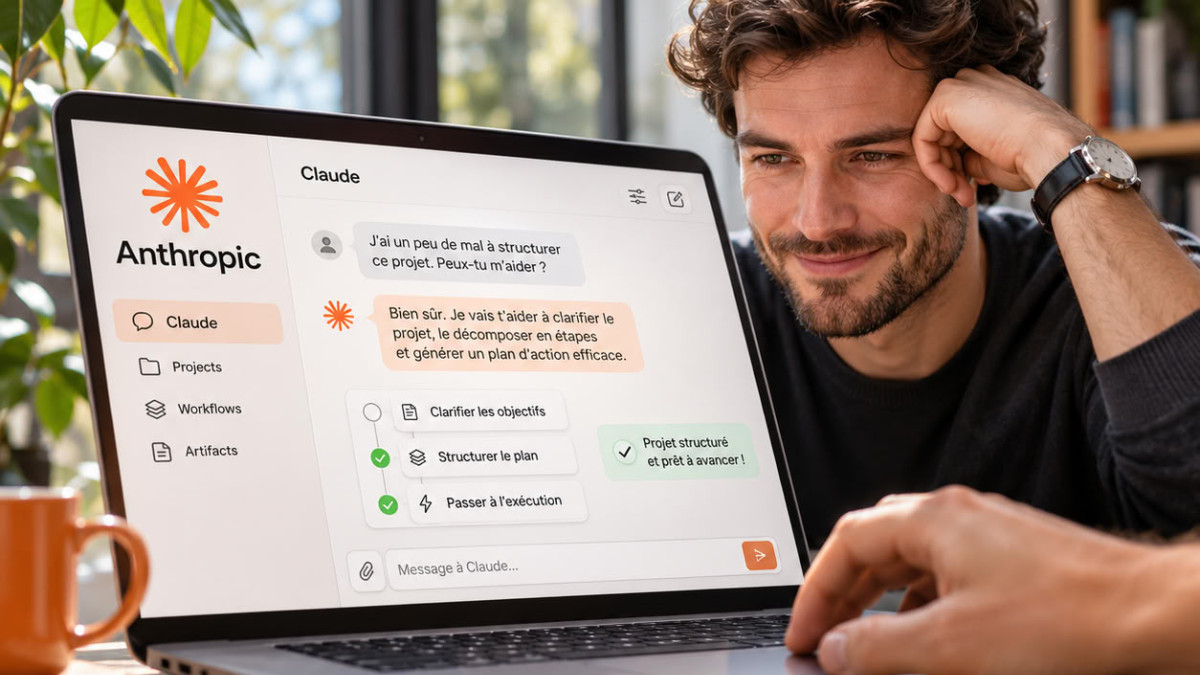

Much of the potential of artificial intelligence remains untapped, less due to its limitations than to how people access it, most often via chatbots. According to the source author, a new generation of interfaces, like Claude Cowork from Anthropic, could change this.
The chatbot, a hindrance to work
The chatbot is suitable for a quick question, but it is ill-suited for real work. A new study asked a small group of finance professionals to perform a complex assessment using GPT-4o, measuring their cognitive load from the transcripts, exchange by exchange. Participants gained in productivity, but part of this gain was absorbed by the presentation of information: long blocks of text, suggestions of new topics, and discussions that go off in all directions.
Once the conversation became confused, it stayed that way. The AI, optimized to be helpful, mirrored the disorganized structure provided by the user, who, overwhelmed, did not reorganize it. It was the least experienced workers who suffered the most, even though they are the ones who could benefit the most from AI.
Specialized tools, especially for code
Among specialized interfaces, only those intended for programming are, according to the author, truly complete. Claude Code, Anthropic’s programming agent, can work autonomously for several hours. Codex from OpenAI and Antigravity from Google offer similar functions. However, these tools assume knowledge of languages like Python and tools like Git, and they are not designed for the 99% of knowledge workers who are not developers.
Google experiments more than other labs with interfaces for other professions. Stitch allows describing an application in natural language and obtaining several coherent screens on an infinite canvas. Pomelli generates social media campaigns from a website address. NotebookLM helps research and work with various information sources. These tools remain imperfect and, according to the author, are not yet as transformative as Claude Code is for programmers.
The personal agent and the phone as a remote control
The open-source project OpenClaw, whose symbol is a red lobster, has experienced growth that the author describes as the fastest in the history of open-source projects. You can talk to it from WhatsApp, Telegram, or Slack, and ask it to check emails, book a table, or find a file. However, it remains difficult to use and presents, according to the source, many security risks.
Anthropic offers Claude Cowork, launched in January, a version of Claude Code intended for knowledge workers. It accesses local files and applications, connects to dozens of applications via connectors, and, failing that, directly controls the mouse and keyboard. With Dispatch, it is possible to send messages to Claude from your phone while it works on the computer, after scanning a QR code.
The author describes several uses. Asked from his phone to prepare a morning briefing, Claude checks calendars, emails, and online channels before producing a report. For a presentation, it was also tasked with checking the chart on slide 3 and updating it: after a temporary blockage due to a site preventing file download, it found a more recent chart in a PDF, extracted it, and integrated it into the PowerPoint. The result is not always perfect, but it allows, according to the author, for significant time savings.
An on-demand generated interface
Cowork operates in an isolated environment, safer but more limited than OpenClaw, without the security risks disappearing entirely. For the author, the logic remains the same: people don’t want a simple chatbot, but an agent that works on their real files and tools.
AIs can also generate the interface themselves. Claude can now create visualizations directly in the conversation, interactive and editable as questions evolve. The author suggests the future will not be a single interface, but an AI that produces the right one at the right time. According to him, some of the disappointment sometimes expressed towards AI stems less from its capabilities than from the way it is presented to its users.
