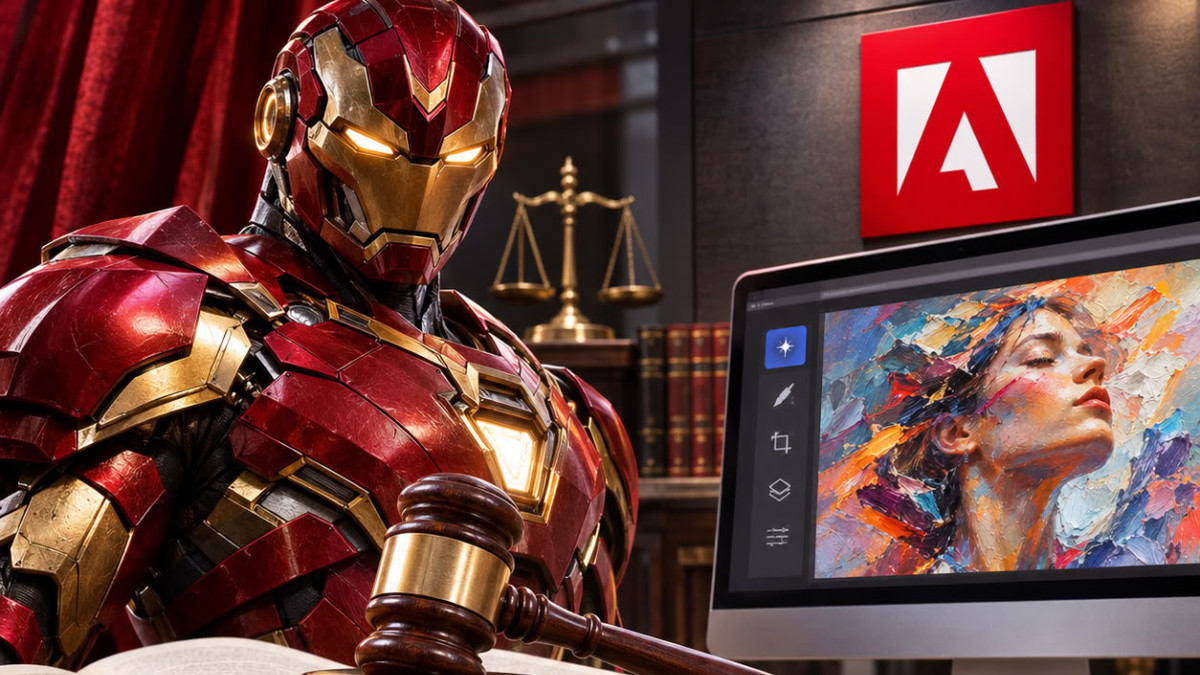

Karen Robinson, Senior Vice President and Deputy General Counsel at Adobe, advocates for regulating AI-generated content rather than relying solely on court rulings. Interviewed at Adobe MAX 2026, she discusses the CREATOR Act, the Darcos bill, and the European Commission’s consultation on copyright and AI, which closed on November 3.
Rules Upfront Rather Than Courts
For Karen Robinson, Europe, which is trying to set rules upfront, is probably adopting the best approach, while the United States largely leaves it to the courts to decide. According to her, courts can only rule on the facts presented to them. However, by the time a case reaches the Supreme Court, the technology in question is already three or four years old, which risks making the ruling outdated. She adds that this Court has generally preferred to judge specific cases rather than define broad policy, which multiplies lawsuits.
She also observes a change in attitude from some tech companies, which are now asking for regulation: ‘regulate us, please.’ She cites the European Union, the United Kingdom, and Australia as examples, which ‘are trying to anticipate.’ Adobe contributed to the European Commission’s consultation on the subject.
Generated Content, the First Point of Concern
Karen Robinson distinguishes two aspects of AI: the training data that goes into the model, and the content produced that comes out. According to her, the main fear of creatives is being pushed out of a market that their own art created. Since generated content is easier to regulate now, Adobe has placed it at the center of its position, notably to prevent an AI from infringing on the rights of characters like Mickey Mouse or a Marvel character, or an artist’s style.
She emphasizes that this approach is independent of the training question: even if that were resolved, an artist with a distinct style whose images were used to train a model would have, without additional protection, no rights over the generated content. The CREATOR Act, introduced in Congress in June 2026 and supported by Adobe, aims to protect artists’ styles from intentional commercial imitation. In France, the Darcos bill, passed by the Senate on April 8, 2026 and sent to the National Assembly, targets training instead, by establishing a presumption of exploitation of works, placing the burden on AI providers to prove otherwise.
To illustrate her point, she uses the example of Iron Man: a model may have been trained on images of the character, but ‘if it is forbidden from generating it, it will never generate it.’ She believes these safeguards benefit large companies holding intellectual property on a large scale, but not individual artists. The exceptions provided, such as satire or imitation for creative purposes, are, according to her, built into the bill.
Habits for Creatives, and a Federal Law
Karen Robinson first recommends documenting one’s involvement in a creation: the decisions made and how the tool was used, which can support an application for registration with the Copyright Office. An image obtained from a simple prompt would not be protectable, according to her, whereas work spanning several days, iterated and documented, could be. She compares AI to a camera and recalls that photography was, in its early days, contested as an art form.
She then advises marking one’s work with Content Credentials, based on the open C2PA standard, adopted by over 5,000 companies. Finally, she urges carefully reading the terms of use of tools. Regarding the United States, she believes a patchwork of state laws, as in California, is not ideal: ‘an artist in Massachusetts should not be less protected than an artist in California: the ideal would be a federal law.’ Asked about the chances of such a text after the midterm elections, she believes Democrats now control both houses ‘in theory,’ but cannot predict their priorities.
