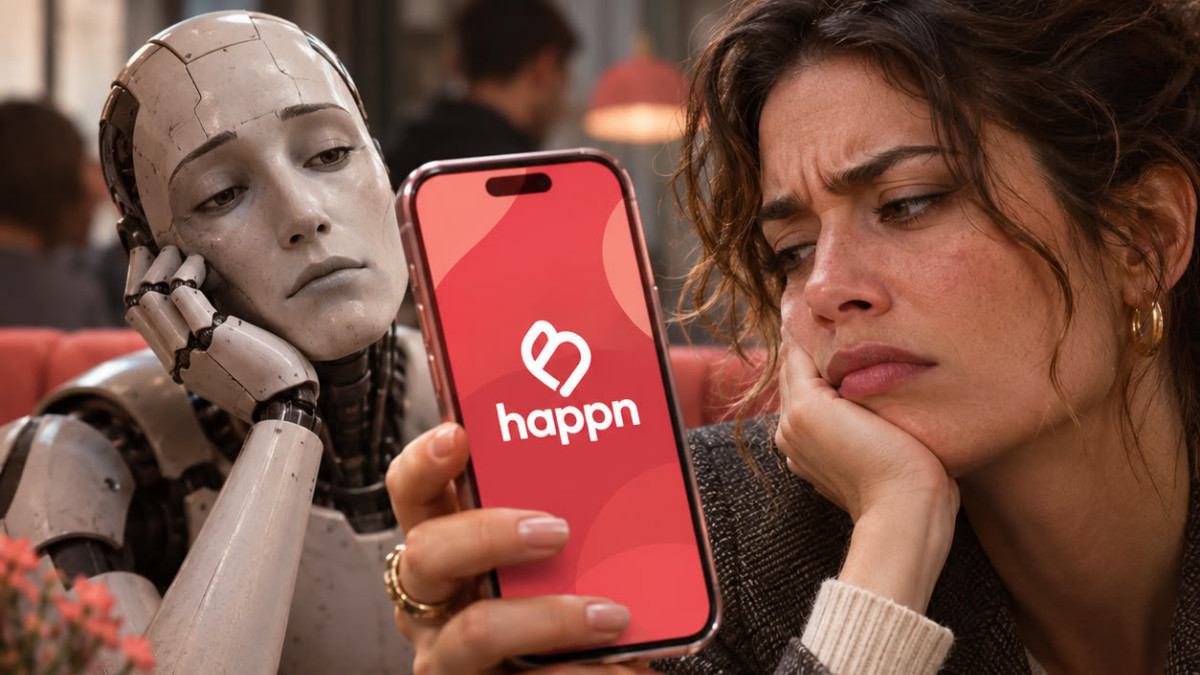

In late 2025, happn announced the advent of the ‘AI situationship,’ where singles would use chatbots as emotional training grounds. Eleven months later, its 2027 trendbook paints a more pessimistic picture, with a particularly marked distrust in France. The survey, the fifth of its kind conducted by the app, involved around 18,000 users in about a dozen countries, including France, Brazil, and India.
AI Fatigue, a Very French Malady
Among the five trends identified by happn, AI fatigue refers to singles’ weariness with messages, bios, and responses written with the help of artificial intelligence tools. Globally, one in five singles (20%) say they feel it. In France, the rejection is clearer: while half of singles (51%) globally declare themselves opposed to the use of AI in dating and relationships, the figure is 64% in France. On the question of authenticity, 49% of respondents internationally believe AI makes dating too superficial, compared to 61% of French respondents.
One figure contrasts with these results. Globally, 20% of singles say they are using AI less and less, compared to 17% in France.
Young Women on the Front Line
The sharpest decline concerns young women. In France, 30% of Gen Z women say they are using AI less and less in their romantic exchanges, nearly twice as many as their 26-35 year-old counterparts (16%). Globally, the proportion reaches 32% among women of this generation.
On dating apps, vigilance already largely falls on them, in the face of fake profiles, romance scams, and inappropriate messages. AI adds another layer of suspicion to an already long list. Claire Rénier, happn’s Communications Director, observes: ‘We are always trying to figure out the codes of the digital world every day […] we remain vigilant, and now we’re adding another layer.’ She also stresses the nature of the challenge: ‘We’re talking about moments when we make ourselves vulnerable. […] We need to know that we are both making ourselves vulnerable.’
The phenomenon extends beyond borders. In the United States, a Match Group survey, owner of Tinder and Hinge, involving about 1,000 singles aged 18 to 39, reveals that two in five would refuse to date someone who uses an AI companion app. Among women aged 18 to 24, the proportion rises to 51%. In terms of practices, 22% of men aged 25 to 34 report having sexual exchanges with an AI, according to the Ifop Observatory for Gleeden, compared to 7% of women of the same age.
AI Companions: America Flirts, France Shuns
The contrast is even starker when moving from assisted messages to virtual partners. In France, only 6% of singles surveyed by happn say they are ready to date an AI. Across the Atlantic, according to Talker Research, 11% of Americans have already had a flirtatious or romantic conversation with a chatbot, and 27% of Gen Z members report having flirtatious exchanges with an AI. According to Appfigures, romantic and adult companion apps have totaled over 165 million downloads and over $427 million in spending worldwide since late 2022.
France is not entirely impervious, however. The Ifop Observatory for Gleeden showed earlier this year that intimate uses of AI are increasing, particularly among men under 35. The French do not reject AI outright either: one in five singles believes it makes dating more efficient. Claire Rénier believes the trend ‘can only worsen in the months and years to come.’ happn promises new measures in 2027.
