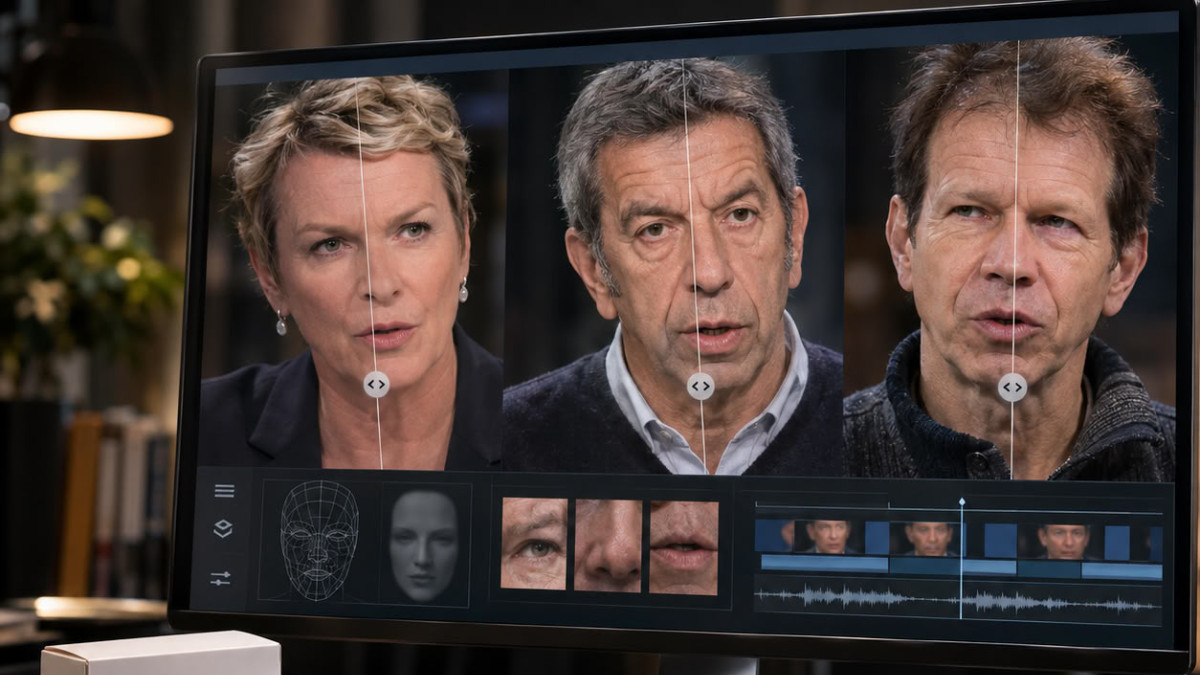

Fake videos, known as deepfakes, use artificial intelligence to make public figures say things they never said. Professor Renaud Piarroux, Michel Cymes, or Jean-Marc Jancovici have thus been digitally duplicated, sometimes to sell products they do not endorse.
- Deepfakes use artificial intelligence to make public figures say things they never said.
- Several personalities, including Renaud Piarroux, Michel Cymes, and Jean-Marc Jancovici, have been digitally duplicated.
- A deepfake only needs existing photos and videos of the target to reconstruct their image and voice.
- Europe requires AI-generated videos to be labeled, but many of them remain unidentified.
In a video posted online, Professor Renaud Piarroux presents the benefits of a medication for intestinal worms. However, the infectious disease specialist firmly denies it: ‘That is not me, it is done in a completely artificial way, I have never uttered those words.’ Several videos misuse his image, and for several weeks, he has been receiving emails from duped patients. ‘It muddies medical discourse, it muddies everything that requires a certain honesty, expertise,’ he laments.
Other public figures have suffered the same fate. The report cites actor Jamel Debbouze, doctor Michel Cymes, journalist Élise Lucet, presenter Marine Lorphelin and, more recently, energy and climate expert Jean-Marc Jancovici. A fake video was created to sell a medication, and a fake advertisement was made using the voice of one of them. In the case of Mr. Jancovici, who states he does not sell solar panels, the person concerned indicates that ‘on the phone, the voice was mine, except it was obviously not me.’
How is a deepfake made?
A deepfake relies on existing content. On the Internet, there are hundreds of photos and videos of the targeted personality, which the AI uses to reconstruct their image and voice. The system can thus model an avatar, some of which are particularly lifelike. The number of deepfakes posted online worldwide each year is estimated at 8 million.
To show how easy the technique is, Thomas Huchon, a journalist specializing in deepfakes, created his own AI avatar to fight disinformation. According to him, the result is obtained ‘in a few seconds’ and is ‘staggering.’ ‘These are extremely powerful, extremely effective tools, and if you put them in the wrong hands, if you put them in the hands of someone who wants to manipulate us, we enter another universe,’ he warns.
A Legal Framework and Its Limits
Europe requires platforms to label AI-generated videos, but a large portion of this content is not identified. In France, in cases of fraud or identity theft via deepfake, the law provides for one year of imprisonment and a 15,000 euro fine.
