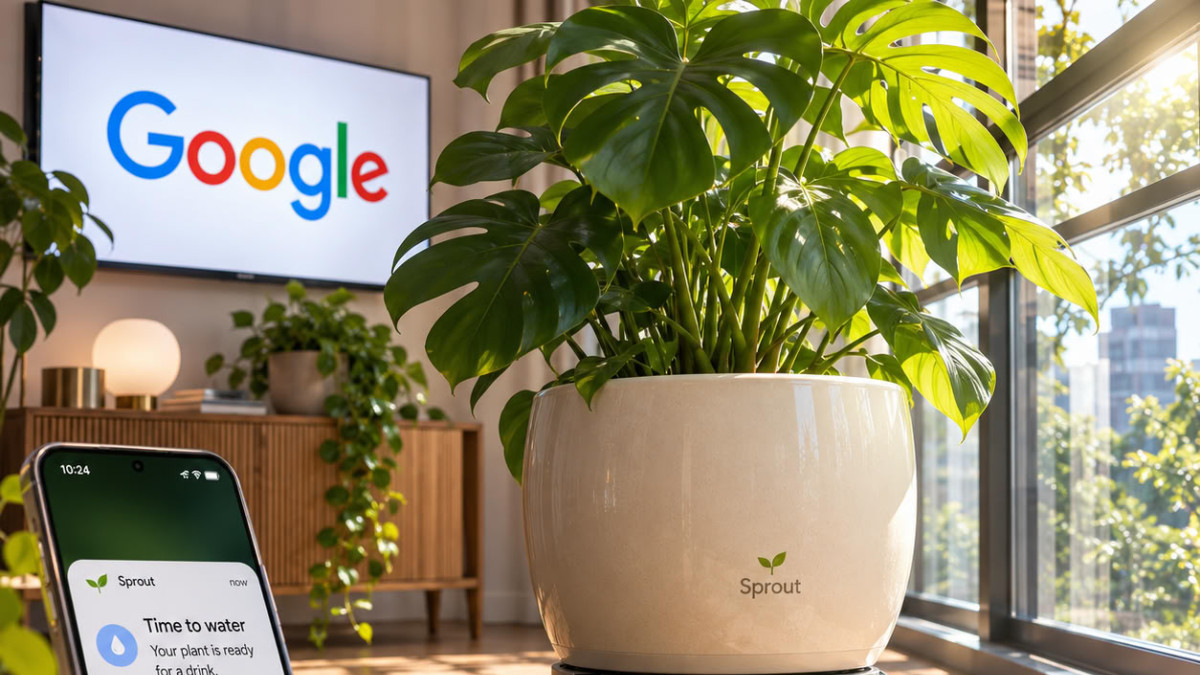

Google’s X account dedicated to developers has unveiled Sprout, a semi-autonomous plant pot powered by an AI. Capable of moving to find the light the plant needs, it also sends a notification when it’s thirsty. This project, which is not for sale, was designed to illustrate the company’s development tools.
- Google’s developer-focused X account unveiled Sprout, a semi-autonomous AI plant pot.
- Sprout moves toward light and alerts users when the plant needs water.
- This demonstration project is not for sale and showcases Google AI Studio and Antigravity.
- Built in two weeks through vibe coding, it shows how AI speeds up prototyping.
A robot vacuum under a pot
Sprout sits atop a TurtleBot 4 base, a small robotic platform that resembles a robot vacuum. Equipped with sensors, it allows the whole unit to locate itself and move around a space. On top, a 3D-printed chassis was designed using Nano Banana, Google’s image generator. A Pixel 11 serves as the robot’s eyes.
The associated software relies on the device’s cameras. According to Google’s presentation, Sprout can thus spot other plants around it and help determine if they need care.
A demonstration project
Google specifies that Sprout is not a product for sale. It serves to showcase the capabilities of Google AI Studio and Antigravity, the company’s AI-assisted development tools, whose principle is commonly referred to as vibe coding, meaning creating software by describing in plain language what you want to achieve.
In the video accompanying the announcement, the developers highlight the ‘speed that Gemini adds to a project’. According to them, the whole thing was designed in two weeks, within an AI-assisted workflow. The chassis, eyes, voice, and software were created in this context.
The device remains primarily a promotional experiment. It illustrates how AI tools can accelerate the creation of a hardware and software prototype, with no mention of any commercialization date.
