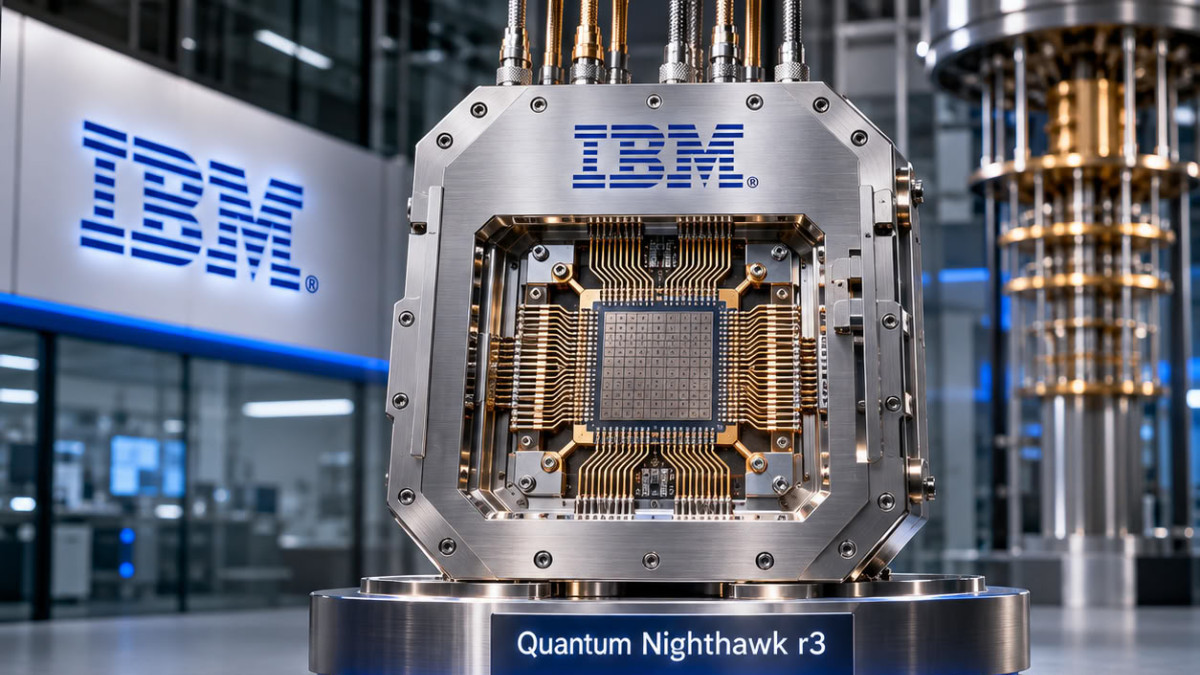

IBM has announced Nighthawk r3, its next superconducting quantum chip, designed to execute 10,000 operations accurately on 520 programmable qubits. The group plans to link two r3 chips into a 1,040-qubit system by 2027.
A qubit, or quantum bit, is the basic unit of a quantum computer. The Nighthawk family is based on a so-called square lattice architecture: most qubits are connected to four neighbors, compared to two or three in previous designs. According to IBM, this connectivity allows for more entanglement structures to be expressed with fewer swap operations.
The chip currently in production, Nighthawk r2, has 120 programmable qubits, 218 couplers, and 120 reset elements, totaling 458 physical elements. It is accessible via the IBM Quantum Platform, in the cloud.
A Faster Reset
According to IBM, the main limitation of previous processors was qubit reset. The method used on Heron, called conditional, measures the qubit and flips it if it is in the excited state. However, it cannot correct ‘leaky’ qubits, so the chip remains idle for several hundred microseconds between runs.
Nighthawk r2 replaces this approach with a dissipative reset device associated with each qubit. An adjustable coupler connects each qubit to a cold environment on demand. The effective relaxation time, noted T1, would thus drop from about 200 microseconds to about 25 nanoseconds, and the idle time between executions could fall to as low as 1 microsecond. IBM announces the following result: more than 100,000 circuits per second, compared to about 4,000 for Heron.
According to IBM, clients have already executed 34 billion circuits on Nighthawk r2. The gains reported by partners, which IBM presents as self-reported, reach up to 19 times the speed of previous processors. Energy provider E.ON cites a 15x gain in quantum machine learning for power grid optimization, and Oak Ridge National Laboratory a 12x gain on a simulation of magnetic materials. For Q-CTRL, a 60-qubit fermionic simulation saw its execution time drop from 4 minutes 25 seconds to 23 seconds.
Linking the Chips
The path to 1,040 qubits goes through l-couplers, interconnections between chips. IBM linked two Nighthawk r1 chips with four of these links, each using an 80 cm cable. The state transfer reportedly reaches up to 99.3%, with an average of 99%, while the stated target is 99.9%. IBM also indicates it has linked two cryogenic modules, reaching less than 15 millikelvins in under five days.
Nighthawk r3 retains the square lattice and fast operations of r2, with 2,034 physical qubits and ten l-couplers. However, it remains a design and not a delivered hardware. The 1,040-qubit system, meanwhile, is presented as a project for 2027.
