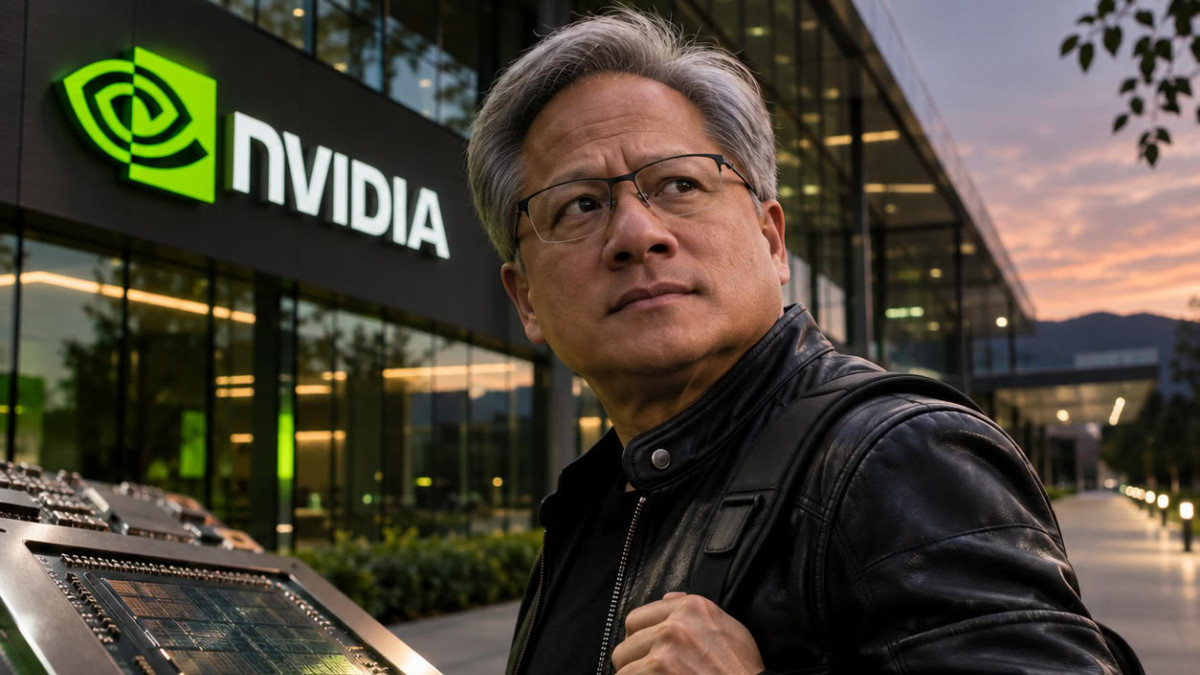

The departure of Jensen Huang, who had led Nvidia since its founding in 1993, has sparked numerous reactions in the artificial intelligence sector. Concerned about open models, advocates of these technologies are questioning the future, while the chip giant’s competitors see an opportunity to take its place.
The 63-year-old billionaire resigned after revelations about his relationships with two women, one a senior executive at his company and the other, a Chinese woman, suspected by U.S. intelligence of spying for China. A third extramarital relationship has since been revealed.
Just hours after his departure, participants at an AI conference held Thursday in San Francisco were already pitting his avatar against others in a video game. In Cerebral Combat, an arcade game designed by Weekend, a video game startup partnering with the event, players pitted Jensen Huang against Mark Zuckerberg, the head of Meta. They bypassed the avatars of Elon Musk, Jeff Bezos, Sam Altman (OpenAI), or Elizabeth Holmes, the fallen founder of blood-testing startup Theranos.
“We are very sad to see Jensen go,” said Asher Spector, co-founder of AI startup Flapping Airplanes, on stage. “That said, Nvidia has been an excellent partner,” he added, before stating that “we are very optimistic.”
A Key Supporter of Open Models
At the Cerebral Valley AI Summit, which brought together some 350 tech players in a small city museum, participants sketched out the post-Huang era. His departure worries advocates of open AI models, of which he was the main supporter. These models, which users can download and modify, contrast with those from OpenAI (ChatGPT) and Anthropic (Claude), which develop closed models, while Chinese companies dominate the open model sector.
Igor Babuschkin, co-founder of xAI, Elon Musk’s AI company, now heading the startup River AI, called Jensen Huang a “leader” for open models. According to him, his departure “creates a lot of uncertainty.”
Under Jensen Huang’s leadership, Nvidia also massively funded the sector, even guaranteeing $100 billion for an OpenAI data center. This practice raises fears of circular setups, where Nvidia finances its own customers, potentially fueling a tech bubble. “Will circular agreements be scrutinized more closely and confronted with reality? Very likely. But does that mean the party is over? I highly doubt it,” Emmanuel Vallod, partner at Hivemind Capital fund, wrote to AFP.
An Opening for Competitors
Other AI chip designers are trying to seize this opportunity. “It seemed almost unimaginable that Nvidia wouldn’t be the biggest player in a few years,” admitted Robert Wachen, co-founder of Etched, an AI computing startup. “But today, we see there is probably a fairly big opening,” he added.
Ali Ghodsi, head of the data platform Databricks, believes that “it’s a blow to pretty much all players in the sector, except direct competitors.” However, he asserts that “Jensen’s legacy will endure (…) for decades.”
On the stock market, Nvidia’s stock has fallen 13% since Monday and more than a quarter in a month, continuing a decline that began before the scandal. For a venture capital investor interviewed by AFP, a correction was already underway on overvalued tech stocks, and the affair only accelerated it.
Other tech groups, like Microsoft or Uber, have survived the departure of their leader. Ali Ghodsi notes that “a company’s culture is largely the personality of the CEO who stays in place for a long time,” and that much “depends on the identity of the next CEO.”
