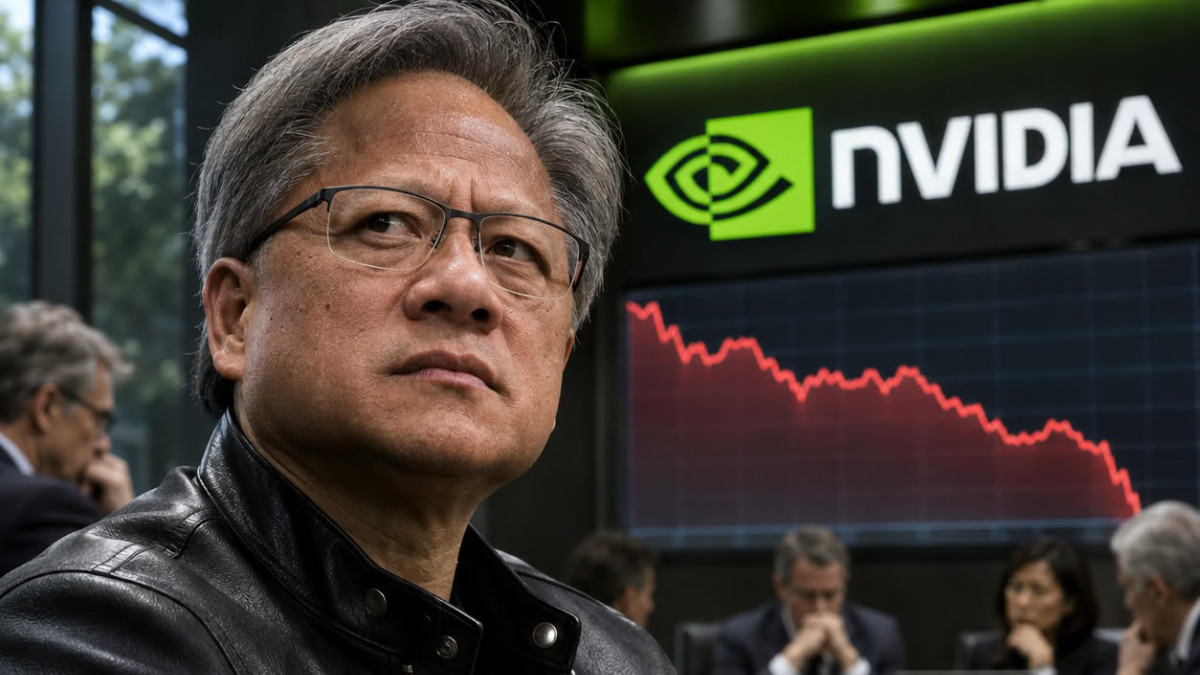

Nvidia’s board of directors met on Wednesday, November 11, 2026, to decide the future of Jensen Huang, its co-founder and CEO, according to the Wall Street Journal. The executive is under internal investigation after admitting to an extramarital affair with a woman suspected by U.S. authorities of spying for China. After market close, Nvidia’s stock fell more than 8%.
According to the Wall Street Journal, citing sources close to the matter, the board was preparing to remove Jensen Huang from his CEO position, a role he has held since the company’s founding in 1993. Reuters, which relayed the information, states it could not independently verify it. According to a source cited by the agency, the board was meeting late Wednesday evening. At the time of publication of this information, no decision had been announced and Nvidia had not commented.
An Internal Investigation at the Heart of the Matter
On Sunday, November 8, Jensen Huang admitted, in a message to employees, to being unfaithful to his wife. The relationship involved Alice Huang, a businesswoman whom U.S. intelligence agencies suspect of being linked to China’s Ministry of State Security and of facilitating deliveries of Nvidia chips to Chinese companies.
The same day, the board of directors announced the opening of an independent investigation into the possibility that the executive was the target of a foreign intelligence operation. A committee of independent directors, assisted by outside lawyers, is overseeing it. The board stated at the time that it had “no reason to believe” U.S. national security or company secrets had been compromised. Jensen Huang indicated he supports the investigation and intends to cooperate fully.
These suspicions constitute neither proof of espionage nor evidence of transmission of confidential information, the investigation being precisely tasked with establishing the facts. On November 11, the New York Times also reported that Jensen Huang allegedly had a relationship with Kimberly Powell, Nvidia’s vice president of health who reported to him. This information had not been confirmed by the company, and it raises questions about executive conduct rules, conflict of interest prevention, and the board’s responsibilities.
A Stock Drop of More Than 8%
Nvidia’s stock fell more than 8% in after-hours trading on Wednesday, November 11, to $159.51. According to CBS News, the group’s market capitalization had already lost over $450 billion since the investigation was announced. Business Insider also mentions stock pressure on CoreWeave, Micron, Supermicro, and TSMC, players in the Nvidia ecosystem, which manufactures the graphics processing units (GPUs) widely used to train and run artificial intelligence models.
The Question of Succession
A potential departure of the executive would immediately raise the question of his succession. “An immediate ouster of Mr. Huang could be difficult for Nvidia, as the company does not have a succession plan,” Gil Luria, an analyst at D.A. Davidson, told Reuters. According to Bloomberg, the board is working with an outside firm to identify possible replacements.
Nvidia holds a dominant position in the market for AI accelerators, and its decisions influence the investment strategies of hyperscalers, meaning the very large cloud providers, as well as server manufacturers. However, hardware roadmaps, commercial contracts, and engineering teams are not exclusively dependent on a single individual. The group’s quarterly results are expected on November 17.
