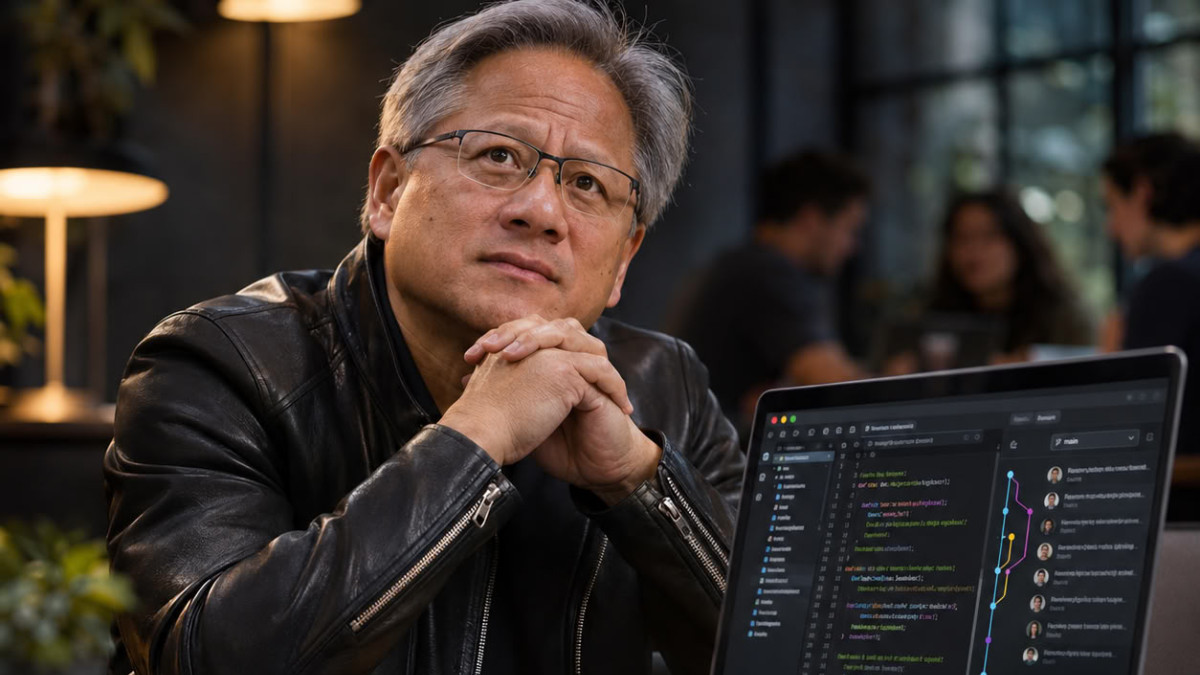

Jensen Huang, who just resigned, had become one of the most influential voices for open source AI advocates, referring to models that can be downloaded and run independently from big tech companies. However, work published online by former OpenAI researcher Will DePue, as well as a new rule from the U.S. Department of Commerce, could undermine both his credibility and that of the movement.
A movement seeking a new champion
Proponents of these models believe that concentrating AI in the hands of a few powerful companies would leave others worse off. This concern would not be out of place among left-leaning critics of the AI industry, except that many open source advocates are also venture capitalists, who benefit when startups can build on cheaper AI without paying tech giants.
Jensen Huang had established himself as the main spokesperson for this movement to policymakers, countering fears that these models have no safeguards and would cede AI leadership to China. Yet it is in that country that the most powerful and popular open source models are being developed. Today, his supporters want to see him return to his position.
But Jensen Huang’s extramarital affairs are not the only element threatening his credibility, and that of Nvidia, as a defender of open source. Recent research on Chinese startups using Nvidia chips, as well as the new U.S. rule, could deal a blow to the movement’s reputation as well as its technical progress.
Blackwell chips in China
On the Thursday of Jensen Huang’s departure, Will DePue published findings suggesting that Chinese AI companies had access to Nvidia’s advanced Blackwell chips far more widely than previously thought. However, China is denied access to Nvidia’s most cutting-edge chips, a restriction intended to protect the U.S. lead in AI.
It is unclear how these companies could have obtained these chips. According to DePue, the findings were verified by senior researchers at OpenAI and Anthropic, but no independent analysis has confirmed them at this stage. The author did not respond to an interview request, and Nvidia did not immediately react.
These findings do not establish that Nvidia helped Chinese companies obtain these chips, and the broader problem of chip smuggling was already known to be beyond Nvidia’s control. However, they suggest that the company may have benefited from the rise of Chinese startups, whose models are increasingly being used by U.S. companies instead of domestic alternatives. An awkward situation for Jensen Huang, who presented open source as a way to strengthen U.S. technological leadership. “Without open source, startups cannot thrive, university researchers cannot do research, you cannot teach AI, scientists cannot use AI, ” he said in December during remarks on the U.S. winning the AI race against China.
The scenario of a Jensen Huang comeback now appears even more unlikely. U.S. Treasury Secretary Scott Bessent stated shortly before that Nvidia should not consider replacing him with someone from within the company. The new findings further reduce his chances.
