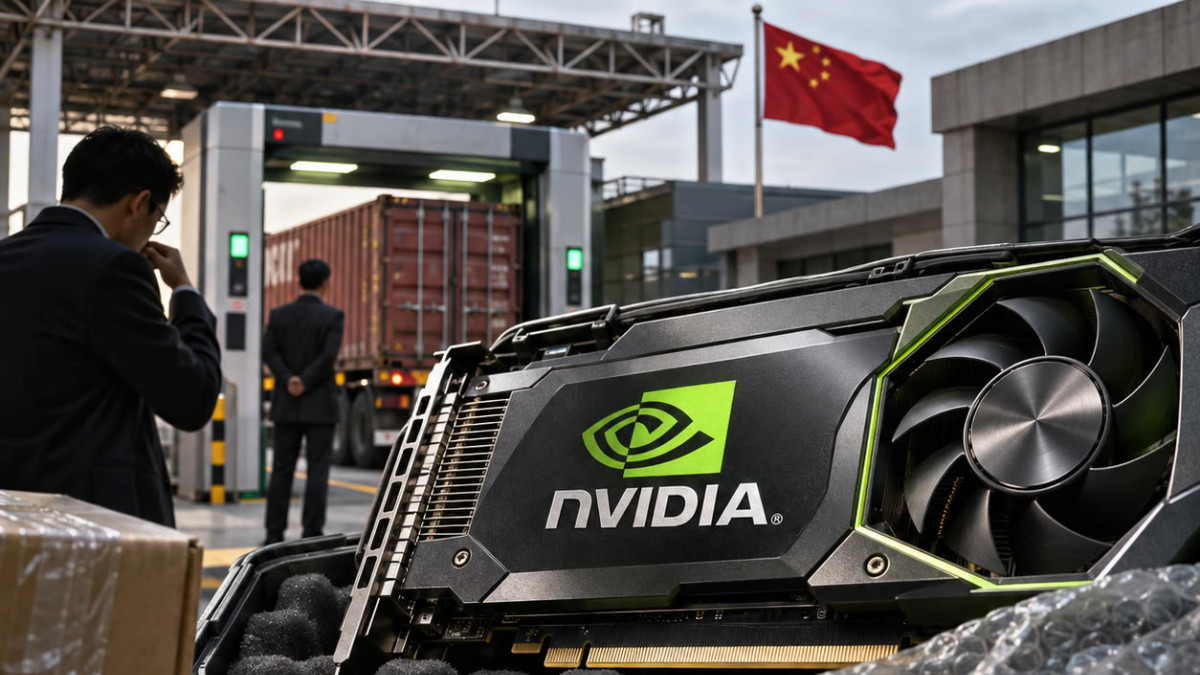

China is managing to procure Nvidia chips, despite strict U.S. export controls that remain in place even after some easing. These components are at the heart of the artificial intelligence race, and the way Beijing obtains them raises questions, as Nvidia CEO Jensen Huang is suspected of having been spied on by China through an extramarital affair.
Nvidia designs graphics processing units, or GPUs. Initially created for 3D graphics in video games, these components can process very large volumes of data simultaneously thanks to thousands of computing cores. They contributed to the new explosion of AI starting in 2012, with the AlexNet architecture, and are now used to train and run AI tools. Since the launch of ChatGPT in 2022, orders have surged and Nvidia’s market capitalization has reached $4.5 trillion, making it, according to the source, one of the two most valuable companies in the world, tied with Apple.
Still Strict Restrictions
Washington bans the export to China of the cutting-edge ‘Blackwell’ and ‘Rubin’ processors for security reasons, as the most advanced AI tools could be used for military purposes. Jensen Huang has lobbied the U.S. government to allow the sale of Nvidia’s cutting-edge chips to China, arguing that these restrictions are fostering the rise of Chinese alternatives. He told the BBC: ‘President Trump is very clear: he wants America to win, and President Xi wants China to win. And it is entirely possible that both will succeed. The reason is simple: it’s not a zero-sum game. The progress of human society is not a zero-sum game.’
In 2026, Washington eased the rules for the H200, a less powerful chip. The United States imposes a 25% levy on sales and has set conditions that make deliveries difficult. For its part, Beijing is reluctant to import these chips, as China has launched a major semiconductor development plan and can rely on players like Huawei or CXMT, specialized in memory.
Workarounds
Chinese startups, such as Moonshot AI, Z.ai, and DeepSeek, offer high-performance AI models. According to Lian Jye Su, principal analyst at Omdia, ‘Chinese providers continue to use Nvidia’s cutting-edge chips to train their models.’ Companies can rent computing power in data centers equipped with Nvidia chips located in another country, often in Southeast Asia. This is the business of Megaspeed, the company run by Jensen Huang’s mistress, which is also the subject of a lawsuit by Nvidia shareholders.
Stephen Wu, founder of the investment fund Carthage Capital, explains that processors that are perfectly legal in Malaysia can be used by a client located in China. ‘U.S. export restrictions are about where a chip is shipped to, not who uses it,’ he sums up to AFP. Michael Kratsios, a White House advisor, claimed that Moonshot AI had access to high-end Nvidia chips in Thailand. The specialized site The Information also reported that in 2025, DeepSeek developed a new model using thousands of chips disassembled abroad and brought into China. Nvidia told the site it had no evidence of such an operation, which it considers ‘implausible.’
Chinese Chips Are Progressing
For Poe Zhao, founder of the analysis publication Hello China Tech, ‘Nvidia chips continue to facilitate and speed up the tasks of cutting-edge AI tools, but they are no longer the only option.’ Nvidia’s main Chinese competitor remains Huawei, which still lags behind the American company. However, Lian Jye Su warns that ‘chips made in China are improving rapidly.’ Huawei announced in September that its next-generation AI chip would be ready in the first quarter of 2027, three quarters earlier than expected.
Cost remains an open question, as, according to Poe Zhao, ‘training with Chinese chips generally takes longer and requires more engineering work.’ Stephen Wu observes that companies in the sector pay for this choice in power and costs, ‘which they can afford because Chinese electricity is cheap and the chips are subsidized by the state.’
