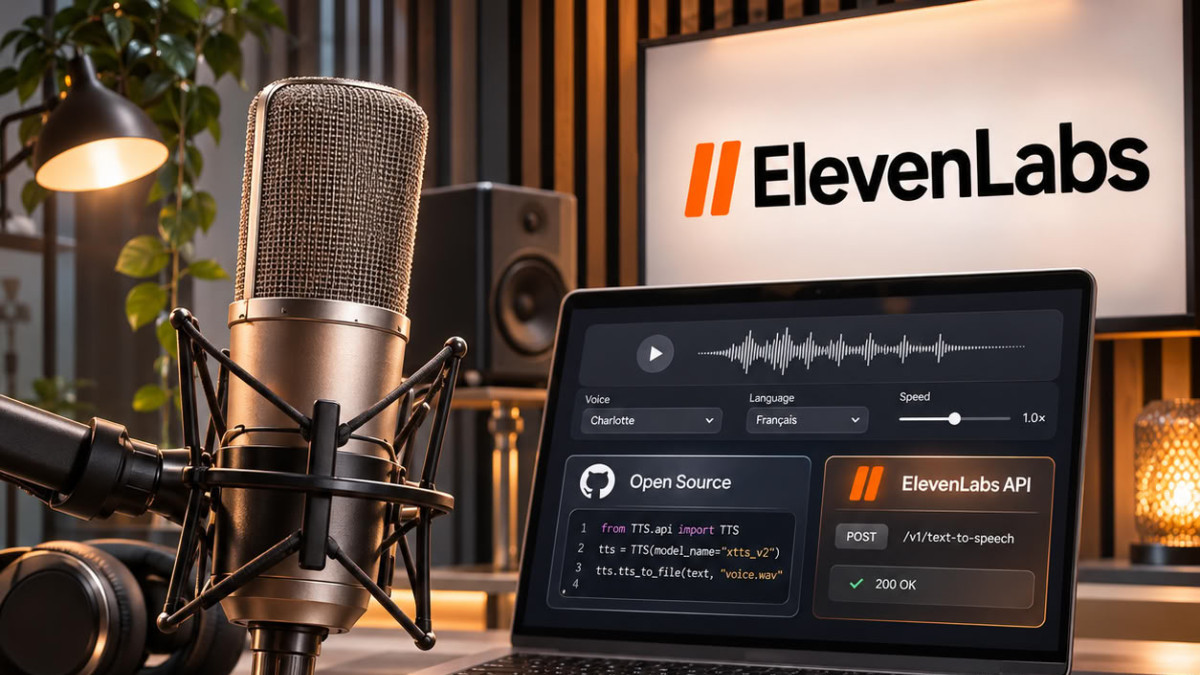

Open source text-to-speech (TTS) solutions and paid APIs are not inherently better than one another. According to an article published by ElevenLabs on its blog, each serves different use cases and business needs. Paid APIs incur regular costs, either subscription-based or tied to workload volume, while open source models shift expenses towards the infrastructure and engineering time required for their maintenance.
Two Approaches Depending on Needs
The choice mainly depends on team size and workload volume. According to the text, open source and self-hosting offer broader control over the entire technical stack. You don’t pay per character processed, but you pay for computation, powered by graphics processing units (GPUs), as well as the personnel managing this infrastructure.
Self-hosting also allows keeping texts and audio files locally, without transit over the public internet. According to the article, this argument can be decisive, or even required, in sectors such as healthcare, finance, or government. Conversely, a managed API offers a turnkey solution, with preconfigured infrastructure, service level agreements (SLAs), and access via REST or WebSocket. It also provides access to the latest models, with a large number of parameters, which can produce a natural prosody, meaning a rhythm and intonation close to human voice. The trade-off remains per-character pricing.
Data, Licenses, and Costs
According to the article, ElevenAPI stores customer data in the United States by default. Enterprise clients can obtain isolated environments in the European Union, India, and Singapore, each with its own workspace, URL, account, and API key. However, this setting only applies to storage: processing may still occur outside the region, notably via subcontractors. The Zero Retention Mode deletes eligible request inputs and outputs as soon as each request ends, for API traffic only.
Licenses also deserve attention. So-called ‘open weight’ models make their parameters downloadable, but not their source code or data preparation steps. A true open source model includes all elements, under an open license. According to the article, some licenses prohibit commercial use, others reserve it for research, and others require citing the model in marketed products.
Finally, free models are not free to run. For reasons of confidentiality, security, version control, or latency, some organizations still choose self-hosting. Freemium offerings typically include character quotas or monthly credits, and often reserve high-end models for paid subscriptions. The article describes this free tier as a marketing channel.
How to Evaluate a Model
The article recommends testing models with real texts from your own domain rather than with samples provided by vendors. It suggests measuring the time to first audio (TTFA), handling of loanwords, foreign languages, and rare pronunciations, as well as maintaining throughput under heavy load. The total cost should include hosting, bandwidth, price per minute or per character, and developer time. To compare open local models, the article points to the Hugging Face leaderboard.
