
Quantum Elements, a young company founded three years ago and known for its digital twins of quantum computers, participated in research showing that a type of error correction can be implemented on a processor whose architecture does not match its structure. The work, conducted with researchers from the University of Southern California, was published in the journal Nature.
The core of the study focuses on the surface code, an error-correcting code organized in a two-dimensional grid and considered one of the most concrete paths toward large-scale fault-tolerant quantum computers. The researchers showed it could run on a quantum processor (QPU) that does not share a similar layout. According to Quantum Elements executives, running this hybrid code on QPUs gives engineers more latitude in machine design, which is no longer constrained to match the physical layout of a chip.
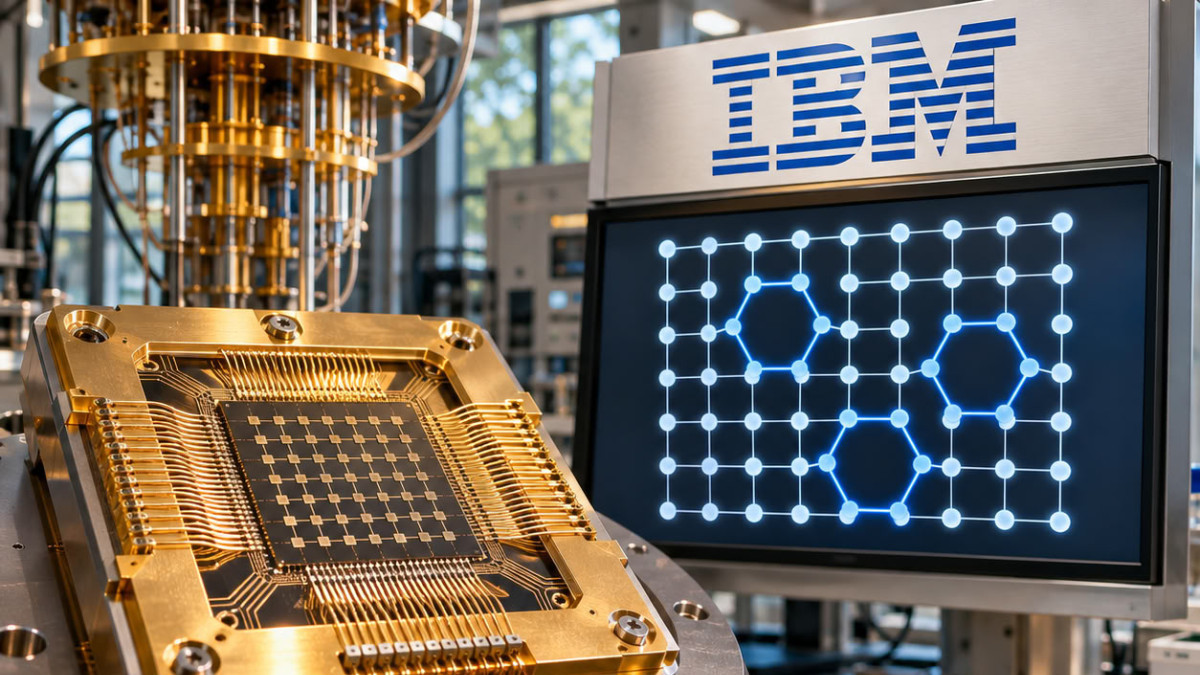
The experiments used IBM’s Heron processor, first introduced in 2023 and offered in 133- and 156-qubit configurations. This processor powers the IBM System 2 systems and modernized System One systems. Its architecture, called heavy-hex, is based on a honeycomb-like hexagonal qubit lattice that limits tight connections to reduce collisions between neighboring qubits.
Constraints to Overcome
Adapting the surface code to this architecture posed several difficulties. The reduced connectivity between the two structures can lead to delays in state transfer between non-neighboring qubits. During these ‘dead times,’ qubits are exposed to noise, which can cause them to lose their quantum properties, so the error count can increase as the code scales. Mapping the surface code to IBM’s architecture also requires more routing, another obstacle.
The researchers adopted several choices to compensate for these discrepancies. They first used a so-called ‘depth-efficient’ error-correcting code, which reduces the number of sequential layers of gates and measurements. They then applied dynamic decoupling, which protects qubits from noise, via Quantum Elements’ Orbit function, using an embedding based on SWAP gates, which exchange the quantum states of two qubits, to map logical qubits to physical hardware. These choices led to ‘directional subthreshold scaling,’ a key step in error correction that increases the code size in a given direction and reduces the corresponding error type.
Orbit, an error suppression tool introduced in July, is available from IBM’s Qiskit function catalog. In its presentation of the tool, Quantum Elements stated it allows researchers and corporate teams to improve the performance of their quantum circuits without requiring deep specialization.
IBM announced five years ago that the heavy-hex architecture would be the base topology for all its quantum devices. In a detailed report, its researchers wrote that ‘the connectivity of other lattices, such as the square lattice, can be simulated on the heavy-hex lattice with constant overhead.’ The authors of the study published in Nature themselves note that applying the surface code to other fixed-connectivity processors remains ‘a problem of fundamental interest and practical importance.’
