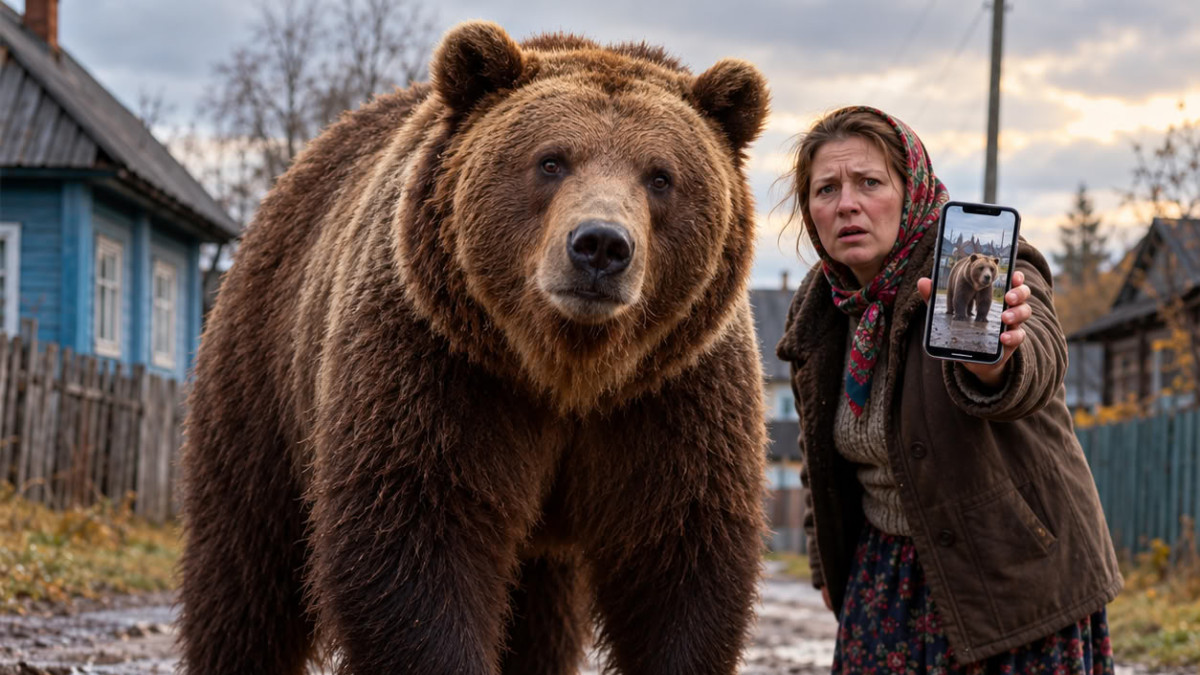

A resident of Magdagachi, a village in Russia’s Far East, was fined 15 000 roubles, about 150 euros, for publishing a doctored photograph showing a brown bear in the middle of a street. Intended as a simple joke sent to a friend, the image spread on social media until it prompted authorities to intervene.
- A Russian woman was fined 15,000 roubles for posting an AI-altered photo of a brown bear on a village street.
- The joke spread on social media, and authorities sent wildlife specialists to find the animal.
- In Maryland, a woman paid $1,000 to settle charges after faking an intruder photo to scare her husband.
- In France, such a hoax could bring up to two years in prison and a €30,000 fine.
The village is located in the Amur region, not far from the Chinese border. Russia is home to several hundred thousand brown bears. According to data reported by Reuters, their population has more than doubled in about thirty years, reaching roughly 308 000 individuals. Encounters with residents can be dangerous, and fatal attacks have been recorded.
In this context, the photograph of a bear circulating on residents’ phones sparked concern. Some alerted the authorities, who took the reports seriously and mobilised wildlife specialists to locate the animal. However, this bear did not exist.
An image that eludes its creator
At the root of this false alert, a resident had photographed a street in Magdagachi, then used ChatGPT to add a gigantic brown bear. Realistic enough to fool residents, the result quickly got out of her control. The image was passed on to others, then spread on social media. A private joke thus turned into a local alert.
The woman eventually admitted to the police that she was behind the photomontage. On October 13, a Russian court fined her for publishing false information that prompted authorities to intervene. This ruling is not an isolated case in Russia: in September, another resident of the Russian Far East was sanctioned for spreading a fake bear photograph. She had been fined 30 000 roubles, about 300 euros.
Similar cases abroad and in France
In the United States, in Maryland, a woman also used artificial intelligence for a hoax. She convinced her husband that an unknown person had entered their home by sending him a photograph showing a man lying on their couch under a blanket. The intruder had been added to the image using artificial intelligence. Worried for his wife’s safety, the husband called emergency services. Eight police cars were dispatched to the scene before officers discovered the ruse.
The woman was prosecuted for this false alert. In August 2026, she agreed to pay $1,000 to the police as part of a settlement that included dropping the charges. According to the source, it was therefore not a criminal conviction.
In France, creating a photograph using artificial intelligence is not, in itself, an offence. Legal consequences depend on the nature of the image, its use, and the circumstances of its dissemination. However, article 322-14 of the Penal Code provides for up to two years’ imprisonment and a €30,000 fine for communicating or disseminating false information that leads people to believe a disaster has occurred and could trigger an unnecessary emergency response.
These cases recall the fable attributed to Aesop, “The Boy Who Cried Wolf”. By repeatedly issuing false alerts for fun, a young shepherd eventually is not believed when danger truly arises.
