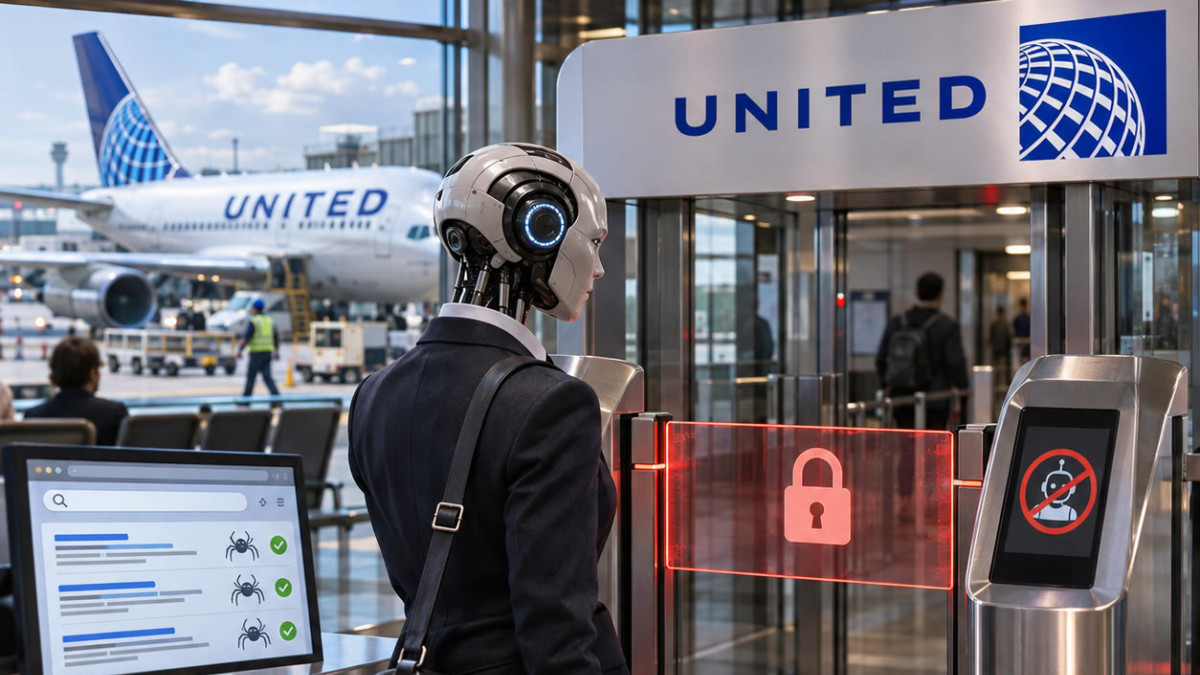

United Airlines now prohibits, in its website terms of use, any artificial intelligence agent from searching, booking, or purchasing tickets on united.com or its application without the company’s written authorization. Search engines, however, may continue to index the site’s public pages. These changes, dated November 11, accompany an update to the airline’s contract of carriage.
According to the airline’s announcement, the measures aim to limit unauthorized third-party agents on its own platforms, as well as in travel agencies and booking sites. United states that sharing login credentials with a third-party AI assistant can expose customers’ sensitive information. The release also mentions risks of ‘unintentional purchases, account modifications, or use of MileagePlus miles.’ It adds that automated actions could violate Federal Aviation Administration (FAA) and Department of Transportation (DOT) regulations. It gives the example of check-in, which requires a passenger to personally confirm that their luggage does not contain any prohibited items, such as explosives.
What the Terms of Use Provide
The website terms of use define an ‘automated agent’ as any software, service, or feature that, with full or partial autonomy, searches, books, purchases, or manages items on United’s website or application, or extracts or copies data from them. This includes AI assistants, robots, scraping tools, browser extensions, and functions integrated into browsers or applications, even when a person supervises or approves their actions. United reserves the right to block or hinder an automated agent at any time, regardless of its operator, be it the user, a third party, or an AI company.
The terms also prohibit using fares, schedules, availability, or prices from the site to ‘train, refine, anchor, evaluate, or otherwise develop’ an AI model. Anchoring, which involves an AI system retrieving external content to build its response, is explicitly listed. Search engines indexing united.com’s public pages are exempt, as are assistive technologies and standard browsers used by a person. Built-in browser agent functions are not exempt. The terms also do not specify the treatment for responses generated by AI systems from search engine indexes.
Travel Agencies Targeted
The contract of carriage introduces the term ‘AI Agent,’ which refers to any software used on behalf of a traveler to search, book, purchase, or manage a United offering, whether a person monitors the activity or not. It notably cites assistants integrated into social networks, messaging services, or search engines, as well as third-party assistants connected to United through an agency or other intermediary. Rule 6.J.6 classifies the use of AI agents to ‘create, modify, or manage a ticket’ among prohibited practices, alongside hidden-city and throwaway ticketing. Rule 5.H provides that United may cancel without notice reservations made, modified, or managed by AI agents.
According to the FAQ from the company’s Digital Trust Center, travel agencies and booking platforms may not use third-party AI agents to search, book, or manage United travel on behalf of their clients. They must also obtain United’s agreement before using their own third-party AI tools. According to the FAQ, United is not yet working with third-party AI agents, and bookings made by agents before November 11 will not be canceled.
Asked at an event in Chicago, reported by the Wall Street Journal, CEO Scott Kirby stated: ‘I don’t want to create another intermediary.’ According to the source, United indicates it will continue to monitor how AI assistants interact with its services and will update its FAQ if it begins working with third-party agents. However, the release, FAQ, terms, and contract do not specify how the company detects an agent.
