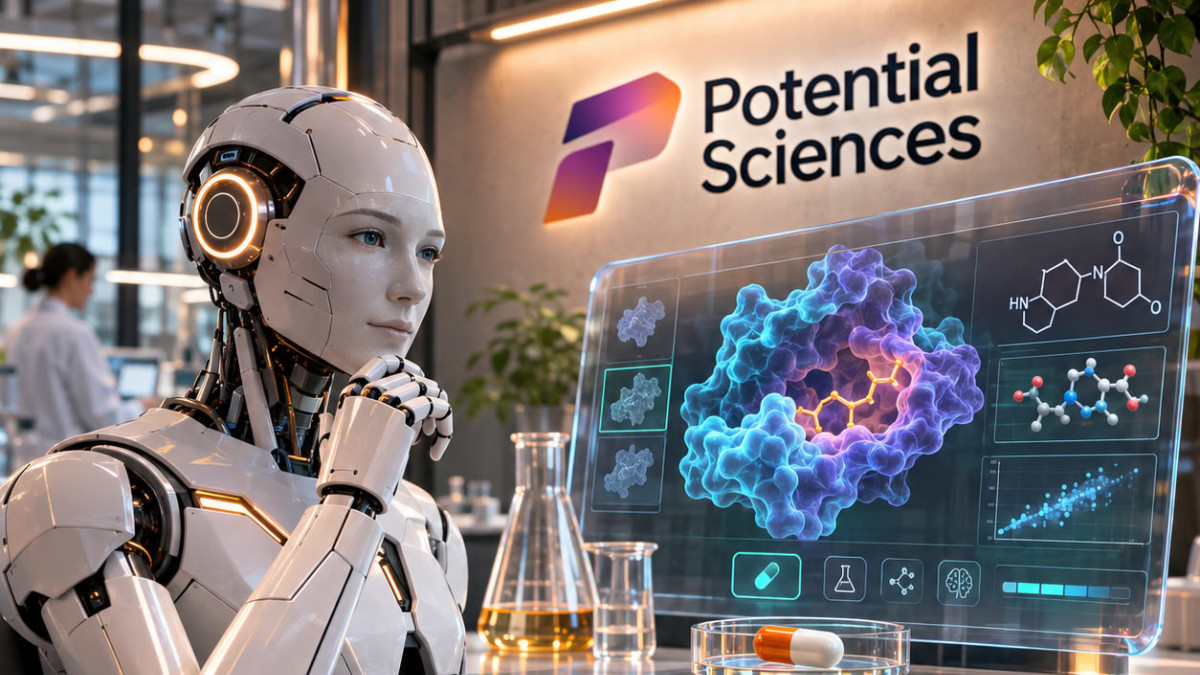

British startup Potential Sciences wants to use artificial intelligence to accelerate drug design, a slow and fickle process. Launched on November 5, it aims to bypass a significant portion of costly, lengthy lab experiments to identify molecules suited to specific diseases.
- Potential Sciences uses AI to speed up drug design by simulating molecules instead of testing them in labs.
- Its models rely on physics-based chemical databases to predict how molecules will behave.
- The startup has raised seed funding of several tens of millions of dollars, without disclosing the exact amount.
- Experts remain skeptical, because the accuracy of these predictions has yet to be proven.
Simulate Rather Than Experiment
The principle relies on simulation. Potential Sciences plans to build large chemical databases based on the fundamental principles of physics, first to model interactions between atoms, then between small molecules, then between complex amino acids and proteins. This data would be used to train AI models and prediction systems—software capable of estimating a molecule’s behavior before testing it.
The company’s founder and CEO, Hatem Helal, explains his goal to WIRED: “We want molecules that will never work in the clinic to fail fast.” He adds that this requires “better tools for predicting how they will behave when they interact with human biology.”
Funding Without a Precise Amount
The startup, launched on November 5, says it has raised seed funding on the order of several tens of millions of dollars from SovAI, the UK government’s AI-focused venture capital fund, and Twin Path Ventures, among other investors. The founders declined to disclose the exact amount or the company’s valuation.
According to Hatem Helal, a reduction in the cost of experiments could also make it profitable for pharmaceutical labs to develop treatments for rare diseases, which have largely been neglected until now. “We want to make more personalized treatments for diseases possible, this idea that drugs could be unique molecular combinations tailored to each person’s own human biology,” he says.
Promises Yet to Be Verified
A central question remains: Will Potential Sciences manage to predict with the hoped-for accuracy how drug candidates bind to disease-related proteins? Such an advance would require significant progress. Peter Wolynes, a chemistry professor at Rice University, says he is “sure it will be an improvement.” However, he believes that for protein design, “the engineering is at the level of the Romans, not the Renaissance.”
Several figures in the field advocate a different vision. Demis Hassabis, Nobel Prize winner in chemistry for his work at Google DeepMind, has long maintained that advances in AI would ultimately lead to major scientific breakthroughs, similar to what the technology has recently begun to produce in mathematics. Young startups like Potential Sciences hope that drug discovery will be one of the first scientific fields transformed by this technology.
