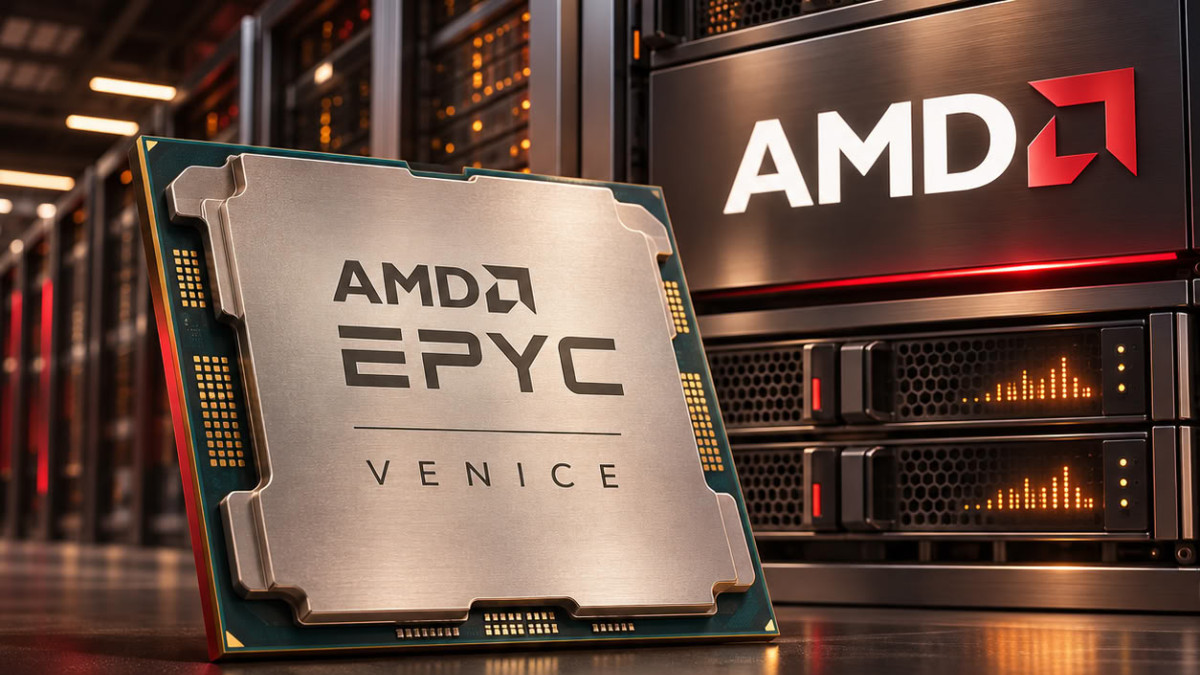

AMD details its sixth-generation Epyc server processors, codenamed ‘Venice,’ which it presents as suited for agentic AI workloads. According to the company, these chips offer 1.9 times the throughput of the previous-generation Epyc 9005 ‘Turin’ processors.
This announcement comes as agentic AI, where a system chains steps to achieve a goal, is expected to grow rapidly. Some analyst firms forecast growth of nearly 43% per year until 2034. According to the text, this evolution is also changing data center infrastructure. The successive waves of generative AI have benefited GPU makers, including Nvidia, but the needs of agents differ from those of chatbots: central processing units (CPUs) play a more significant role, orchestrating tasks, applying security rules, and executing code generated by models.
The ratio of GPUs to CPUs in data centers currently ranges between 1:4 and 1:8. Expectations cited in the source anticipate a 1:1 ratio with the rise of agentic AI. Dan McNamara, senior vice president and general manager of enterprise compute and AI at AMD, explained in a blog post published in May that ‘the shape of the workload is changing entirely.’ ‘Instead of responding to a single query, an agent breaks a goal into steps, decides what’s next, calls multiple models, queries databases, connects to APIs, runs business applications, checks permissions, retrieves memory, validates results, and then repeats the process,’ he wrote.
Mike Clark, Corporate Fellow, senior vice president, and chief architect of Zen at AMD, emphasized that the company had not anticipated the scale agentic AI would take. ‘We always believed the Core Complex Die would play a critical role in AI,’ he said, recalling the investment made with Zen 5 and continued with Zen 6.
Madhu Rangarajan, corporate vice president of enterprise compute and AI products, presented the lineup as the culmination of an evolution that began with the first-generation ‘Naples’ in 2018. According to him, AMD now has ‘a portfolio ready for the agentic AI era,’ with over 1,000 instances.
On the technical side, AMD indicates that the frequency increases from 5.0 GHz to 5.3 GHz, memory bandwidth evolves from 12 channels of DDR5 at 614 GB/s to 16 channels at 1.6 TB/s, and input-output bandwidth doubles with the move from PCI-Express Gen 5 to Gen 6. According to the company, the 256-core chip consuming 400 watts offers 3.3 times more agents per watt than Nvidia’s Vera, 1.8 times more agents per dollar than Intel’s sixth-generation Xeons, and 1.5 times more agents per Helion AI rack than a Vera rack. These figures come from AMD and have not been independently verified.
Madhu Rangarajan also emphasized ephemeral tools, short-lived and isolated execution environments created during an agent session and then automatically destroyed. ‘There is no well-defined benchmark for this,’ he stated, adding that AMD had selected a few representative workloads, including document parsing and compilation. The Verano and Venice-X models are expected next year.
