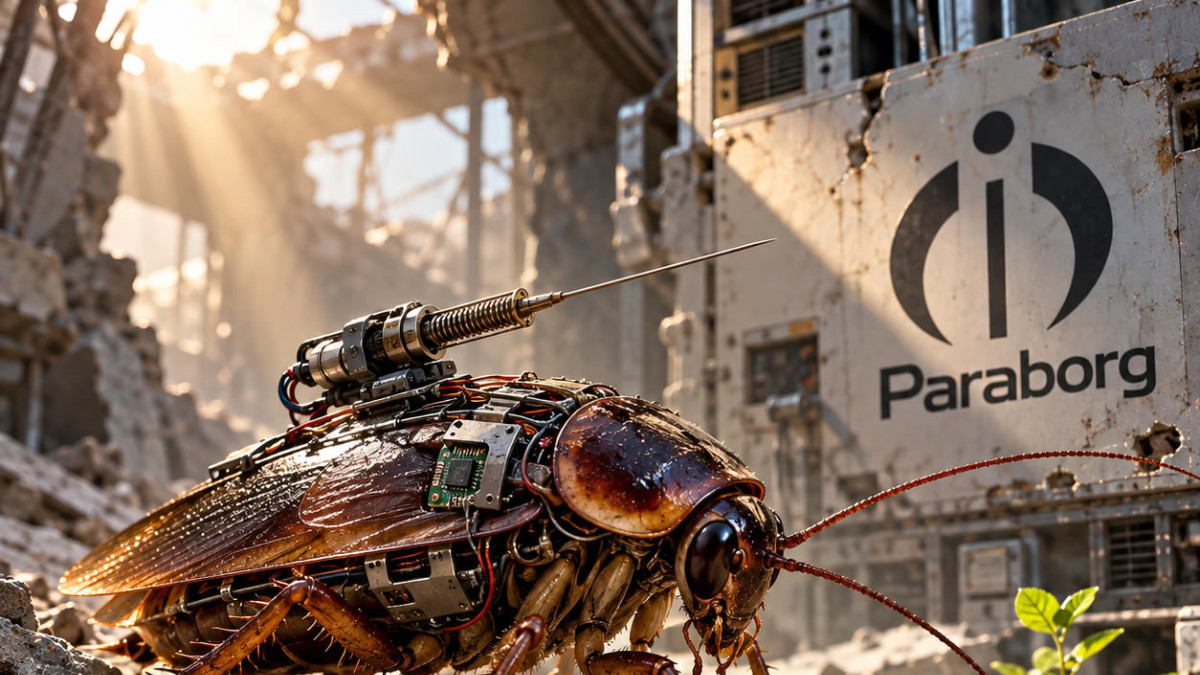

Imagine being trapped under rubble after an earthquake and seeing a cockroach covered in electronic components, carrying a spring-loaded needle on its back, approach. This prototype of a “cyborg paramedic, ” dubbed “Paraborg, ” could one day provide vital aid to victims that rescue teams would struggle to reach. Its designers from the University of Queensland, Australia, described the results in the journal Advanced Science.
- Researchers at the University of Queensland developed Paraborg cyborg cockroaches to help trapped earthquake victims.
- Electrodes let operators steer the giant cockroaches remotely.
- Some cockroaches carry cameras, while others carry injectors that deliver medication.
- In trials, the cyborgs completed every course but injected targets successfully only 72% of the time.
An insect that already knows how to move
For decades, scientists have sought to develop cyborg insects, meaning insects modified by an electronic interface. For T. Thang Vo-Doan, head of the Biorobotics Lab at the University of Queensland in Brisbane, these insects offer “a shortcut to bypass some of the most challenging problems in robotics.” Building an insect-sized robot capable of “reliably moving through rubble, navigating uneven surfaces, getting up after a fall, carrying its own energy, and still having room for useful sensors” remains, in his view, “extraordinarily difficult.”
Rather than mechanically reproducing every part of an insect’s body, researchers can therefore graft an electronic interface onto an animal that already possesses these capabilities. Previous work has shown it is possible to steer beetles and moths, but these mainly served as passive sensor platforms.
In 2023, Vo-Doan and his colleague Thanh Nho Do discussed cyborg insects for search and rescue just before the IEEE International Conference on Robotics and Automation (ICRA). They then asked themselves a question: “What happens after an insect finds a trapped victim?” Could it go beyond simple location and provide some form of assistance while rescuers try to reach them?
Giant cockroaches in the service of rescue
To answer this question, the researchers worked with giant burrowing cockroaches (Macropanesthia rhinoceros), native to Australia. They needed an insect capable of carrying a significant load, more than half its weight. Weighing around 40 grams, this species is the heaviest cockroach in the world, and its size facilitates the attachment of interfaces.
The cockroaches were fitted with lightweight electronics, including electrodes implanted in their antennae and in small tail-like appendages called cerci. Wirelessly activated using a video game controller, these electrodes allow the insect to be turned left or right, made to move forward, or stopped.
Some insects carried a wireless camera, others a remote-controlled injector. A spring propels a syringe filled with medication toward a nearby target. A chemical reaction in the syringe then generates a burst of carbon dioxide, whose pressure pushes the contents into the target. The Paraborgs are designed to work as a team, some carrying a camera, others an injector loaded with potentially life-saving drugs.
The scientists chose not to combine a camera and an injector on the same cockroach, as the weight and bulk could have hindered its mobility on complex terrain. This dual electronics would also have increased energy consumption, reducing operating time. They therefore envision a swarm approach, with specialized cyborgs in complementary roles.
During feasibility trials, the Paraborgs successfully traveled 2.5 meters, passing three checkpoints, before firing their needles at an 8 by 10 centimeter silicone target. Out of 25 trials, the cockroaches completed the course every time and succeeded in the injection in 72% of cases.
Many practical challenges remain
Vo-Doan and his colleagues now want to solve several practical problems: compensating for victims’ movements, establishing reliable wireless communications inside collapsed structures, and guiding the cyborgs as they navigate environments filled with rubble and dust. Autonomy will become, in his view, increasingly important, especially if researchers want to control multiple cyborgs at the same time.
The researcher points out that these insects remain living beings. “We don’t steer them like conventional wheeled robots, ” he explains. “Electrical stimulation influences their direction, but the insect still generates and controls much of its own locomotion.” To compensate for these uncertainties, the Paraborgs will need more powerful onboard systems, capable of determining their position and monitoring their actions.
Vo-Doan also wants to put the scope of this work into perspective: “We are not suggesting this is a medical device ready for use on people today.” The choice of medications and dosages, sterility, needle safety, reliability, and regulation all remain open questions.
