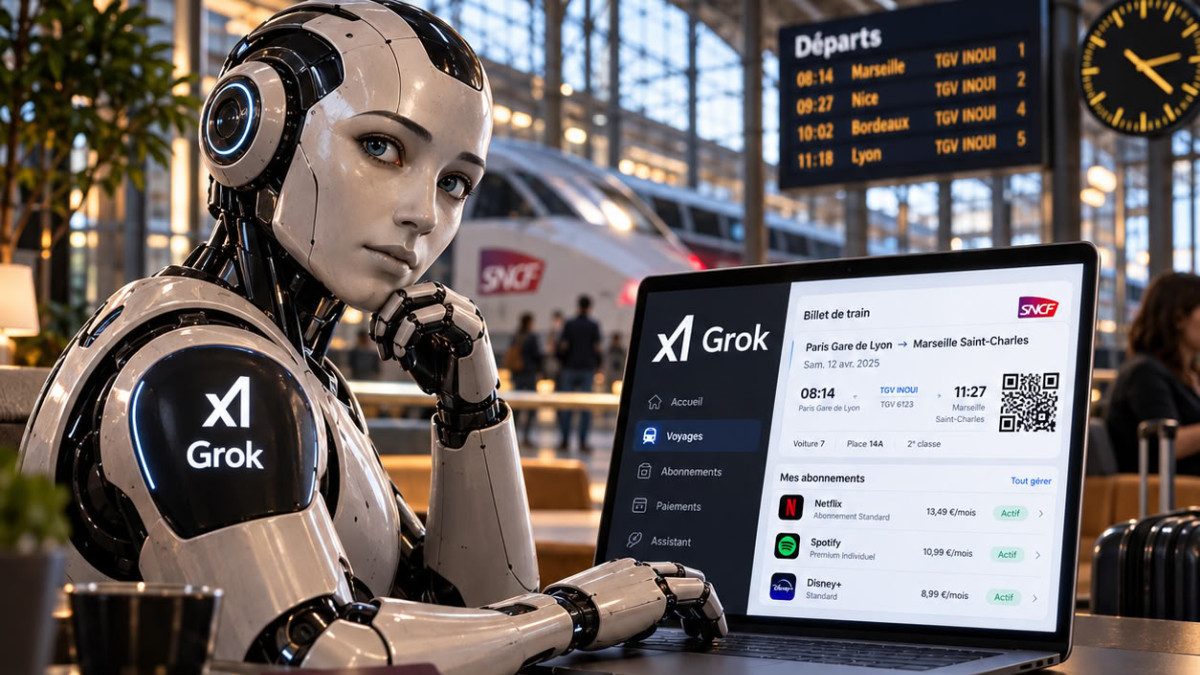

SpaceXAI launched Grok Bot in August, an agent that reserves, purchases, and subscribes on behalf of the user, only handing back control for sensitive steps. Tested on three everyday tasks, it successfully completed two of them, but encountered obstacles and displayed a password in plain text.
- Grok Bot agit seul pour l’utilisateur et s’arrête uniquement pour les étapes sensibles.
- Il réussit deux tâches sur trois, malgré plusieurs obstacles.
- Il affiche un mot de passe en clair dans la conversation.
- L’accès coûte entre 30 et 200 dollars par mois selon l’usage.
An Agent with Its Own Machine
Grok Bot relies on a main agent with its own virtual machine in the cloud, equipped with a dedicated browser. It can summon sub-agents assigned to a specific mission and be connected to dozens of third-party connectors, like Google Drive, Notion, Gmail, or 1Password. Everything is orchestrated by Grok 4.7, the company’s latest model, specifically trained on the agent’s harness, meaning the software environment that frames the model and provides its tools. According to leading industry analysts, it is primarily the teams from Cursor, acquired by SpaceXAI and finalized in August, that developed this harness.
The tool comes as an application for PC and Mac, complemented by a mobile app, and remains accessible on Grok.com with a more minimalist interface. Since tasks run in a cloud-hosted virtual machine, they continue to run even with the computer turned off. As of October 12, Grok Bot is included in The X Subscription, which bundles Grok, Cursor, and X Premium. Three tiers provide access to the agent: Premium, at $30 per month, offers “reasonable but limited” access; Super, at $100 per month, provides 3.5 times more usage than Premium; Ultra, at $200 per month, offers 12 times more.
Three Tasks Tested
For the train, the request was to book a round trip between Avignon TGV and Marne-la-Vallée–Chessy at the lowest fare, comparing Nîmes. The agent performed searches on SNCF Connect, proposed a checkout on the Ouigo website, filled out the forms, then handed back control for payment. It correctly compared fares as requested before selecting Avignon TGV. The appointment at a veterinary clinic in Val d’Europe, however, encountered a login issue with the online appointment manager Pilepoils. The agent handed over control to log in, then found available slots and finalized the chosen one.
Changing mobile operators, from Bouygues to Sosh, required more steps. The agent first requested all necessary information at once, then filled out the subscription forms, before stopping for two operations: transmitting the RIO, the code that allows keeping one’s phone number, and the final validation of account creation, blocked by a captcha at Orange. Once the order was confirmed, the Grok Bot summary included the password for the created Orange account, displayed in plain text within the conversation.
These obstacles are not isolated. According to the same test, Amazon has blocked Meta’s Muse agent in the United States since September, and several banks now prohibit AI agents from moving their clients’ money. According to the article, e-commerce sites will need to learn to distinguish between an agent authorized by a client and a malicious script. The test also notes that Muse is unavailable in the European Union, making Grok Bot one of the few proprietary agents offering this level of autonomy.