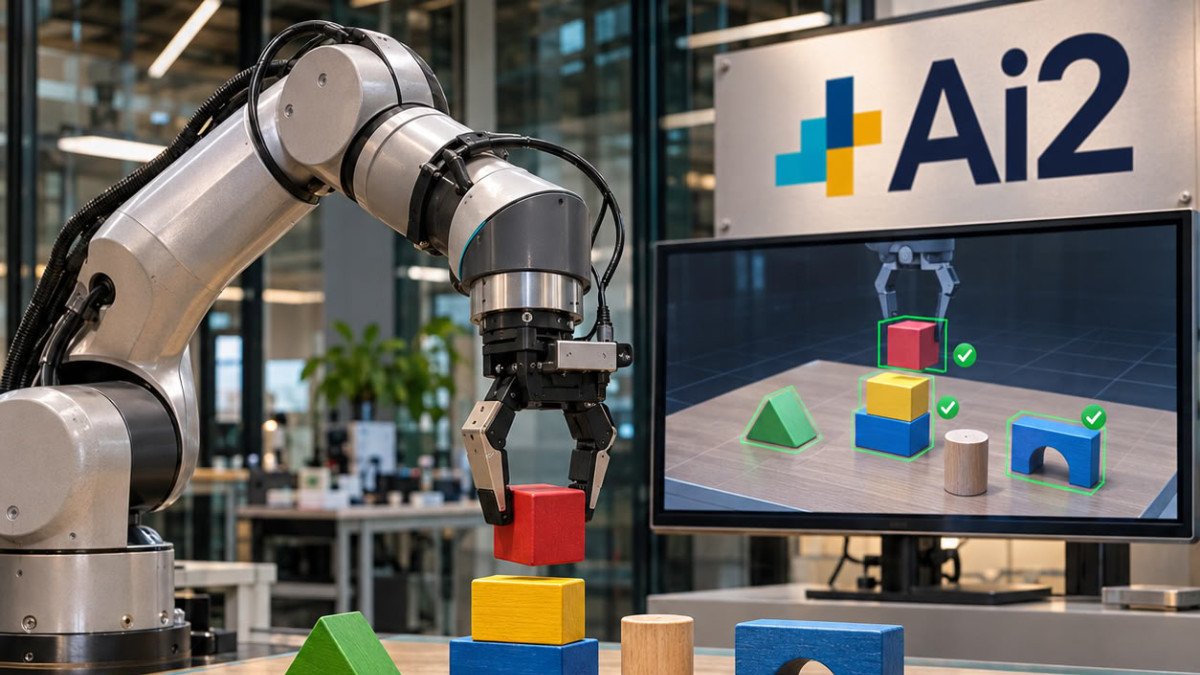

Ai2 introduces FoundationWorlds, a framework for creating controlled environments to study robotics, and releases its first example, ToyBlocks. It is an open simulation framework, built around a robot arm and blocks placed on a table.
Recent demonstrations of robots folding laundry or sorting parts often remain narrow, and they poorly explain what the robot has learned or why it fails. Researchers therefore need environments where they can modify training data or model design, repeat a test, and trace the cause of a failure. Each FoundationWorld combines a simulated world, tools for automatic task and demonstration generation, and measurements of robot behavior over time.
Generating demonstrations without teleoperation
ToyBlocks automatically produces demonstrations, meaning recordings of a robot completing a task in simulation, without resorting to teleoperation, where a person controls the robot remotely. To learn short-horizon skills, like pushing a block or flipping it without grasping, the system combines reinforcement learning (RL, which proceeds by trial and error) and motion planning. Training takes place in Isaac Lab, an open-source framework from Nvidia for robot learning in simulation.
A task and motion planner (TAMP) then chains these skills to solve a task. According to Ai2, hundreds of plans can be executed in parallel on a single graphics processing unit (GPU), up to 24 times faster than real-time.
Testing model generalization
Vision-language-action (VLA) models, which translate a language instruction and images into robot actions, are supposed to generalize quickly thanks to their pre-training on large datasets. Available studies, however, remain contradictory. Ai2 states that its tests, conducted with ManiFlow, π0.5, and MolmoAct 2, show poor generalization in the initial state, and that the team subsequently improved these results. The company believes the question is far from resolved.
In another part, a vision-language model, Molmo 2, serves as a high-level planner and ManiFlow as the executor. For a task consisting of spelling “Ai2” with a block tower, the letters may not be visible initially, forcing the agent to first seek information.
Agents conducting their own experiments
In another series of trials, Ai2 uses Claude Opus 5.5 and exposes ToyBlocks’ skills via the Model Context Protocol (MCP), a standard for connecting AI applications and tools. According to the source, by letting the agent write its own skill descriptions based on its experiences, the success rate rises from 24% with default descriptions to 63%, compared to 36% with descriptions written by a human expert.
Another test concerns action-conditioned world models, which predict the evolution of a scene based on the robot’s actions. On 900 trajectories per skill, Wan 2.2, a 5-billion-parameter video prediction model, best predicts block movement and task outcomes. Ai2 adds that 100 trajectories generated by this model raise a policy’s success rate in an unknown area from 19% to 78%.
From simulator to real arm
On a Franka FR3 arm equipped with a Robotiq gripper, and across thirty scene configurations, ManiFlow achieves an 80.0% success rate in simulation and 81.1% in the real world for its isolated skills. The hierarchical Molmo 2 + ManiFlow system reaches 55.5% in simulation (111 out of 200) and 50.0% in real-world conditions (15 out of 30). Ai2 specifies that further trials will be needed to establish statistical confidence.
The initial published data includes 85,336 long-horizon demonstrations, approximately 1,600 hours of robot runtime, and 144 million images. A second version, with a larger dataset and more skills, is targeted within a few weeks.
