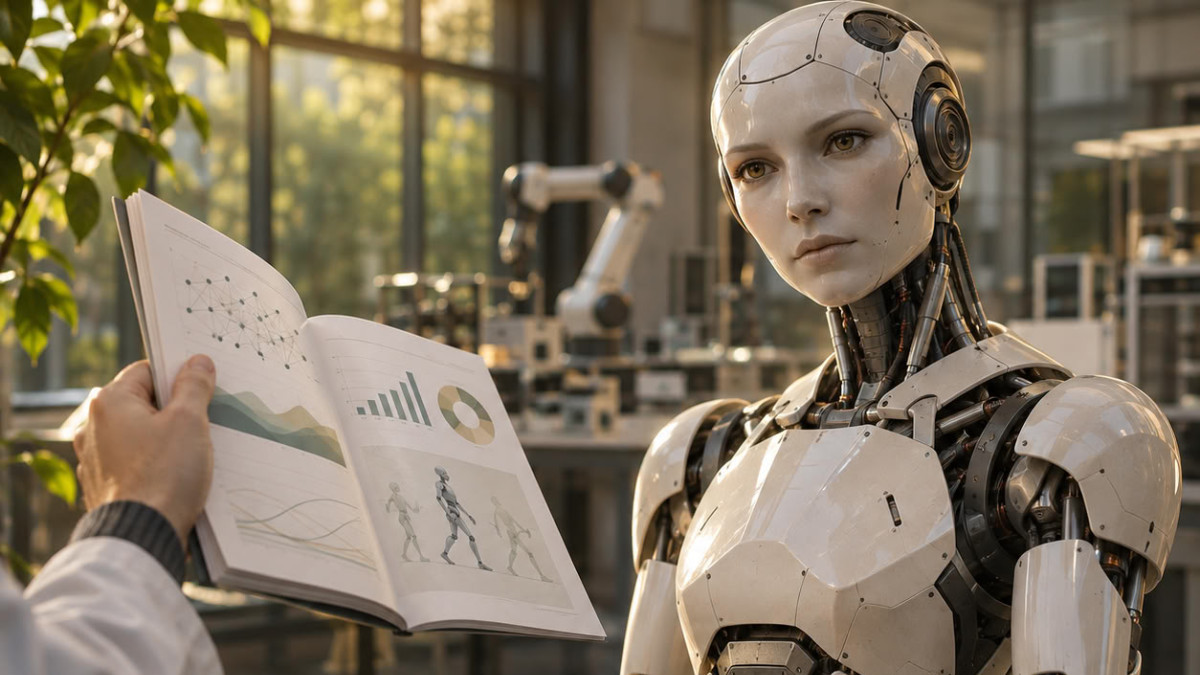

The third edition of the One Hundred Year Study on Artificial Intelligence (AI100) report, titled ‘AI Goes Mainstream: The Scaling Era and the Rise of Generative AI,’ identifies physical AI and embodied intelligence as one of six major open challenges in the field. This topic is considered the most relevant for the robotics community, which is progressing rapidly but remains far from large-scale real-world deployment.
The study, published every five years, is conducted by an international committee of experts tasked with examining the evolution of AI from technical, ethical, economic, and societal perspectives. The 2026 report addresses twelve perennial questions and compares progress since 2021 with the assessments of the previous committee. It notably covers the scaling of data and computational resources behind generative AI, investment in infrastructure, the concentration of cutting-edge model development, as well as cybersecurity and military applications.
Technical Progress Since 2021
Since the previous report, published in 2021, the authors note three significant developments. Natural language processing, which enables machines to understand and produce text, is now being integrated into robotic systems. Vision-language-action models, which combine visual perception, language understanding, and motion control, are being used to train and pilot robots. Finally, advances in simulation allow models trained in virtual environments to be deployed on physical hardware.
The report also examines China’s place in this sector. According to the study, the country is the leader in industrial robot development, with more robots deployed than the rest of the world combined. It is also estimated to produce about 80% of the world’s humanoid robots. This segment currently represents only 2% of the market but is experiencing rapid growth.
A Gap Between Demonstration and Deployment
Despite these advances, the report highlights a significant gap between capabilities demonstrated in the lab and their real-world use. The most notable successes concern highly constrained environments, such as warehouses, or very specific products, like floor-cleaning robots. The complexity of the real world remains the main obstacle.
Among the scientific problems to be solved are long-horizon planning in uncertain contexts, dexterous manipulation of diverse objects—meaning the ability to grasp and manipulate very different objects with skill—and establishing formal performance guarantees. The report notes that researchers are not unanimous on the path forward. Some believe current paradigms, based on statistical learning, are sufficient to meet these challenges. Others think fundamentally new ideas will be needed to deploy robots in real-world situations. The answer, in the report’s words, should become clearer over the next five years.
The full text of the report can be accessed online.
