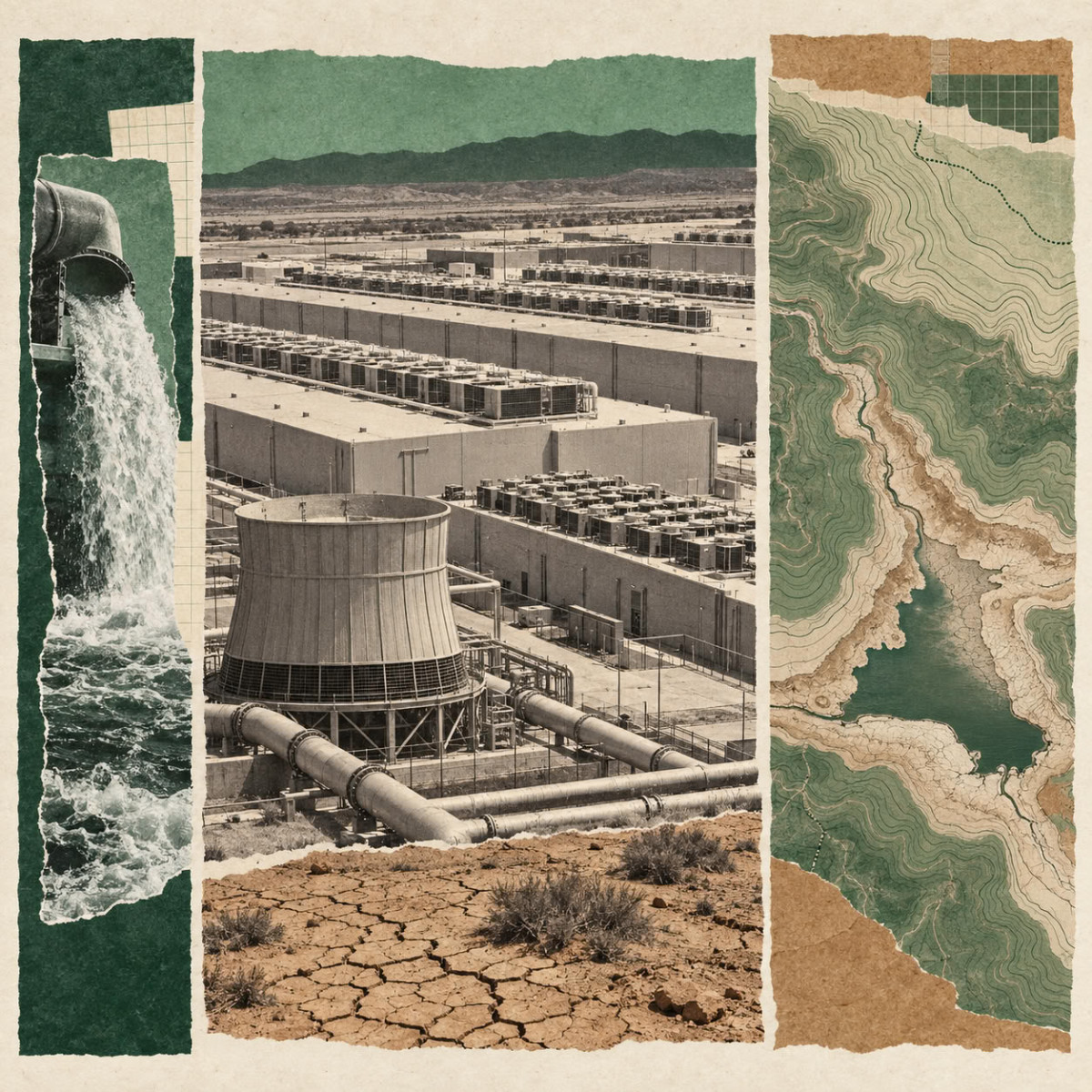

A quarter of the world’s data centers are located in areas where water demand exceeds supply for at least one month per year. This is the finding of a study by researchers from the Carnegie Institution for Science, published on September 24 in the journal Environmental Science & Technology. According to projections cited in the article, the share of these facilities exposed to water stress could increase further.
Data centers, which host AI models and cloud service data, consume significant amounts of energy, most of which is converted into heat. Without cooling, their components, including graphics processors, digital processors, TPUs and NPUs (chips specialized in AI computation), and DRAM memory modules, would overheat and fail within just a few minutes. The most common method involves circulating water through cooling towers, where it absorbs heat from the servers before evaporating into the atmosphere.
This freshwater is never returned to distribution networks, and it disappears by the millions of liters for the largest facilities. According to the Environmental and Energy Study Institute, the largest can consume “up to 19 million liters of water per day, equivalent to the daily consumption of a town of 10,000 to 50,000 people.”
The researchers have, for the first time, cataloged the 9,347 data centers located around the world. Among them, 2,315, or about 25%, are situated in the water-stressed zones described above. “These infrastructures are not built in the middle of nowhere,” emphasizes Lorenzo Rosa, lead author of the study and an environmental science researcher at the Carnegie Institution for Science. “They are built right on top of the resource that already supplies cities and farms.”
Water drawn from community reserves
The team modeled the effect of a 3°C rise in global temperatures, in line with current climate projections, on the watersheds supplying the 9,347 data centers. In this scenario, aquifers would dry up, due to increased evaporation, longer drought periods, reduced river flow, and groundwater levels that would recharge less and less.
Within about ten years, 33% of data centers would find themselves in scarcity zones, an increase of 8 percentage points from today. The majority of these at-risk facilities would be in the United States, the country already hosting the largest number of data centers worldwide. Furthermore, 41% of centers draw their water from the same reserves as local communities, and 28% compete with farmers for it. For 523 facilities, or just over 5% of the total, water is scarce for at least nine months out of twelve.
Cooling in competition with other uses
“The energy footprint of data centers has been quantified very precisely because electricity is metered and reported,” explains Lorenzo Rosa. “Water scarcity, however, is measured locally, inconsistently, and often not at all. So we built the map because it didn’t exist.”
According to the researchers, “data centers generally have the financial power and institutional priorities needed to secure their supplies whenever water is available.” They conclude that “the main risk lies not so much in the operation of these infrastructures themselves, but with the other users sharing these same basins.” The water consumption of these facilities moves in the opposite direction: it increases when temperatures rise, just when restrictions hit agricultural and domestic uses. Local populations will be, according to the study, the first victims of this territorial conflict, which is expected to intensify with heatwaves.