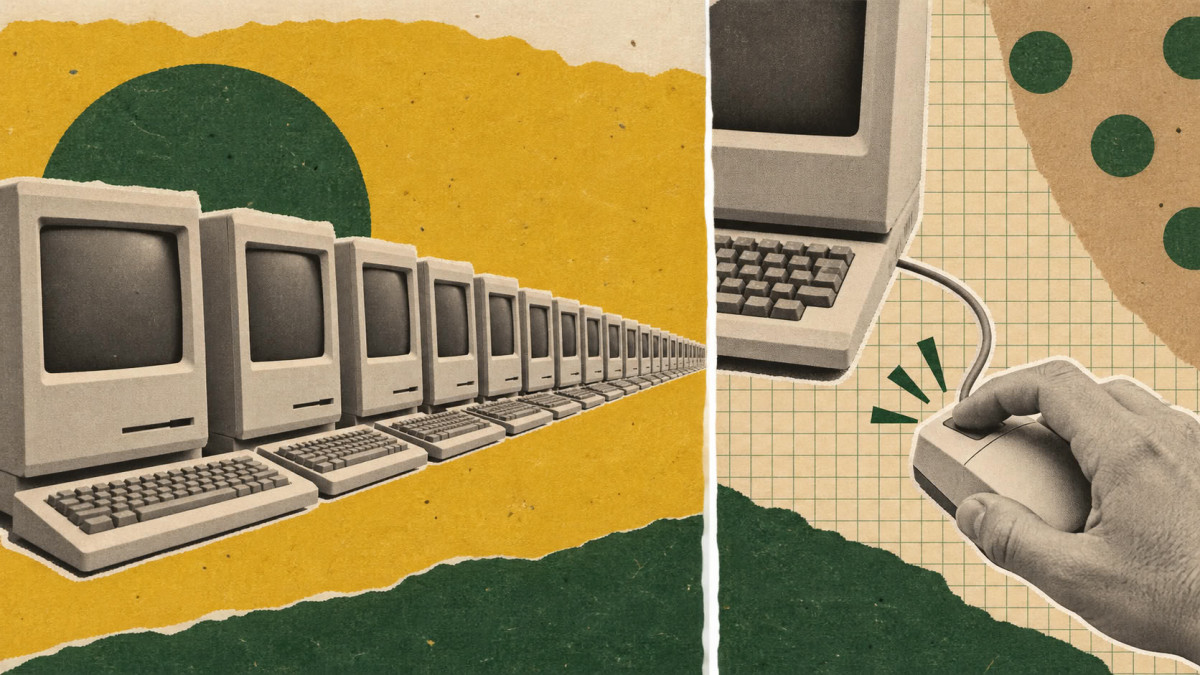

Tens of thousands of Mac mini and Mac Studio computers to teach an AI how to use a computer: this unconfirmed information targets OpenAI and describes another way to train AI. It’s not about building the next GPT, but about teaching an agent to use a computer, and Apple could be the unintended beneficiary.
The story comes from an article by The Information, published in late August 2026 and based on anonymous sources. OpenAI is said to have purchased tens of thousands of Mac mini and Mac Studio computers in recent months to train so-called “computer use” agents, AIs that manipulate a screen like a human would, through reinforcement learning. No exact figures were given, and neither OpenAI nor Apple has confirmed the volumes, dates, or costs.
AI Agents: Learning to Use a Computer, Not to Become More Knowledgeable
The nuance matters: large language model training remains Nvidia’s territory, with its GPU clusters. Here, the goal is to teach an AI to chain actions on a real computer, and reinforcement learning precisely involves letting it try, fail, and try again.
Anthropic and Mac Minis: Renting Rather Than Buying
Anthropic would not be left behind, but via a different route: the company is said to rent Mac minis rather than buy them, for similar uses. Most reports on the scoop mention renting via Amazon Web Services, while others present this AWS route as a hypothesis linked to Anthropic’s ties with Amazon. What is verifiable: AWS does offer dedicated EC2 Mac instances, with chips ranging from M1 to M4 Max, and M3 Ultra. The rented volumes are unknown and Anthropic has not confirmed anything.
Mac Mini, Mac Studio: Unified Memory and Cooling Highlighted
Why a Mac rather than another server? The explanations put forward by the tech press boil down to two points: unified memory, where the CPU and GPU draw from the same pool, allows keeping a model and desktop tasks on the same machine, and the cooling of these desktops supports long loads.
However, several claims circulating on social media are not supported by any of the articles read: that thousands of these machines would run without screens, that training agents would primarily be a matter of memory rather than computing power, or that Apple is now one of the most important AI companies in the world. The first two are unverifiable as things stand, the last is a matter of judgment.
Apple”: “$10.4 Billion in Mac Sales”, No Established Link to Labs
Apple’s figures are good: Mac revenue grew 29% year-over-year, to $10.4 billion for the quarter ending in late June. However, nothing links this to lab purchases: Apple does not detail the share of Mac mini and Mac Studio, and the financial site 24/7 Wall St. considers it “premature” to attribute this growth to AI labs. Apple is also said to have been surprised by this demand and does not have a dedicated sales team for such clients, according to Cult of Mac.
On August 25, Apple renewed both lines: a Mac mini with an M6 or M5 Pro chip, a Mac Studio with M5 Max or M5 Ultra, most shipping starting September 22. The most powerful Mac Studio configurations were sold out for months by late August due to a memory chip shortage, according to the same scoop.
Mac-to-Mac: RDMA over Thunderbolt 5 Has Existed Since macOS 26.2
Last piece of the puzzle: linking several Macs together. This is not a recent novelty. Since macOS 26.2, released in December 2025, the RDMA protocol works over Thunderbolt 5 and allows a Mac to directly read another’s memory, creating clusters of machines.
Apple dedicated a session at its WWDC26 conference to this: with four Mac Studio M3 Ultras, the cluster generates tokens nearly three times faster than a single machine on a Qwen model, and fine-tuning goes from about 180 to 600 tokens per second. This is inference and fine-tuning, and Apple does not link these demonstrations to lab purchases.
It remains to be seen whether these Macs herald a lasting shift in the sector or a one-off order, as neither OpenAI nor Apple has confirmed the volumes.