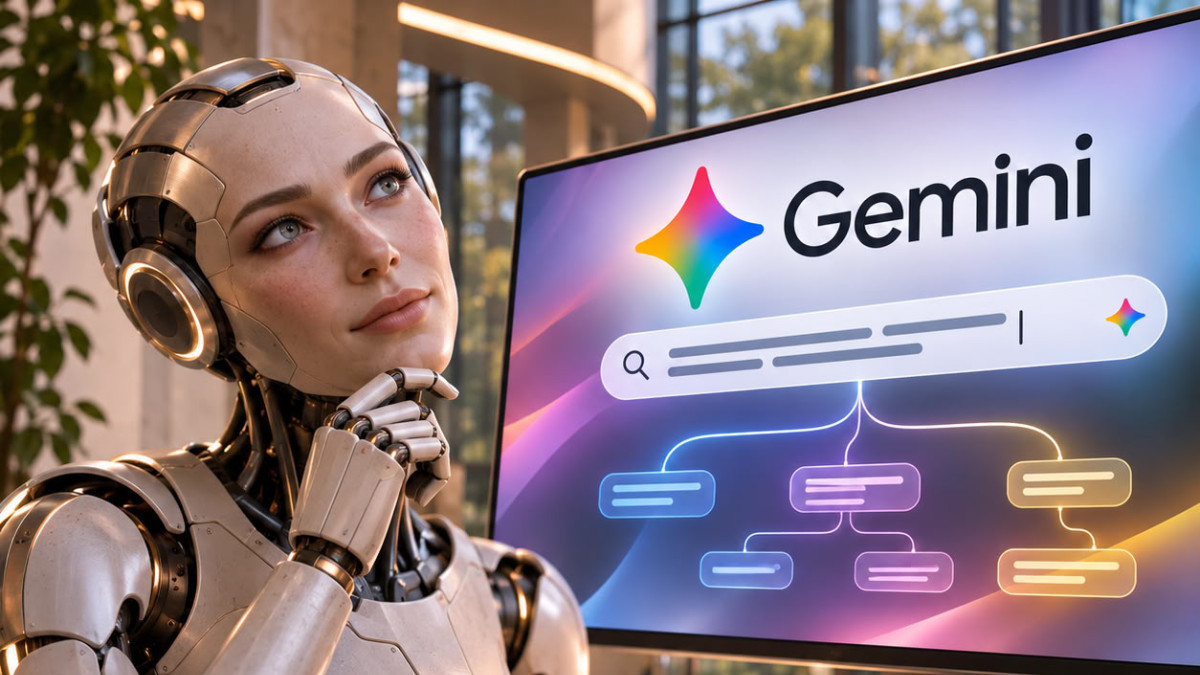

Google announces that its new model, Gemini 4 Hydrogen, can provide more useful answers to complex questions, including those with “multiple parts,” “hard-to-understand typos,” or “very specific requests.” The model breaks down questions and addresses each part in its response. It is available at launch in Search, in the Gemini app, across all Google AI Studio tiers, in the Gemini API, in Gemini for business, and in Google Antigravity for Google AI Pro and Ultra subscribers.
- Gemini 4 Hydrogen répond mieux aux questions complexes.
- Le modèle découpe chaque question et traite chaque partie.
- Les réponses de Search affichent plus de liens et d’éléments visuels.
- Google affirme que le modèle est plus rapide et plus intelligent, sans vérification indépendante.
Richer Answers in Search
According to Robby Stein, Vice President of Product at Google Search, Gemini 4 Hydrogen is now “the new default model in AI Mode” and serves the “most difficult questions” asked in AI Overviews. Google states that the model performs “simultaneous queries on all relevant sub-topics,” enabling it to display a greater number of links in its answers. These answers also include more visual elements: images, comparison tables, graphs, and maps.
One example published by Robby Stein shows a question about how phones can determine which lane a car is in on a highway, in areas with no mobile network. In response, the AI generates an animated, interactive driving simulation. Google also claims that language understanding has improved “across all languages supported by AI Mode.”
Multiple Thinking Levels
Gemini 4 Hydrogen also offers more thinking level options, namely “low,” “medium,” “high,” and a new mode, “xhigh.” These settings determine how much time the model spends reasoning before answering. According to Google, the model “delivers significant improvements in both speed and intelligence” compared to Gemini Flash 3.8. The group also states it “matches or surpasses some competing models in its class,” citing Claude Sonnet 5.5 and GPT-6.1 Terra.
These assessments come from Google and have not been independently verified in the source. The group does not specify, in the cited materials, the comparison criteria used.
