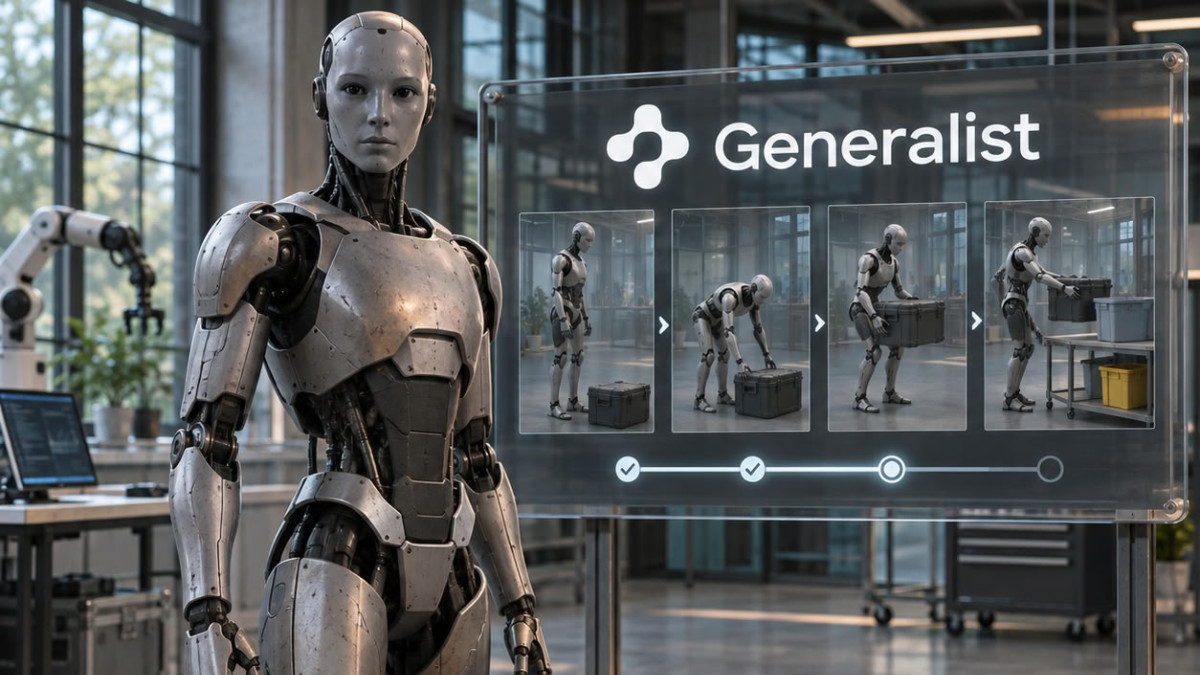

In its weekly Video Friday selection, IEEE Spectrum highlights several recent works in robotics, including Generalist’s GEN-1.5 model, which reportedly learns a new physical task in seconds from a single example. The other featured projects concern drone flight, construction equipment, brachiation, and a new human-robot interaction interface.
- Generalist’s GEN-1.5 model reportedly learns new physical tasks from a single example, without fine-tuning.
- The tasks remain simple, and some claims rely on the absence of relevant training data.
- Other projects cover drone trajectory optimization, a retrofit kit that turns hydraulic machines into robots, brachiation robots, and a cobot handwriting interface.
- The agenda lists several robotics conferences scheduled for 2026.
Learning from a single example
Generalist presents GEN-1.5 as its latest foundation model for robots, meaning a general artificial intelligence model designed to control physical machines. According to the company, it can learn a new task in seconds, from a single example, without updating its parameters or fine-tuning. The cited blog post also mentions few-shot learning capabilities and zero-shot physical generalization, meaning without prior examples for the task.
Generalist specifies that the tasks remain simple and short in duration. The company believes this is the first known model to demonstrate, at scale, one-shot or few-shot learning of physical skills, and sees it as “a significant step” towards its mission of building a general intelligence for the physical world. However, the selection’s authors note that for several of these demonstrations, the blog post can only state the absence of relevant training data “to the best of our knowledge.”
Drones, construction sites, and robotic arms
A project born from a collaboration between the AIMS group of the Hong Kong Polytechnic University and the DRAGON Lab of the University of Tokyo proposes what its authors describe as the first trajectory optimization framework based on sequential convex programming, a mathematical optimization calculation, for generalized multirotors, whether conventional or omnidirectional. The researchers explain they wondered “how far a first-principles-based analytical model” could go, rather than teaching a behavior from data.
On the construction side, the company Gravis Robotics offers the Gravis Rack, a retrofit kit that turns commercial hydraulic equipment into robots. Cameras, lidar, which is a laser detection sensor, and an onboard computer allow the machine to perceive its environment, while a learning-based control enables it to work near its limits, with full and fast cycles.
Researchers from EVARL have also presented a reinforcement learning approach, WGRL, for brachiation, that mode of locomotion involving swinging from bar to bar. According to them, the learned control policy worked on courses with varied bar heights, spacings, and orientations in simulation experiments, and their full-size bimanual robot traversed four consecutive bars in the real world. Finally, work from TS-Robotics leverages the joint torque sensors of standard cobots: a passive plexiglass plate attached to the robot’s flange transforms it into a handwriting interface.
Agenda
The Humanoids Summit Seoul will be held on September 22-23, 2026 in Seoul, followed by the IROS 2026 conference from September 27 to October 1, 2026 in Pittsburgh. The CoRL 2026 conference will take place from November 9-12, 2026 in Austin.
