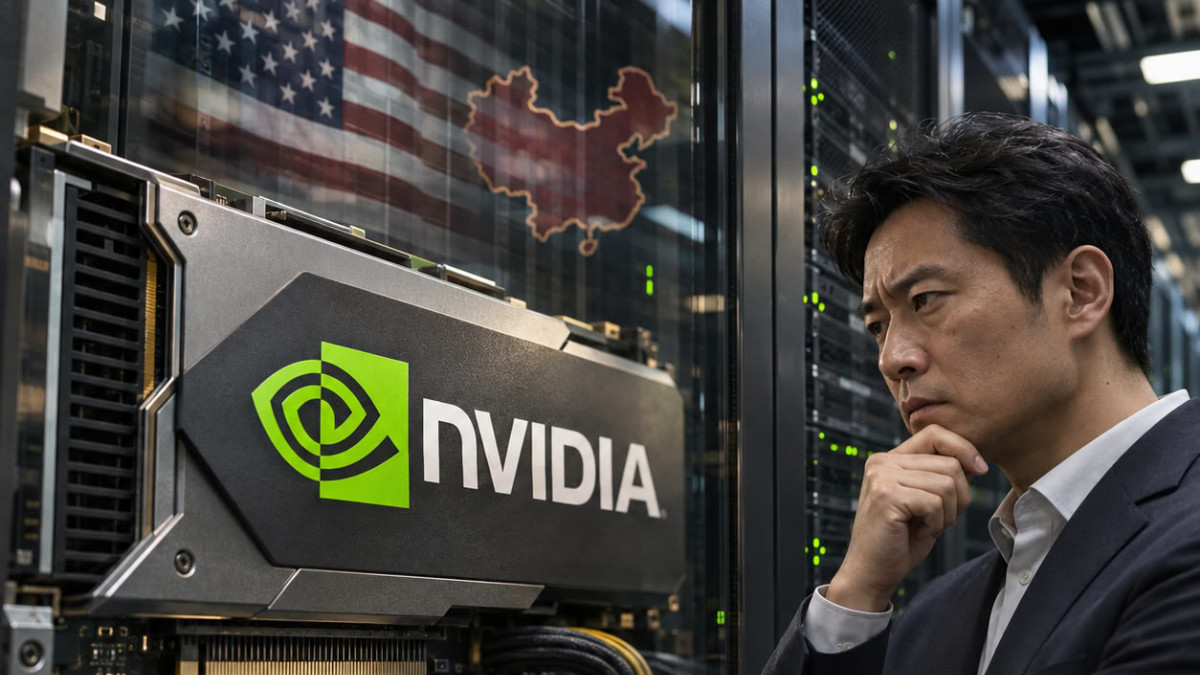

Chinese companies specializing in artificial intelligence are seeking to reserve more computing power equipped with Nvidia GPUs in data centers located abroad, according to Reuters. They fear that the affair involving Jensen Huang, CEO of the American manufacturer, will accelerate Washington’s tightening of restrictions on remote access to advanced processors. At the same time, purchases of Nvidia chips on the Chinese grey market are reportedly intensifying.
Tensions surrounding Nvidia are worrying the Chinese artificial intelligence industry. Several players want to secure their computing capacity outside China, fearing that the United States will extend its controls on access to advanced semiconductors. According to an exclusive Reuters report published on November 12, 2026, which relies on three people close to the matter, Chinese cloud providers and AI labs have taken steps to reserve computing resources hosted abroad.
These initiatives come in a context of uncertainty surrounding Jensen Huang. The executive has admitted to being unfaithful to his wife, and an internal investigation was opened after allegations were published that the woman in question, Alice Huang, former head of the Singaporean company Megaspeed, is linked to Chinese intelligence services. Reuters specifies that it has not been able to verify these accusations, which Beijing denies.
Chinese providers turn to foreign datacenters
US restrictions already limit the export to China of several categories of advanced Nvidia processors. However, one option remains: leasing computing power in data centers located outside China, without physically importing the equipment. This practice provides access to infrastructure equipped with high-end GPUs, these graphics processors widely used to train and run large language models.
According to Reuters, a major Chinese cloud provider recently internally studied the possibility of reserving additional capacity abroad. Other companies are said to have directly contacted data center operators to guarantee their access to these resources. Smaller AI labs are also reportedly considering this strategy, particularly with providers based in Southeast Asia. However, these advance reservations could increase pressure on available capacity and complicate supply for other clients.
The Remote Access Security Act in the background
Concerns focus in particular on the Remote Access Security Act (RASA), a US bill aimed at extending controls to remote access to certain technologies subject to export restrictions. Passed by the House of Representatives in January 2026, with 369 votes for and 22 against, the text was still awaiting, according to information available as of November 12, its review by the Senate. If definitively adopted, it would give the US Department of Commerce the power to regulate, via the cloud, remote access to restricted technologies.
Such a development could call into question the strategies of leasing GPUs abroad used by some Chinese developers. International cloud providers might also have to strengthen their controls on their clients’ identity, authorized uses, and conditions of access to equipment.
Purchases intensifying on the grey market
Fears of a regulatory tightening are also reportedly fueling purchases on the Chinese grey market. According to two people interviewed by Reuters, intermediaries and traders have begun stockpiling Nvidia processors subject to US restrictions. This development comes as several cases have highlighted the difficulties in enforcing export controls. Supply documents notably show that a Chinese university linked to the People’s Liberation Army acquired Nvidia H200 chips in October, despite being on a US blacklist.
In March 2026, US authorities also initiated prosecutions against three people, including Yih-Shyan « Wally » Liaw, co-founder of Super Micro Computer, for their alleged participation in a network diverting servers equipped with Nvidia GPUs to China via a company based in Southeast Asia. According to prosecutors, this company purchased approximately $2.5 billion worth of servers between 2024 and 2025, a significant portion of which was allegedly redirected to Chinese territory. Wally Liaw pleaded not guilty, while one of the two other defendants pleaded guilty in October, according to Fortune. Super Micro is not implicated and claims to have been a victim of this scheme.
For cloud providers and companies developing artificial intelligence models, these developments increase uncertainty around access to computing infrastructure. A potential tightening of US controls could alter the commercial and regulatory conditions of the global GPU market, even before a general ban on remote access has come into effect.
