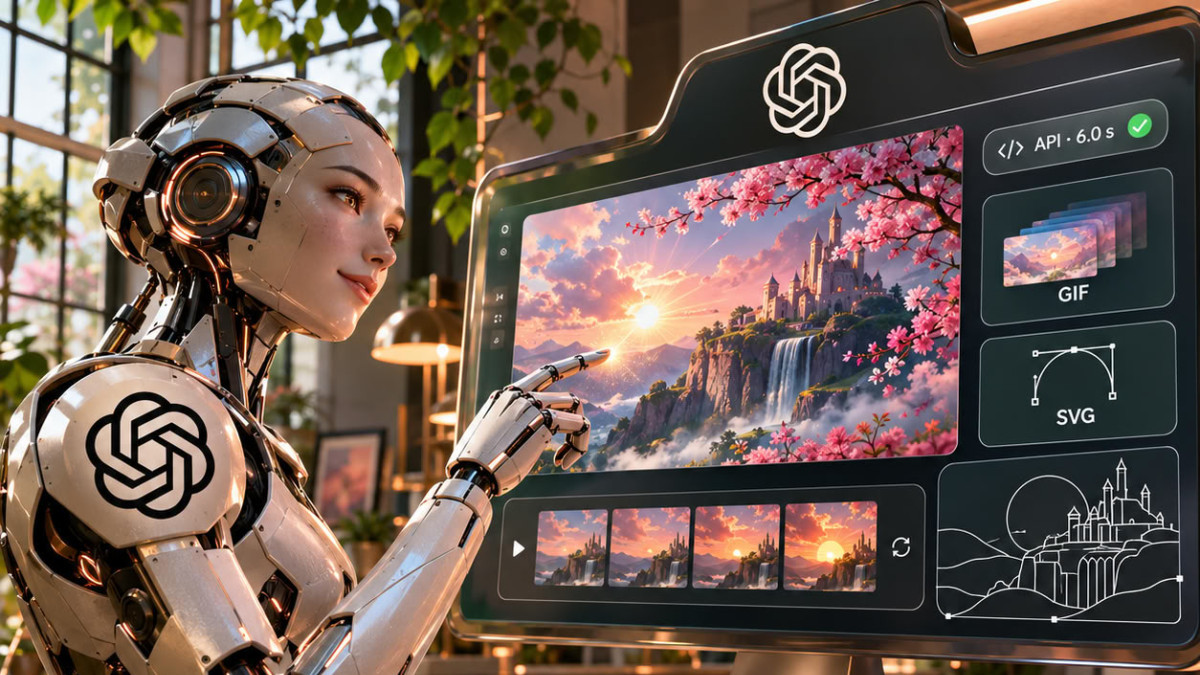

OpenAI has launched Images 2.6 in ChatGPT, Codex, and the API. For developers, the main new feature is GPT-Image-2.6, offered via two API models, Flare and Sunburst. According to OpenAI, image generation is 50% faster than the previous version.
Two Models for the API
GPT-Image-2.6 is OpenAI’s family of models dedicated to generating and editing images, accessible via the API (an interface allowing developers to integrate the model into their own applications). It accepts text and images as input and returns images. Flare is presented as suited for rapid iterations and interactive workflows, while Sunburst is intended for detailed compositions and editing.
OpenAI states that Flare can generate an image in just 6 seconds when quality is set to low. Sunburst aims for higher quality and better consistency between edits, at medium or high levels.
New Features for ChatGPT and Surging Usage
In ChatGPT, users can now turn text or a photo into an animated GIF, adjust animation speed, modify individual images, and share the result. They can also save and tag reference images of people, animals, or characters, which can be reused without needing to be uploaded again.
OpenAI claims users now generate over 4 billion images per week in ChatGPT and the API, compared to over 3 billion eight weeks ago at the launch of Images 2.5. This represents, on average, over 500 million images per day.
Settings, Formats, and Pricing
The new complexity field determines the degree of planning the model does before rendering the image. OpenAI’s image generation guide lists three levels: low, medium, and high. Without specification, both models use high. The low level is suitable for targeted edits, like changing a background or a sign, while high helps with dense text, complex layouts, and object relationships. OpenAI warns that higher complexity can increase latency and introduce unwanted changes. This setting is distinct from quality, which controls the level of detail in the render, and does not incur any extra cost.
The models can also produce animated GIFs and SVG files, a vector format that remains sharp at any size. According to the launch, inpainting (marking areas to modify) is coming to the API, with the guide already listing it for both models.
According to the model pages, per-token pricing (a unit of text or image processed by the model) is identical for Flare and Sunburst: $5.00 per million text input tokens ($1.25 cached), $8.00 per million image input tokens ($2.00 cached), and $30.00 per million image output tokens. Google and BFL, meanwhile, publish per-image prices: Nano Banana 2.1 starts at $0.0336 for 1K and goes to $0.113 in 4K, FLUX 3 Image at $0.048 for 1K and $0.607 in 4K. The source notes that OpenAI has published neither benchmark scores nor a per-image cost table for Images 2.6.
The GPT-Image-2.6 models are closed: their weights are not public, and they only operate hosted by OpenAI, in ChatGPT, Codex, and the API.
