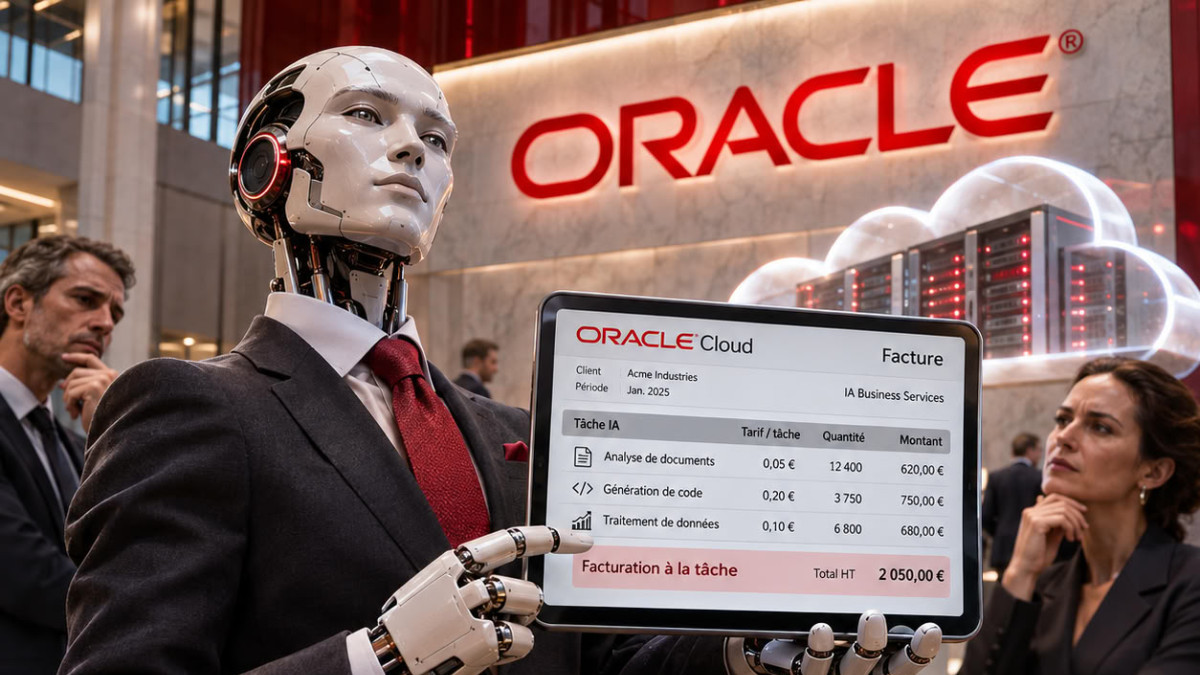

American software publisher Oracle is considering charging for tasks performed by its artificial intelligence (AI) agents, in addition to its traditional software subscriptions. This direction, revealed during its investor day on October 28, 2026, comes in a context of massive investments in the cloud and a target of $225 billion in revenue by 2030.
- Oracle considers charging for tasks performed by its AI agents, on top of subscriptions.
- This usage-based billing would complement the current per-user licensing model.
- Fusion Claw extends this monetization to operations performed outside Oracle’s applications.
- Oracle plans $90 to $95 billion in spending for fiscal 2027 to support its growth.
Until now, a large part of professional software relies on a per-user licensing system, called “seat-based pricing.” The client company pays based on the number of employees with access to an application. Oracle wants to complement this model with consumption units linked to operations performed by AI, with the goal of increasing revenue generated by its existing customers without necessarily selling more licenses.
Usage-based billing
Chris Leone, executive vice president in charge of application development at Oracle, explained that each task performed by AI could generate additional revenue for the publisher. Existing subscriptions would not disappear: consumption of AI capabilities would be added on top.
This approach concerns notably the Fusion cloud applications, used for financial management, human resources, or the supply chain. Autonomous agents, meaning programs capable of chaining several actions on their own, are set to handle operations previously performed by employees, such as data processing, process automation, or execution of business tasks. The more operations customers entrust to these agents, the more their consumption of AI units is likely to increase.
Fusion Claw
At the end of October, Oracle unveiled Fusion Claw, an execution environment designed to manage AI agents. The tool notably targets the automation of business processes in the areas of enterprise resource planning (ERP), finance, and the supply chain.
Its scope is not limited to Fusion applications alone. According to Chris Leone, these agents will also be able to intervene on operations performed outside this environment. Fusion Claw thus fits into the publisher’s strategy for monetizing AI usage.
Investments in the cloud
This pricing evolution comes as Oracle is dedicating particularly high sums to its infrastructure. The publisher invested $55.7 billion in data centers and cloud infrastructure during its 2026 fiscal year. For the 2027 fiscal year, it plans between $90 and $95 billion in spending in this area.
Oracle is betting on Oracle Cloud Infrastructure to host its customers’ workloads, as well as those of major AI players, including OpenAI. This development requires ever-increasing computing capacity and significant funding.
The group is betting on this model to support its growth. It aims for over $225 billion in revenue by 2030, representing an average annual increase of 35% compared to 2026.
