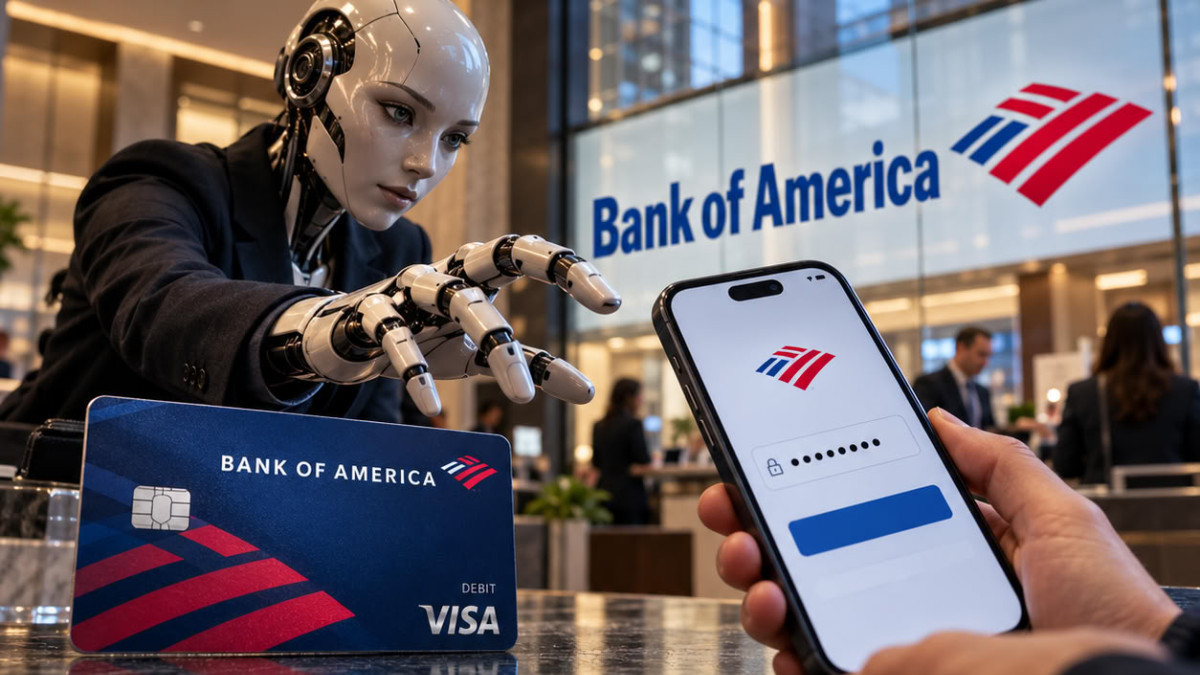

Bank of America is asking its customers not to share their login credentials and passwords with anyone, including any tool or agent powered by artificial intelligence (AI) that offers to act on their behalf. This message, emailed to all customers under the title ‘Protecting your finances in the AI world,’ is part of a broader concern in the banking sector about AI agents, programs capable of performing tasks on a user’s behalf.
The phenomenon is due to the growing popularity of autonomous AI assistants. The trend of letting these assistants make payments on a customer’s behalf has also grown, posing a real regulatory headache for banking providers. AI agents record everything the user tells them, including highly sensitive information, which can be disclosed in the event of a security breach.
Major banks restrict third-party agent access
Major U.S. banks have prevented third-party AI agents from accessing customer accounts and making transactions. This decision follows a report indicating that agents were accessing bank accounts and performing operations without regard for user instructions. The sector is increasingly concerned about sophisticated agents harming the banking system and the institutions responsible for managing individuals’ assets.
Morgan Stanley has blocked third-party agents’ access to its platforms, without having observed any cases of unauthorized or malicious AI agents. For its part, Jamie Dimon, CEO of JPMorgan Chase, stated that the largest U.S. lender is developing tools to manage the risk associated with AI agents: ‘We are not going to allow any external agent to enter the company, because it is simply too risky for customers and for JPMorgan.’
Automatic purchases and customer liability
Entrusting a purchase to an agent has an obvious advantage: if the price of an item drops or it becomes available again after a stock-out, the agent can buy it so the user doesn’t miss out. However, these payments can be flagged as unauthorized by financial institutions, which can lead to customers’ accounts being blocked. It also happens that an agent buys an item the user did not want, forcing some customers to fight with their bank to get a refund.
In these cases, liability largely falls on the customer. If the agent had not had their banking details, the purchase would not have been made. According to the article, the best way to stay safe is to consider an AI assistant as a stranger capable of doing almost anything you ask almost instantly, but not always as you intend. Every conversation held with this stranger is also used to train others.
The case of Muse, Meta’s assistant
In mid-October 2026, Meta’s new AI assistant Muse was perceived as a ‘parasite’ due to concerns about the confidentiality and security of personal data. To function optimally, it required ‘intrusive access’ to messages, calendars, and bank accounts, allowing the company to collect vast amounts of intimate information. Recent incidents had shown that the application could act autonomously without the explicit approval of its users. According to some critics, Muse allowed Meta to monetize the psychological profiling of users for the benefit of advertising clients.