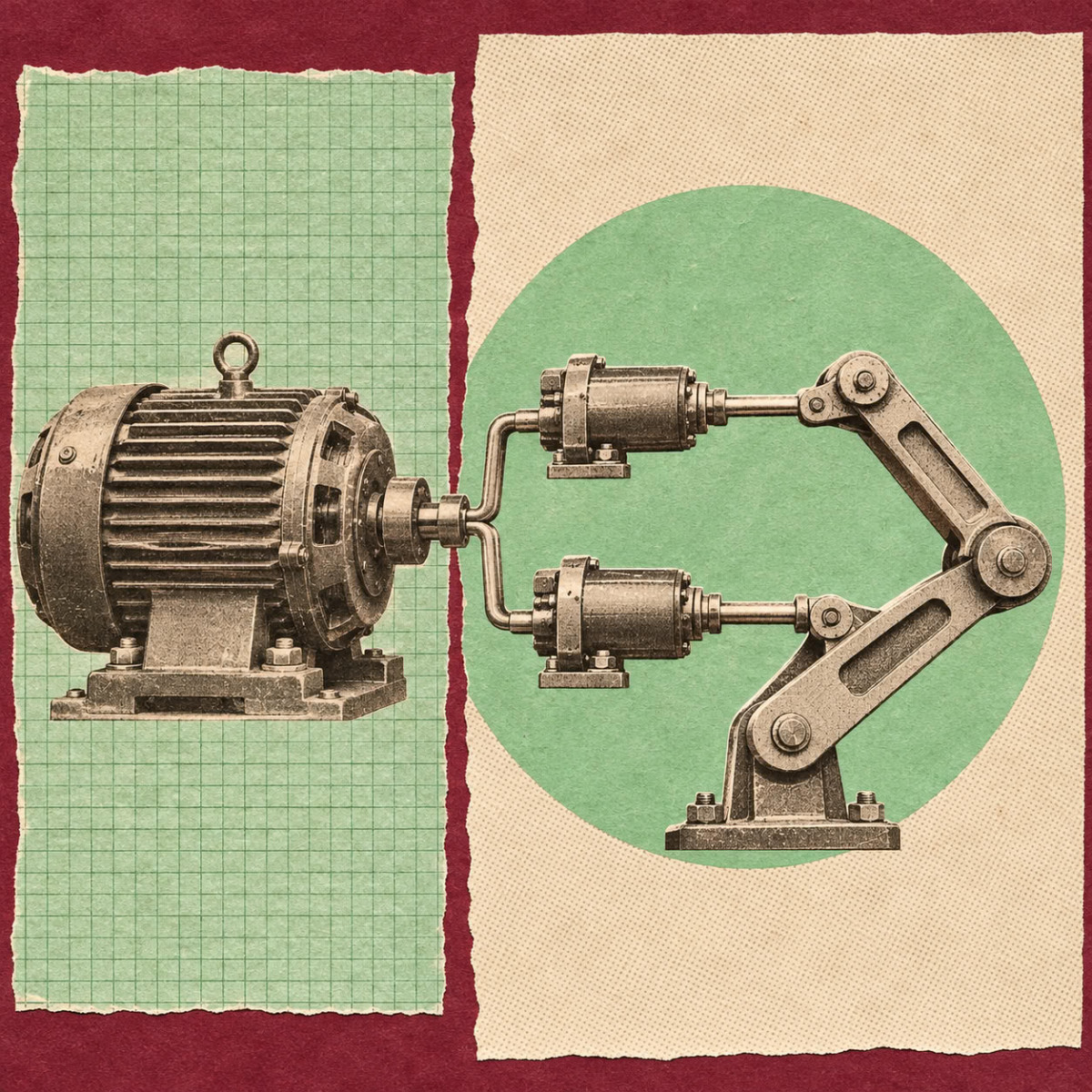

Researchers from the University of Bristol have built a physical model using simple electric motors to study muscle coordination. According to their work, published in the Royal Society’s Interface journal, this coordination could emerge spontaneously from the system’s configuration without needing to be programmed, and could inspire robotics.
Muscles convert chemical energy into motion and produce a steady force, even though they are made up of a very large number of small molecular components. When the load varies, they adapt without faltering or giving way.
At the heart of the muscle is the sarcomere, the elementary unit of force production, formed of actin filaments and molecular motors called myosin. These motors repeatedly grab, pull, and release the actin cables, allowing muscle fibers to contract.
Rather than reproducing the chemistry of myosin, the researchers represented it with a ‘rotor’ that only contributes when it is mechanically linked to a physical ‘backbone’. Their tabletop device brings together a row of small electric motors connected by a common mechanical structure, pulling against a thick fluid, a resistance comparable to that experienced by biological motors.
The motors do not stay permanently connected: each briefly pushes the moving structure, then releases it. This structure thus transmits the effect of one motor to the next, without direct communication between them.
A coordination without a conductor
In this simplified system, several behaviors close to those of muscle appear spontaneously. When resistance increases, the motors collectively develop a relationship between load and speed, and more units contribute to the effort. Under certain conditions, the movement becomes jerky, with pulling phases interrupted by sudden slips. The system can also form coordination waves that propagate along the device.
The researchers liken this organization to that of flagella and cilia, microscopic extensions of certain eukaryotic cells, like the sperm tail. Here too, molecular motors are distributed along a structure, the axoneme, which transforms their activity into bending waves. In sperm, these waves are essential for mobility and fertility, while cilia circulate fluids in the airways, with links to health and disease.
Leads for robotics
In robotics, getting many actuators, i.e., the ‘muscles’ of a robot that convert an energy source like electricity into motion, to cooperate remains difficult and costly. Sensors, feedback loops, and control algorithms are often required, which can make the whole system fragile and prone to errors.
According to the authors, a model where coordination emerges from the configuration suggests the possibility of simpler actuators. This avenue aligns with research on soft robots, which use flexible materials, and on artificial muscles for robotics. The researchers believe this principle could be exploited, towards machines whose bodies help shape their movements.
