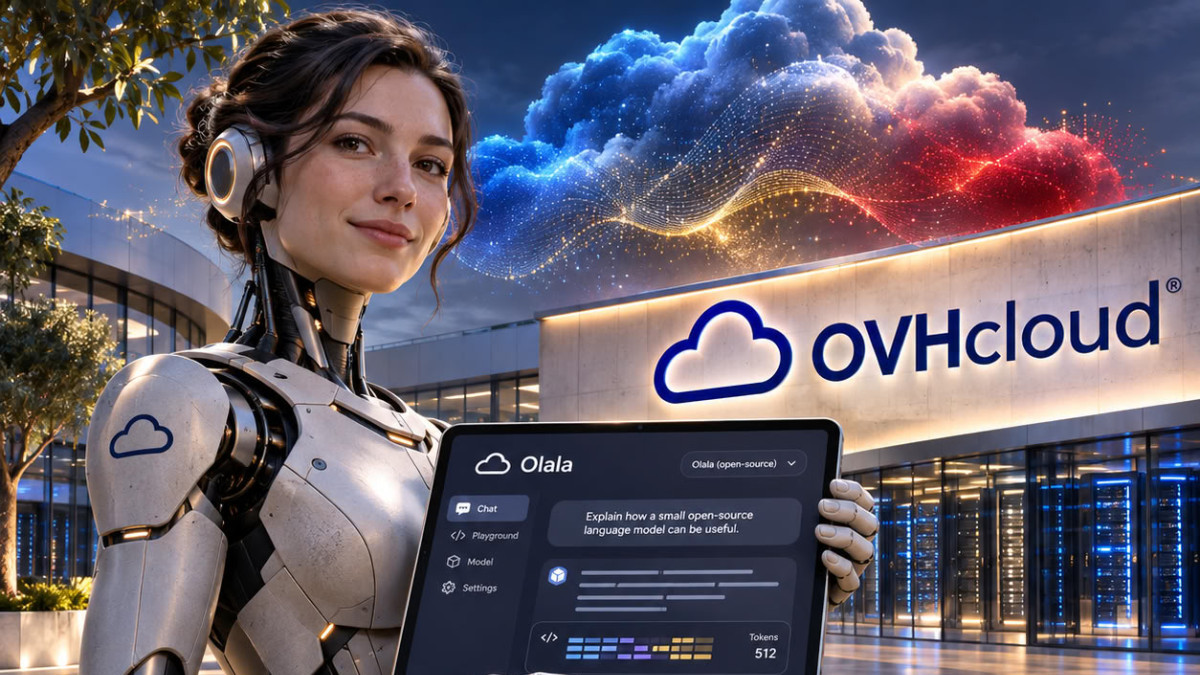

Until now, OVHcloud primarily sold the infrastructure for artificial intelligence, notably the rental of GPUs (graphics processors used to train and run models). With Olala, the French company is now designing its own models, the first of which, Olala mini 7A1B, is set to be released on Thursday, November 19.
“What we want to show is that Europe has its place in all layers of artificial intelligence,” said Octave Klaba, CEO of OVHcloud, to AFP.
Olala mini, a compact model for local use
Olala mini 7A1B is based on a mixture of experts architecture: only a fraction of its parameters, meaning its internal settings, work on each request. According to OVHcloud, this organization reduces memory requirements and allows the model to run locally, even on a simple processor.
The model has 7 billion parameters, with 1 billion activated per request, distributed among 256 experts per layer. Its hybrid architecture alternates attention layers (Differential-TPA) and Mamba-3 layers, designed to limit the required memory. It requires a GPU with at least 8 GB of memory and achieves 160 tokens per second (units of text processed by the model) on an RTX A4500, compared to 50 on a processor alone. Its context window, i.e., the amount of text it can process at once, is 32,000 tokens.
The model will be published on Hugging Face, under an Apache 2.0 license, on the day of the OVHcloud AI Summit. OVH provides the weights, the pre-trained base model, a technical report, and AI Act compliance documentation. According to the company, Qwant already uses it for the flash answers of its search engine, which are said to be 20% faster and three times cheaper than with the previous model.
A roadmap towards more than 100 billion parameters
The model was trained on three European public supercomputers: Jupiter, MeluXina, and Jean Zay. This aid, equivalent to 7 million euros worth of compute hours, gave birth to OVHai LLM, its agentic lab. “Expertise in model training has become widely democratized, and the cost of training has been divided by 20 in 3 years,” Octave Klaba emphasized in the press release.
Version 1.1, expected by the end of the year, is set to increase the context window to 128,000 tokens and improve mathematical reasoning. Version 2.0 will exceed 100 billion parameters and will be available in specialized models: agentic for businesses, intended to power OVHai Workspace; cloud DevOps for developers, architects, and operations teams; and cybersecurity, both defensive and offensive. Speaking to AFP, Octave Klaba also mentioned code assistance tools, similar to Claude Code or Codex, and aims for 100 million users, without a specific timeline.
Direct competition with Mistral AI
Olala puts OVHcloud in direct competition with Mistral AI, under a different business model. The French startup, valued at over 21 billion euros, raised 3 billion euros in September. OVHcloud, which is profitable, does not plan to raise funds to finance its AI strategy.
Its CEO had already pointed out, in an interview with La Tribune, that OVH and Mistral are “very different,” notably comparing the revenue and number of customers of the two companies. “We are not starting from scratch. We have a customer base, with an OVH brand,” he insisted to AFP.
Technically, Olala mini falls into the category of Ministral 3, Mistral AI’s compact models (3, 8, and 14 billion parameters), also designed for local use. It remains far from Mistral Small 4, with its 119 billion parameters and a context window eight times wider, and even further from Mistral Large 4.
OVH has not published any benchmarks: the press release provides throughput figures but no quality scores, which for now prevents any quantified comparison with Mistral AI’s models.
