

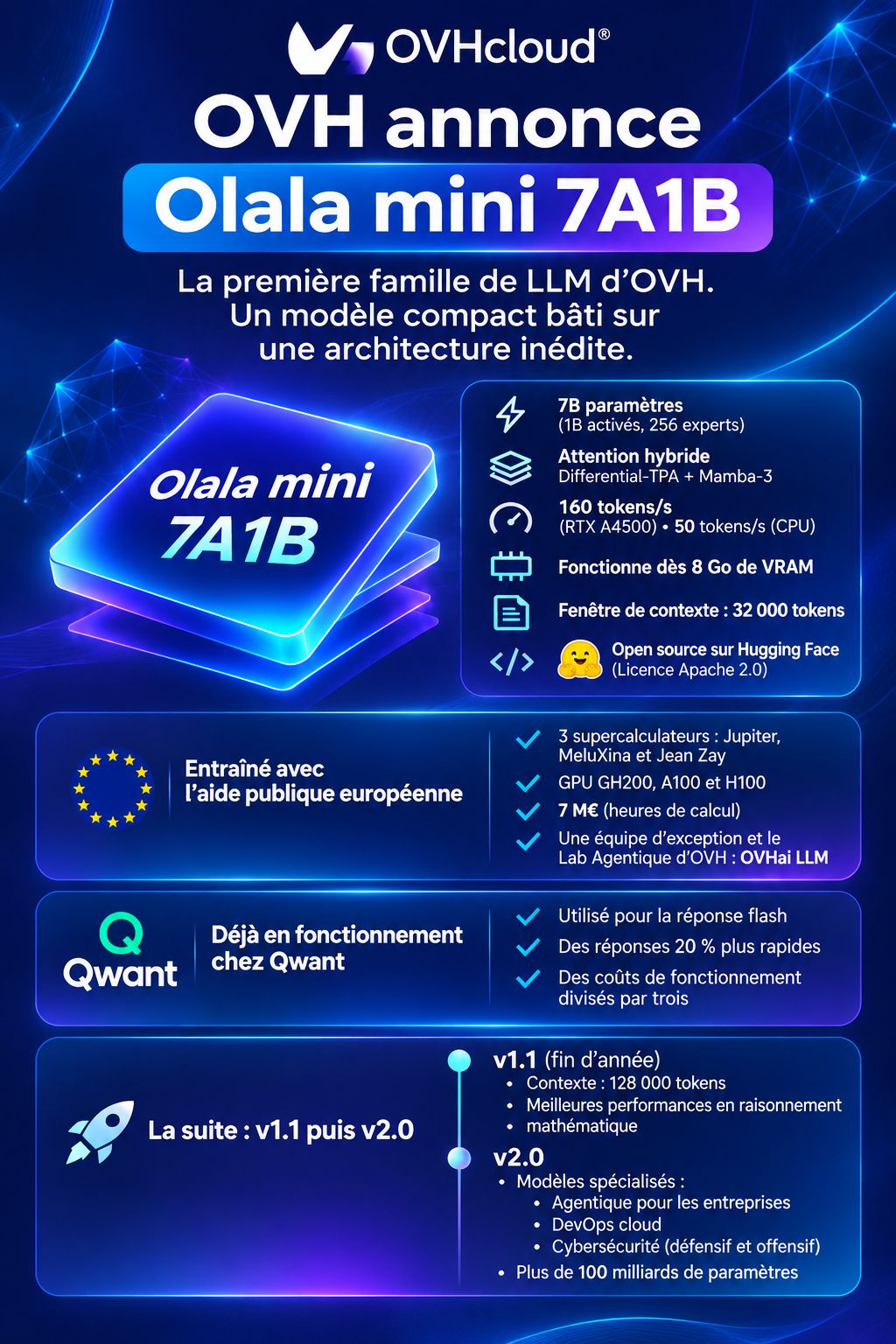
OVHcloud unveils Olala mini 7A1B, the first language model of its new family: 7 billion parameters with only 1 billion active, announced to run on an 8 GB graphics card, or even on a simple CPU. The weights are to be released online on Thursday, November 19 under the Apache 2.0 license, but no quality scores accompany them for now.
OVHcloud presents Olala mini as the first representative of an internally designed family of language models, in a press release dated November 17, in Roubaix. The official launch takes place on Thursday, November 19, during the OVHcloud AI Summit: that day, the group is to publish the weights, the pre-trained base model, a technical report, and AI Act compliance documentation on Hugging Face. Octave Klaba, CEO of OVHcloud, posted the announcement on X. For now, the available figures are those from the company.
Olala mini 7A1B: 7 billion parameters, but only 1 billion active
The name reads like a spec sheet: 7 billion parameters total, with 1 billion activated per request, distributed among 256 experts per layer. In other words, Olala mini is a mixture-of-experts model, where only a fraction of the network works on a given text. OVHcloud sees it as a faster and less memory-hungry model.
The attention is hybrid, with Differential-TPA and Mamba-3, and the model is released in BF16 format. According to Next, the first component reduces the memory needed for inference and focuses attention on useful information. The Mamba-3 layers work on a summary of constant size, whereas classical attention sees its memory grow with the conversation. OVHcloud speaks of a “novel” architecture, but how these components fit together is still unknown.
Olala mini on 8 GB or on a simple CPU: announced speeds, no scores
Regarding speed, OVHcloud announces 160 tokens per second on an RTX A4500 and 50 tokens per second on a simple CPU, with a context window of 32,000 tokens. These figures come from the group, not from an independent benchmark.
The press release, however, publishes no benchmark results. So we know how fast Olala mini writes. But how good are its answers?
Another point to clarify: memory. Seven billion parameters in BF16 (two bytes each) weigh about 14 GB, almost double the announced 8 GB, and the press release does not explain how the gap is bridged. Moreover, the RTX A4500 is a professional card with 20 GB, meaning the 160 tokens per second were not measured on an 8 GB card. If you were planning to run Olala mini on your PC, that 8 GB figure is the first one to verify.
Then there’s the 32,000 token window, which Next considers more suited to quick answers than complex queries. OVHcloud promises 128,000 tokens with version 1.1.
Qwant already uses Olala mini: responses 20% faster, according to OVHcloud
OVHcloud claims that Qwant has already adopted Olala mini for its flash answer feature: responses 20% faster and operating costs divided by three, compared to the previously used model. According to Next, Qwant had been relying on Mistral’s models until now.
This feedback remains a statement from OVHcloud, not an independent measurement. And context matters: Qwant is owned by a company co-held by the Klaba family and the Caisse des dépôts.
Olala mini: €7M in public compute, then over 100 billion parameters in v2.0
Olala mini was trained on Jupiter, MeluXina, and Jean Zay, three European public supercomputers equipped with GH200, A100, and H100 GPUs. OVHcloud values this support at the equivalent of 7 million euros worth of compute hours, thanks public authorities, and says it gave rise to an exceptional team, which became OVH’s Agentic Lab: OVHai LLM.
Human resources remain modest: fewer than a hundred people work on AI at OVHcloud, compared to over 1,000 at Mistral, according to AFP. Octave Klaba says he wants to “show that it is possible to train a model with limited resources”.
Another nuance, on the “open” label: the weights, base model, technical report, and AI Act documentation will be published, but Next notes that the code and training data are not mentioned.
OVHcloud announces the roadmap in two stages. Version 1.1, expected by year-end, is to increase the context to 128,000 tokens and improve mathematical reasoning. Version 2.0, with no date, will exceed 100 billion parameters and will be available as specialized models: agentic for businesses (OVHai Workspace, whose encrypted version will require models capable of running locally on the workstation), cloud DevOps, and cybersecurity, both defensive and offensive.
It remains to be seen whether Olala mini’s answers hold up against other small open models. The technical report, expected on Thursday, will be the first place to look for the answer…
