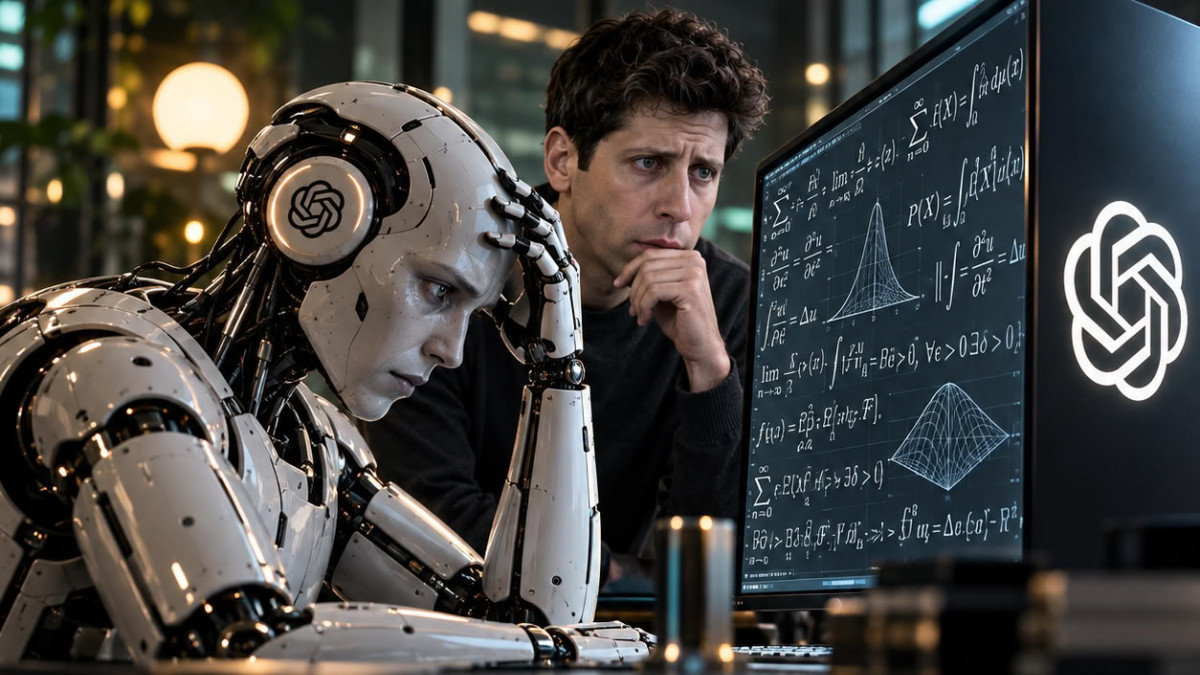

OpenAI CEO Sam Altman says he understands mathematicians’ frustration with the flood of AI-produced results, but he has no intention of slowing down. He also hints that the company has many other discoveries it has not yet made public.
In a episode of the Cheeky Pint podcast released Thursday, he states: ‘I think, overall, the world deserves to understand how the universe works. But I have empathy for the method.’ In his view, the public’s right to new scientific knowledge ‘outweighs’ the disruption caused by OpenAI’s announcements, even as he acknowledges the company needs to improve how it communicates its findings.
‘I am adamant on this point: humanity deserves fundamental knowledge, and we should not keep a major fundamental scientific discovery to ourselves,’ he further asserts.
Mathematicians interviewed by The Verge have criticized for months how OpenAI announces its results, which they deem inadequately attributed, poorly contextualized, and insufficiently verified. They then have to check and decipher these works themselves. OpenAI has published hundreds of mathematical results, often accompanied by brief notes that researchers describe as poorly written and hard to follow.
A criticized publication choice
OpenAI is now being criticized for what Sam Altman says it should not do: keeping potentially important results under wraps. Mathematicians and scientists interviewed by The Verge this week say they are frustrated by what they perceive as a takeover of research. These criticisms follow the announcement of three major breakthroughs, in mathematics, physics, and computer science.
The details of one of these results, related to Yang-Mills theory, which forms the mathematical foundation of modern particle physics, have not been made public. OpenAI explains this decision by citing recommendations from a hand-picked panel of experts consulted on the best way to release it. This practice directly contradicts advice from a group of mathematicians previously consulted by the company, but it is part of, according to OpenAI, a new approach to communicating its discoveries.
Considerable resources
Asked about the existence of additional proofs, beyond the hundreds already published, Sam Altman replies: ‘We have them. Of course.’ He also acknowledges that the search for mathematical problems ‘got out of hand’ for a short period, a choice he presents as deliberate and necessary to test the limits of its models. He describes an internal Slack channel called ‘Model Name-Hold My Beer,’ where employees ‘just threw it at the hardest problems they could find’ to observe model performance.
Sam Altman also estimates that OpenAI has spent on the order of several hundred million dollars tackling mathematical problems. He mentions, for instance, about $10 million, ‘maybe a bit more,’ spent on its solution to the Navier-Stokes problem, one of the legendary Millennium Prize problems in mathematics. These figures give an idea of the resources AI labs are marshaling for scientific questions, and raise fears among some researchers of being sidelined in their own fields.
It seems that mathematicians and other researchers hoping for a lull are not going to get one.
