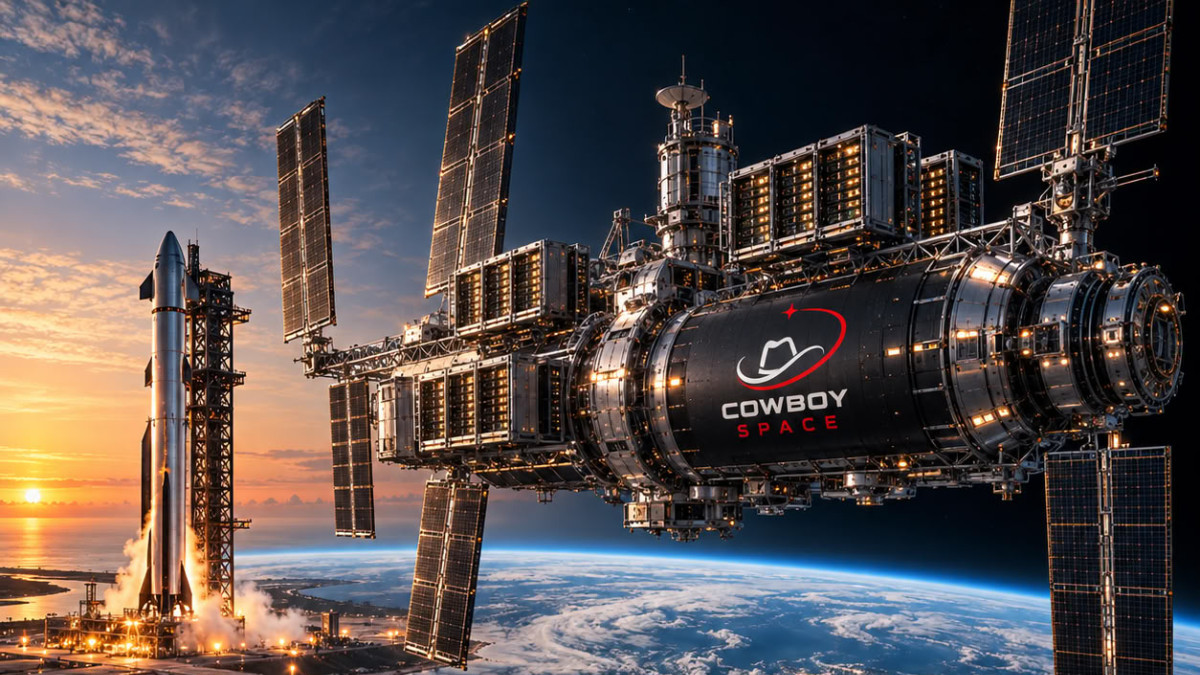

Startup Cowboy Space aims to deploy a low‑Earth‑orbit megaconstellation of 20 000 “satellite‑data‑centers” powered by solar energy, to run artificial‑intelligence calculations. To achieve this, it has designed its own rocket, with the inaugural flight slated for December 2028.
Satellite megaconstellations have proliferated in low Earth orbit since the mid‑2010s. Starlink already operates 10 000 satellites and wants to exceed 100 000, while Amazon has launched its own constellation to compete with Musk’s service. Cowboy Space, however, is not after Internet connectivity but computation. Founded in 2024 in California by Baiju Bhatt, co‑founder of Robinhood, the mobile brokerage app, the company seeks to run AI workloads that ground‑based infrastructures can no longer handle.
An all‑in‑one rocket
On October 26, at a Palo Alto event called “Big Sky Rising”, Baiju Bhatt unveiled the launcher that will carry these satellites. Big Iron measures 86 metres tall. “To us, this represents a completely unprecedented breakthrough in modern rocket design,” he said. The novelty lies in the upper stage: it carries no satellite, it is itself the satellite.
Once in orbit, this stage deploys its solar panels, giving it a total length of 132 metres. Its fairing, the nose cone that protects the satellite during atmospheric passage, also unfolds and serves as a radiator to vent heat generated by five GPU bays, graphics‑processing units. Together, these bays provide about 1 megawatt of computing power. According to the company, the lack of atmosphere allows heat to dissipate directly via infrared radiation. “By integrating a one‑megawatt data centre directly into the upper stage of our launcher, we eliminate superfluous mass and devote every possible kilogram to high‑performance AI computing,” the firm states on its official website.
Each satellite weighs approximately 15 tonnes before launch, roughly the mass of an International Space Station module. By comparison, a latest‑generation Starlink V3 satellite weighs about 1.25 tonnes. The first stage of Big Iron, however, is reusable: it must descend and land on a ship at sea, similar to SpaceX’s Falcon 9 boosters. The launcher is powered by Clydesdale engines, developed in‑house, with nine on the first stage and one on the second, running on liquid methane and liquid oxygen.
A considerable launch schedule and volume
Deploying Stampede entails 20 000 launches, a rocket that can carry only one satellite at a time. This figure is likely an underestimate, as several thousand more each year will be needed to offset losses, given the limited lifespan of low‑Earth‑orbit satellites. To maintain the constellation, the cadence would reach several launches per day, which would mean multiplying SpaceX’s annual launch rate by at least ten, the current world record holder with about 134 launches in 2024.
Cowboy Space has raised $275 million, but the overall programme would run into billions: multiple launch bases, each estimated at $1 billion by Bhatt, the Clydesdale engine still in testing, the industrialisation of Big Iron and serial production of the satellites. Bhatt acknowledges the challenges. “Everything has to go off without a hitch; there are no guarantees,” he said. “I know it’s ambitious. But if it weren’t, I wouldn’t be an entrepreneur.” The total mass calculation yields 20 000 satellites at 15 tonnes each, or 300 000 tonnes of hardware to be sent into orbit, 23 times the mass of everything currently orbiting Earth, estimated at around 13 000 tonnes.
