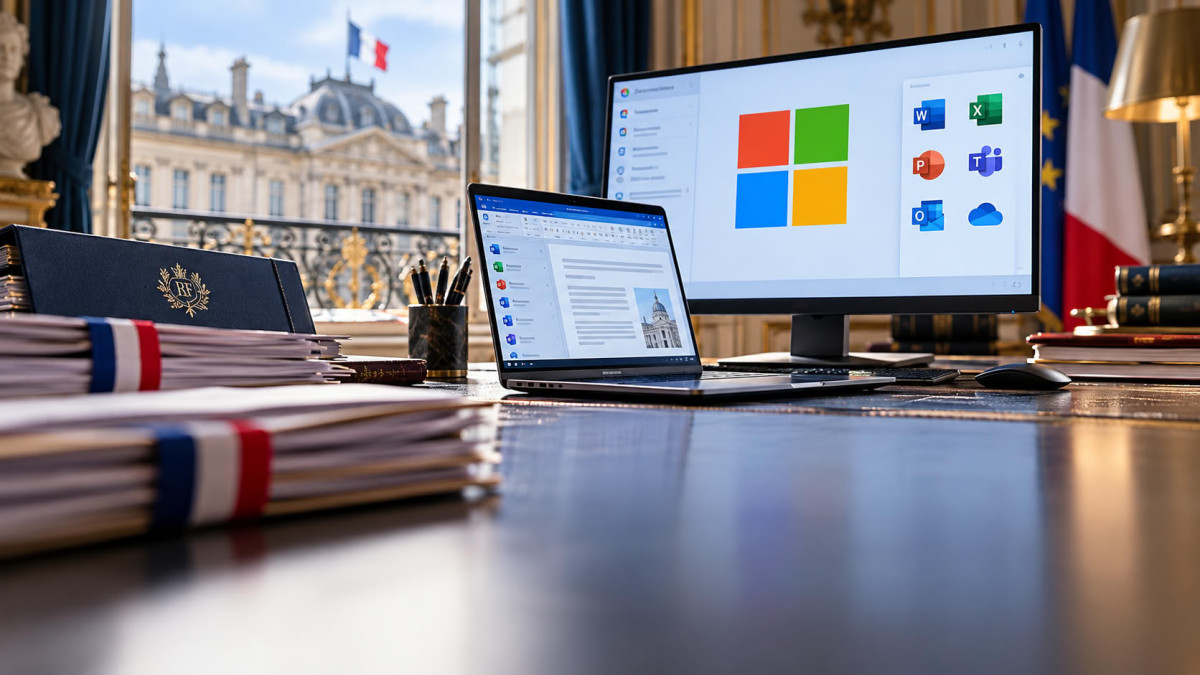

The Court of Auditors urges the State to reduce its dependence on the American publisher Microsoft. In a report published on 22 October 2026, it estimates that migration to open‑source solutions could generate several tens of millions of euros in savings per year, while the State’s spending on office and collaborative tools reached about €100 million in 2025.
- La Cour des comptes veut que les ministères quittent rapidement Microsoft pour des logiciels libres.
- La migration pourrait commencer en 2027 et se terminer vers 2031.
- Les économies restent des estimations et demandent des financements et un accompagnement.
- Héberger Microsoft dans un cloud de confiance ne suffit pas à réduire la dépendance.
The Court calls on ministries to accelerate their migration to open‑source software, whose code can be viewed, used and modified by anyone. The goal is to launch the movement from 2027 and carry out the transition in three to four years, which could lead to a gradual exit of Microsoft by 2031.
The issue is not new, but the Court this time aims to speed up the movement. Of the roughly €100 million spent in 2025, €61 million pertain to software licences, and Microsoft captures nearly 80 %. According to figures cited in the report, the bill has risen by 50 % over five years. For the financial magistrates, continuing to purchase Microsoft licences, even when hosted in a trusted cloud, is not enough to reduce technological dependence.
Savings that remain to be realized
The financial argument carries weight in the recommendations. The Court estimates that a widespread adoption of free office suites installed on workstations could generate between €30 million and €65 million in savings per year. In a cloud‑based scenario, the gap would be larger: about €100 per workstation per year for a free suite hosted in a SecNumCloud environment, versus €250 for Microsoft 365.
These estimates provide a ballpark figure, but they do not constitute guaranteed savings. Funding will be needed for the migration, adapting certain applications and supporting staff through the change. Ministries will also have to manage existing documents and business tools that rely on functionalities specific to the Microsoft environment. The average annual cost of office tools varies widely from one ministry to another, reflecting differences in scope, equipment and usage. Before setting common targets, the State must therefore have a clearer view of its fleets and contracts.
Hosting Microsoft in France is not enough
Several administrations are considering keeping Microsoft software while hosting it in a cloud that meets French security requirements. This is notably the logic of the Bleu project, led by Orange and Capgemini. For the Court, this approach does not solve everything: even when hosted in France, the solutions remain tied to an American vendor subject to U.S. law. Using a trusted cloud can provide important guarantees, without eliminating dependence on the vendor nor the legal issues related to data access.
The State already has a foundation with La Suite numérique, the suite of collaborative tools developed under the impetus of the Interministerial Digital Directorate (Dinum). Applications such as Tchap and Visio are already used in administrations. However, the offering does not yet cover all the needs of a complete office suite: word processing, spreadsheets, document exchange and integration with business applications still need to be consolidated. The Court also highlights the limits of the current development model, which relies heavily on independent developers, and recommends calling more on companies specialized in free software, capable of ensuring development, support and long‑term maintenance.
A project that goes beyond IT departments alone
The Court asks that the migration be prepared from 2027, within a plan of at most three to four years. This timetable still needs to be translated into operational decisions, as contracts, technical constraints and usage are not identical across ministries. The government also plans to strengthen the State’s digital steering, with the announced creation of Ariane on 1 January 2027, set to succeed Dinum.
IT departments will have to balance the expected savings, transition costs, security requirements and user needs. Some uses can switch quickly to free solutions, others will require more time, especially when business applications or macros – those small programs that automate tasks in a document – depend closely on Microsoft.
