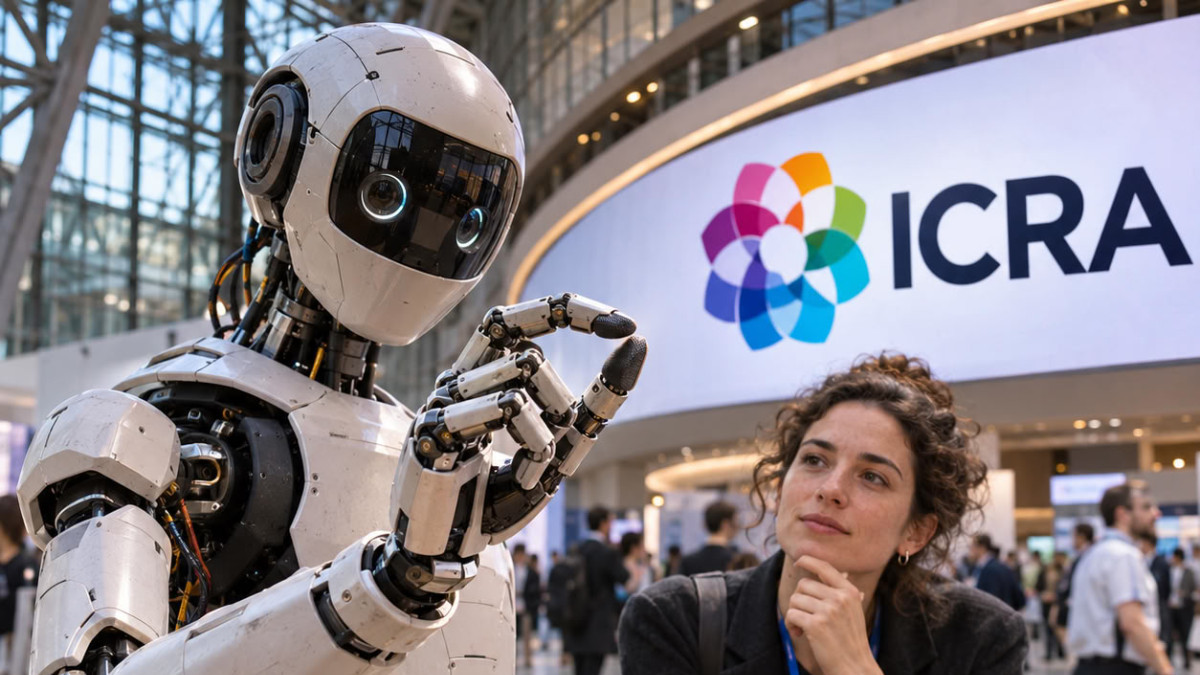

From June 1st to 5th, Vienna hosted the 2026 IEEE International Conference on Robotics & Automation (ICRA), which brought together robotics researchers and industry professionals for a week at the Messe Wien, just steps from the Danube. Between technological demonstrations and in-depth debates, the event primarily highlighted robot dexterity and the question of the data required for their learning.
Ethics and Human-Robot Interaction
The day began with WOROBET, a workshop dedicated to robotics ethics. Yasuhisa Hirata, a professor at Tohoku University, presented his vision of physically assistive robots, such as detachable exoskeletons, raising the question of how to provide help without falling into deception. Minoru Asada, a professor at Osaka University, discussed his project to integrate pain signals into robots, a proposal which, according to the report, raises more ethical questions than there are answers.
Alan Winfield, Professor of Robotics Ethics at UWE Bristol, advocated for an approach where robots are tools and not potential beings. He proposed an investigation framework for accidents involving social robots, comparable to that of aviation. Praminda Caleb-Solly, Professor of Embodied Intelligence at the University of Nottingham, then led a ‘red-teaming’ exercise, i.e., a critical risk assessment, on an assistive robot intended for a teacher recovering from a stroke at home. The debate focused on personal autonomy and the legitimacy of decisions made on someone’s behalf in their best interest.
Robots Becoming Increasingly Dexterous
On the exhibition floor, robots ranged from the most endearing to the most strange. The D1-modular from Direct Drive, which can split into two halves, particularly caught attention, as did the Mirokaï social robot from Enchanted Tools and the humanoid from Tesollo, which picked up fruit to place in baskets. The strong trend of this edition, however, concerned robotic hands, whose levels of dexterity were deemed impressive.
The Smarter Robot Bodies program from the British agency ARIA, presented by its program director, Professor Jenny Read, has two components: locomotion and dexterity. It is set to launch in early 2027. The Chinese startup TARS also made an impression with its DexHand, a 1:1 model of the human hand. According to the company, it ‘can interpret tactile data to distinguish slipperiness, roughness, and hardness in real-time and perform 26 gestures of the English alphabet with precise finger control.’
Data and Robot Learning
The plenary talk by Ken Goldberg, titled ‘A Tale of Two Cultures: Can Agentic Coding Close the Gap?’, focused on the lack of data for robotic manipulation. According to the report, the data needed to train vision-language models is equivalent to 100,000 years of real physical experience. Goldberg presented four avenues: simulation, world models, human teleoperation, and real data from operating robots. He cited as an example Ambi Robotics, a company he led for 22 years, which used its own production data to train its robots to grasp bags.
For her part, Stefanie Tellex from Brown University presented robots capable of understanding complex commands in dynamic and partially observed environments, as well as a ‘grounded Turing test,’ a version adapted for embodied AI. The final highlight of the congress was a science communication workshop conducted for an audience of 100 researchers.
