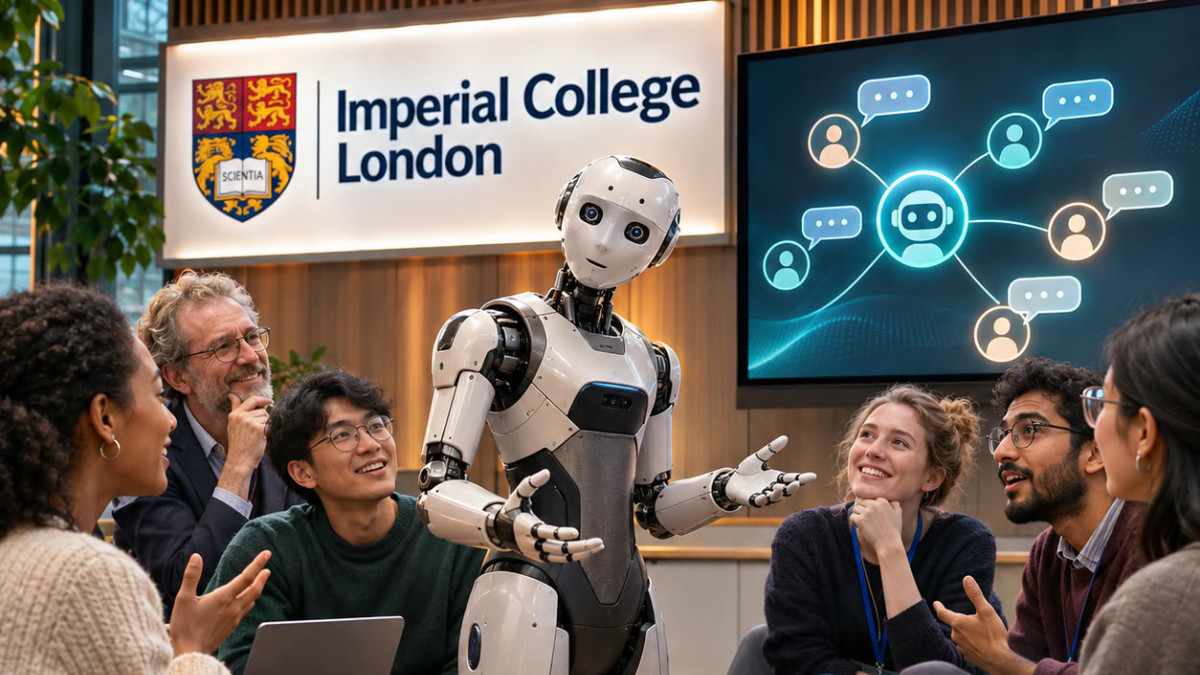

From July 20 to 24, control engineer Umar Farooq, who works at the University of Cambridge, took part in the Imperial Robotics Summer School, held at Imperial College London. At the heart of his week was a question: how to make a robot converse with a group of people, rather than just with a single individual.
- Umar Farooq a suivi une semaine de formation en robotique à Imperial College London.
- Son projet porte sur un robot capable de dialoguer avec un groupe entier.
- Le robot détecte qui parle, suit chaque personne et bouge les yeux et la tête.
- Le projet lui a montré la chaîne complète, du langage au mouvement.
The summer school brought together emerging researchers, academics, and industry professionals in robotics for an intensive, hands-on program. Lectures covered robot kinematics and dynamics, perception and control, as well as robot learning. Specialized sessions addressed aerial robotics, robot intelligence, vision for robotic surgery, bio-inspired sensing and control, and personal assistive robotics.
Participants also toured Imperial’s laboratories, dedicated notably to adaptive and intelligent robotics, aerial robotics, robotic surgery, manipulation and touch, and assistive robotics. With researchers from the UK and beyond, they worked on concrete challenges: quadruped robot locomotion, vision-based robot learning, tactile perception, and healthcare applications.
A group project on multi-party interaction
The group project focused on a robot capable of interacting with multiple people at once, whereas most social robots are designed for one-on-one interaction. The team worked on three points: detecting in real time who is speaking, tracking each person’s identity throughout the exchange, and generating natural eye and head movements so the robot appears attentive to the whole group.
The project also allowed the author to better understand the complete chain, from language to movement. An LLM (large language model) translates an intention expressed in natural language into structured commands, which are associated with the robot’s high-level functions. Inverse kinematics—the calculation of the joint movements needed to reach a given position—then transforms these functions into joint trajectories. Finally, these trajectories reach the actuators, the components that put the robot in motion, via its control stack. Umar Farooq describes this project as a practical introduction to the real difficulty of multi-human-robot interaction.
Funding and acknowledgments
The author’s participation was funded by UK RAS STEPS, which selected him as one of five RTPs. In his view, this program also supported him beyond the summer school, through several workshops. He particularly thanks Marie Daniels for her support and advice during the application process.
He also extends his thanks to the team at Imperial College London, the instructors, researchers, and fellow participants, for a week rich in exchanges and in an environment conducive to learning.
