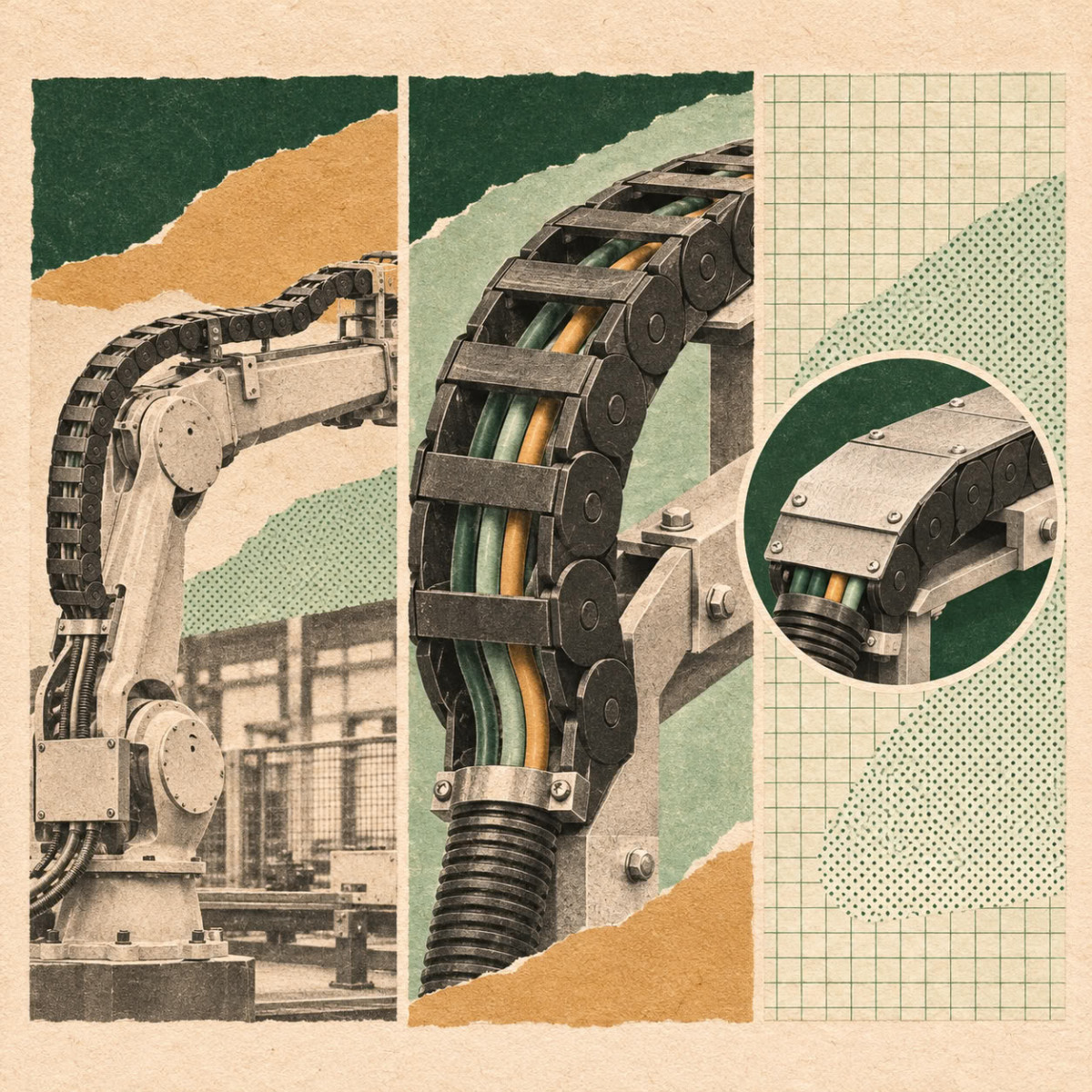

In automated workshops, six-axis articulated robots perform rapid, repeated movements, which place significant strain on the electrical cables, fiber optics, and pneumatic hoses that power them. To limit these stresses, Tsubaki KabelSchlepp presents its Robotrax system, a three-dimensional cable carrier, meaning a chain that guides cables and hoses through the movements. This article is published in partnership with Tsubaki KabelSchlepp.
A central steel cable to withstand pulling forces
According to the article, conventional cable carriers transmit movement-related forces directly to the electrical lines and hoses. The Robotrax integrates a central steel cable into each link, which runs through the core of the chain and absorbs the majority of the tensile forces. When the robot arms change direction abruptly and experience accelerations of up to 10 g, this cable isolates the electrical lines and fluid conduits from these tensions, which, according to the manufacturer, preserves conductor integrity and significantly extends cable life. An integrated clamping piece allows technicians to adjust the system’s tension.
Spherical links and cable separation
The system is based on single-piece, open plastic links, featuring spherical snap-fit connections on both sides. This geometry allows the chain to flex on three axes, with a radial rotation of up to ±450 degrees per meter depending on the model size. Each link can have up to three compartments, which separate power lines, data channels, and fluid conduits, to avoid, according to the article, interference and mechanical abrasion between these elements.
For standard models, from R040 to R100, cables can be inserted without tools, which greatly reduces installation and maintenance time. Larger configurations, such as the R140X, feature pivoting crossbars with snap-fit locking, as well as vertical and horizontal partitions for internal layout.
Active retraction and impact protection
In large work envelopes, slack chain loops can swing and hit the robot body. To avoid these collisions, Tsubaki KabelSchlepp integrates an active retraction unit, the Pull Back Unit (PBU), which maintains optimal tension on the cable carrier throughout the movement cycle. By limiting slack and troublesome contours, it reduces, according to the source, the risk of collision on complex trajectories. Its retraction element requires no maintenance, and the unit is offered with standard mounting configurations for KUKA, ABB, and FANUC robots.
External protections can also be added to individual links. These shields limit the minimum bend radius to prevent over-flexing and protect the chain body from external abrasion. In case of wear, only the modular protector is replaced, not the entire cable carrier.
Accessories for harsh environments
From automotive welding to high-speed machining, the Robotrax adapts, still according to the article, to demanding working conditions thanks to several accessories. The heat shields, made of aluminum-coated textile fiber, protect against radiant heat, hot welding spatter, and sparks. The protective sleeves, made of coated polyester, cover sensitive lines against aggressive cutting fluids, hydraulic oils, paint splashes, and abrasive dust. Finally, the LineFix tensile discharge device, made of multi-layer clamps, anchors cables at both ends to prevent any axial movement during intense motions.
According to the manufacturer, all these devices allow factory engineers and system integrators to maximize robot availability and reduce total operating costs.
